The Òṣun-Òṣogbo Festival: History, Ritual, and Living Tradition
Every August, a young woman who is forbidden to speak carries the weight of an entire city’s prayers on her head, walking through one of the last sacred forests in Yorùbáland. That image — silent, deliberate, cosmically charged — is the Òṣun-Òṣogbo Festival distilled to its essence. I’m going to cover the festival’s founding covenant, its ritual sequence, the human offices that keep it alive, the grove that anchors it spiritually and ecologically, its diaspora reach, and the pressures threatening to reshape it from the outside in.
Origins of the Òṣun-Òṣogbo Festival
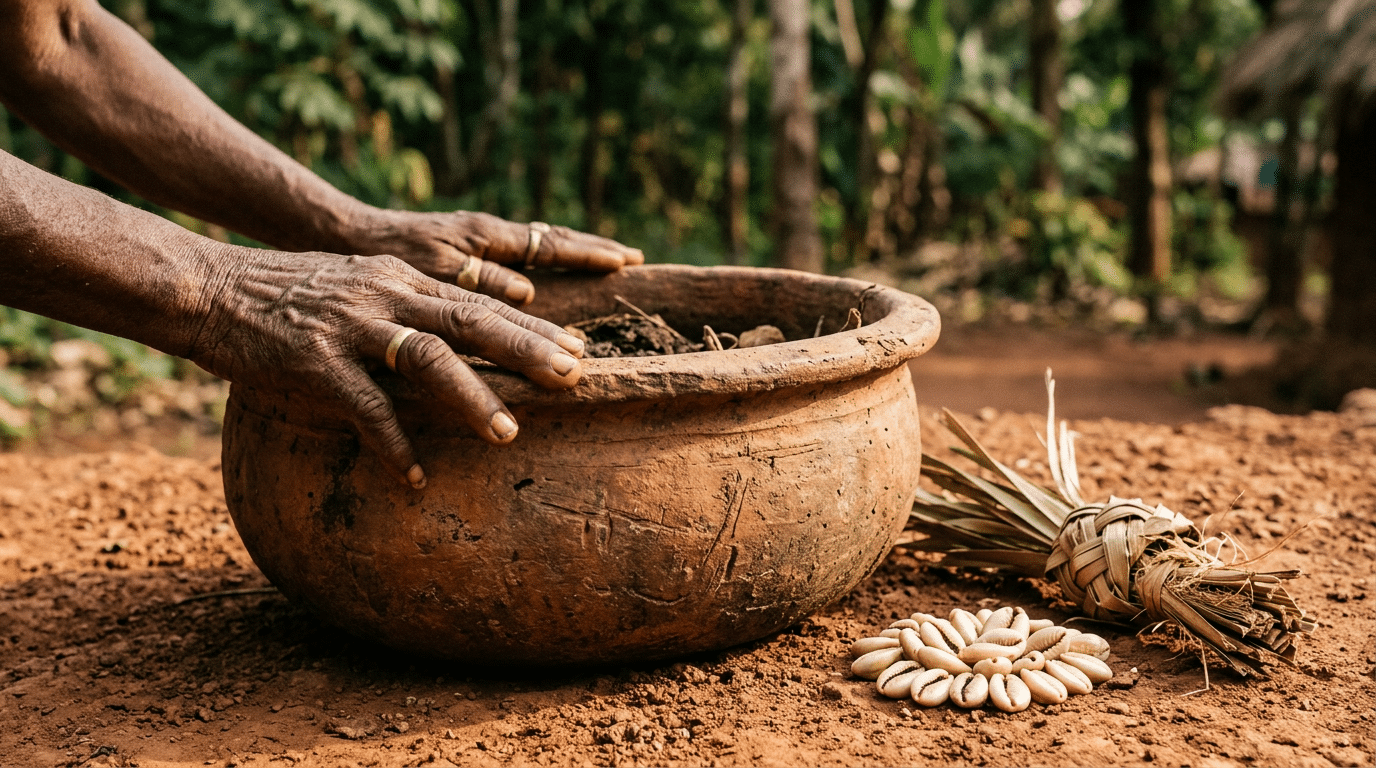
The Òṣun-Òṣogbo Festival did not begin as a celebration. It began as an apology — and a negotiation.
The Covenant Between Òṣun and the Founders of Òṣogbo
Widely cited oral accounts describe the founding moment as a rupture that demanded repair: when the early settlers of Òṣogbo cleared land for the growing town, they encroached upon the sacred grove that Òṣun, the Yorùbá river goddess, already claimed as her dwelling. Mortars were broken, trees felled, the ground disturbed. Òṣun’s anger; expressed through illness, crop failure, and communal distress — forced a reckoning. The community offered sacrifices, acknowledged their trespass, and negotiated a covenant: Òṣun would remain as protector of the town; in return, the people would honor her annually and preserve her grove. The festival, as it stands today, is the living renewal of that agreement, performed every year so the covenant does not expire.
That founding pact is generally placed several centuries in the past — approximately 600 years ago, though the precise dating is traditional reckoning rather than documentary history. What matters practically is what the covenant established: the inseparability of Òṣogbo as a place and Òṣun as its spiritual guarantor.
Oral Histories and Odù References
The mythic account of Òṣun’s founding role in Òṣogbo is not isolated to local legend. Understanding Ifá divination and Odù provides the broader theological architecture that situates her: Òṣun appears prominently in the Ifá literary corpus, particularly in Ọṣẹ Méjì and Ìrosùn Méjì, where she is invoked as healer, as the force that restores fertility and flow when conditions have stagnated, and as the one who mediates between human suffering and divine remedy. These Odù attributions vary by lineage and are best understood as traditional teaching rather than a single fixed canon, but the convergence across multiple Odù signals that Òṣun’s role in restoring broken relationships — between humans, between humans and the divine — is baked into the deepest strata of Ifá thought.
Oral tradition also preserves a more cosmological origin story: according to many lineage traditions, when Olódùmarè sent the Òrìṣà to prepare the Earth, the mission repeatedly failed. The other Òrìṣà had overlooked Òṣun, proceeding without her consent. Once they sought her participation, the work succeeded. The festival, in this reading, annually restores that original consultation — human beings re-seeking Òṣun’s cooperation rather than assuming it.
The Sacred Grove as Axis of the Festival
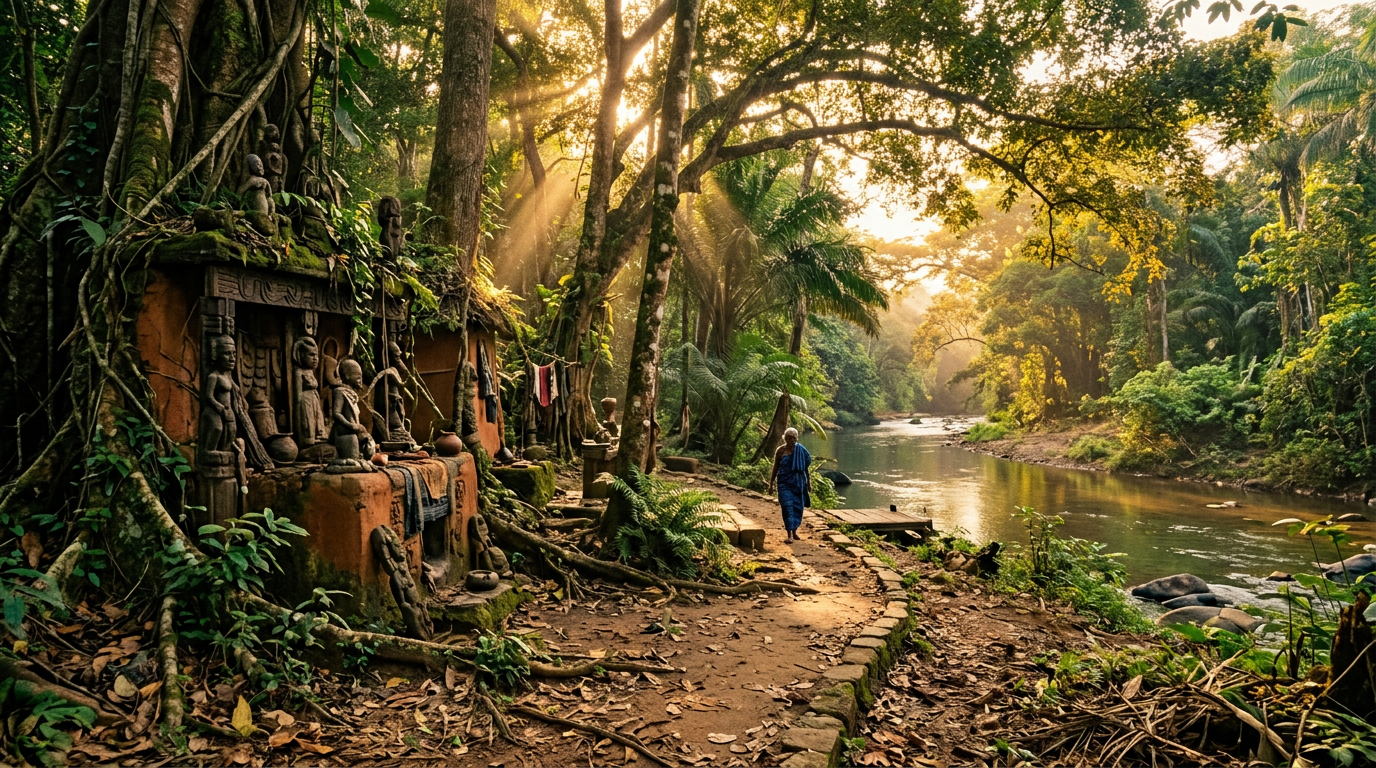
The sacred grove is not the backdrop for the festival. It is the festival’s destination, its reason, and its proof. The Osun-Osogbo Sacred Grove is regarded by UNESCO as one of the last remnants of primary high forest in southern Nigeria — “probably the last” sacred grove of its kind in Yorùbá culture, which once maintained consecrated forest spaces outside nearly every settlement. To walk toward the grove during the festival is to walk toward the original covenant itself. The tree canopy, the river, the shrines: together they constitute what the tradition understands as Òṣun’s actual house, and the annual festival is, among other things, a formal visit to her domain.
Òṣun in the Yorùbá Spiritual Landscape
Calling Òṣun a “fertility goddess” is accurate but incomplete — roughly as accurate as describing a baobab as a tree.
Àṣẹ of Òṣun: Water, Fertility, and Divination
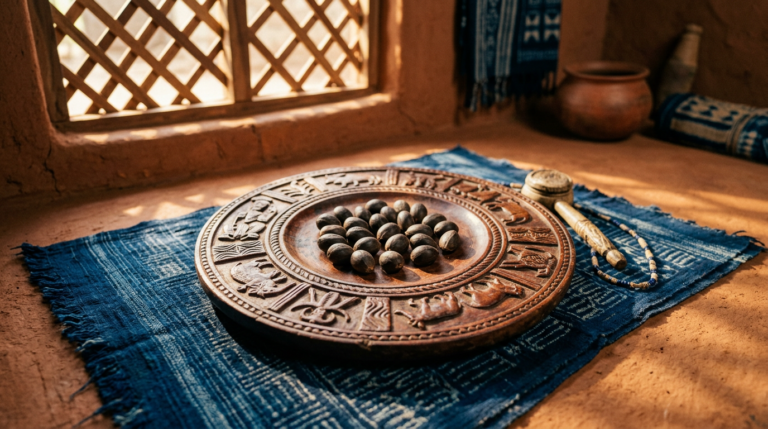
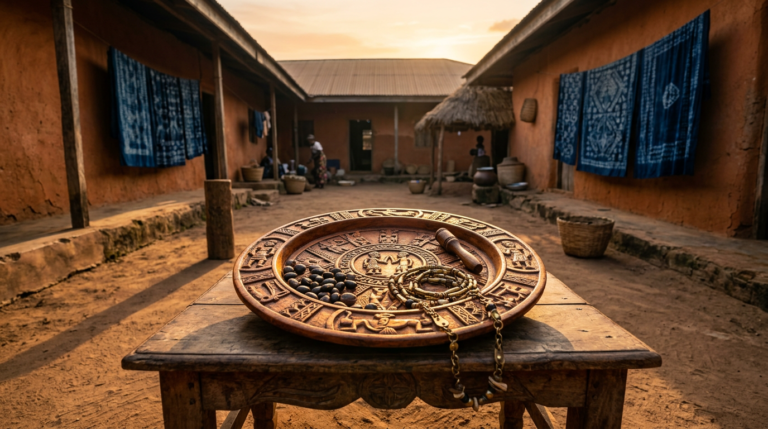
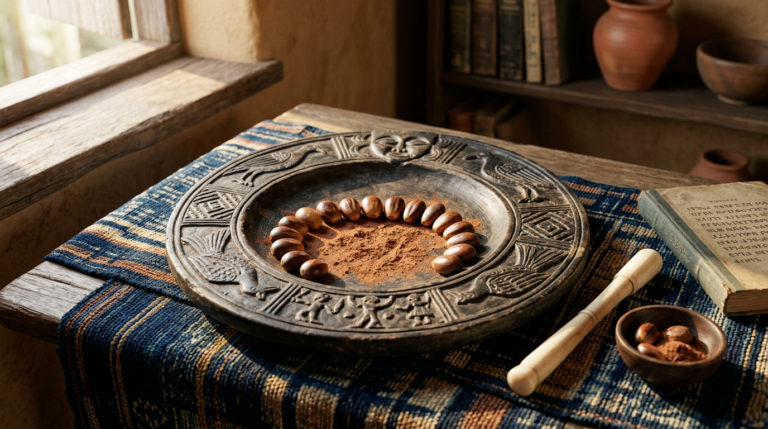
Àṣẹ is the Yorùbá concept of sacred power, the animating force behind all things. Introduction to Òrìṣà and their roles explains the broader system; within it, Òṣun commands an àṣẹ that encompasses sweet water, fertility in its widest sense (of bodies, of fields, of creative projects), and the capacity to make things flow again when they have stopped. She is associated with the color amber-gold, with honey, with the cowrie shell that was once currency and is still a divination tool. That cowrie connection places her inside Ifá practice — not as an outside force but as a participant in how human beings seek divine guidance.
The Ifá corpus’s presentation of Òṣun in Ọṣẹ Méjì and Ìrosùn Méjì underscores this range. She is not simply called upon for children, though that petition appears frequently. She is called upon when what has dried up needs to run again, when a community or an individual has lost the thread of flourishing.
Òṣun’s Relationship to Other Òrìṣà
Òṣun’s relationships with other Òrìṣà are defined by lateral authority rather than subordination. She is Ọbatálá’s complementary force in matters of creation — where he shapes, she animates. Her historical relationship with Ṣàngó is one of mutual recognition: both are sovereign in their domains, both volatile when disrespected. The tradition of the original mission’s failure in her absence, cited above, is the strongest statement of her lateral authority — she is not beneath the other Òrìṣà in the divine hierarchy; she is the condition under which their work becomes possible.
This matters for understanding the festival. The Òṣun-Òṣogbo gathering is not a secondary or supplementary spiritual event in the Yorùbá calendar. Practitioners understand it as the renewal of a cosmic agreement that undergirds Òṣogbo’s very existence.
Òṣun in Ifá Literary Corpus
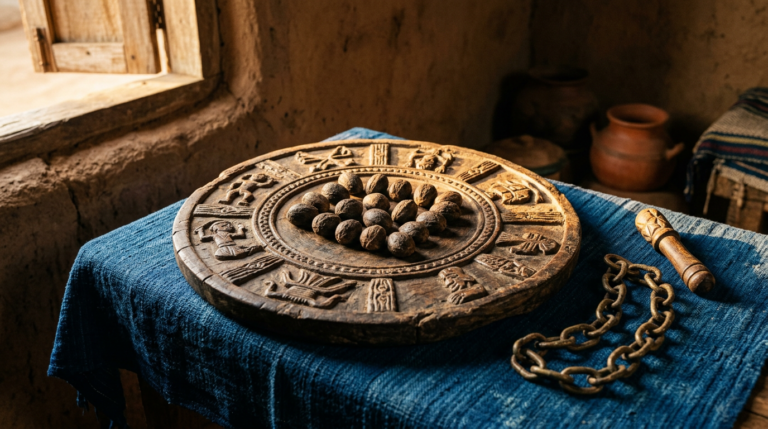
Scholars and practitioners commonly note that Òṣun appears across the Ifá corpus with a frequency that reflects her centrality. The Odù Ọṣẹ Méjì in particular contains verses describing Òṣun’s intercession when the world was on the brink of irreversible drying out — a narrative that functions in the oral tradition the way a myth of origin functions in other literary canons. These are not peripheral mentions; they are structural episodes. For practitioners consulting the role of Babaláwo in community ceremonies, Òṣun’s appearance in divination outcomes frequently signals that what is needed is not force or authority but persuasion, sweet medicine, and restored relationship.
Structure and Ritual Sequence of the Festival
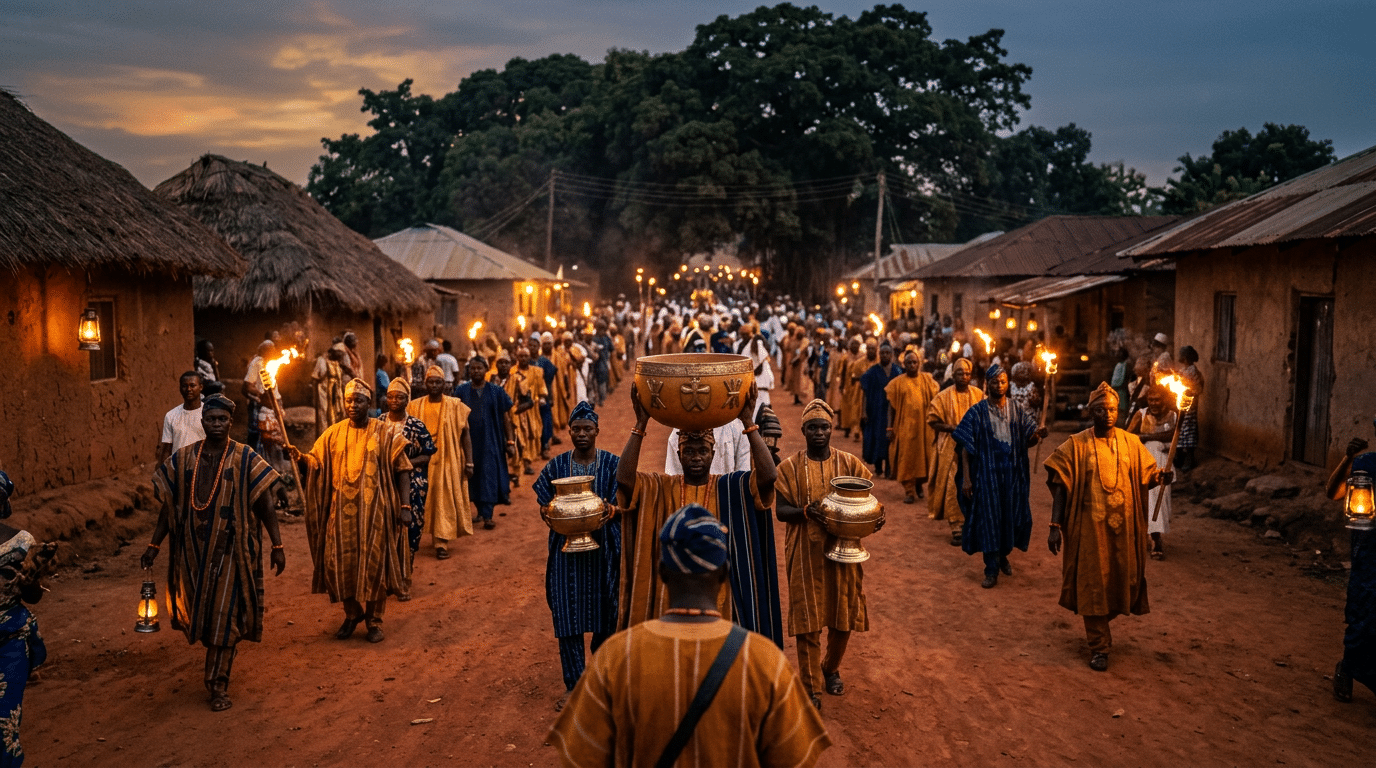
The Òṣun-Òṣogbo Festival is a two-week annual event held each August, and its structure rewards attention — each rite is a distinct act in a longer conversation between the community and Òṣun.
The Preparation Period and Invocations
The festival opens with Iwopopo, a ritual cleansing procession intended to purify the town of Òṣogbo before the main ceremonial events begin. The logic is practical and theological at once: you do not approach the goddess carrying the city’s accumulated disorder. Iwopopo sweeps the town spiritually and creates the ceremonial threshold that separates ordinary time from festival time.
The second major preparatory rite is Ina Olojumerindinlogun — the lighting of a sixteen-point lamp that is traditionally said to be approximately 500 years old, though this age is the tradition’s own reckoning rather than an archaeologically confirmed figure. The sixteen points correspond to the sixteen principal Odù of the Ifá system. Widely cited accounts describe this lamp as the oldest continuously lit fire associated with the festival, symbolizing that the tradition has not been interrupted. Whatever its verified age, the lamp’s lighting signals that what follows operates under the same authority that has always governed the festival.
The Procession to the Sacred Grove
After the preparatory rites, the climactic procession moves from the Atáója’s palace through the streets of Òṣogbo to the sacred grove. The route is not incidental — it maps the relationship between civic and sacred space, tracing a path from the seat of governance to the seat of the goddess. Thousands of devotees, priests, masquerades, and onlookers move along this corridor, and the procession itself is understood as a collective act of supplication, not a parade.
The Babaláwo and other officiants play active roles throughout this procession, performing invocations and managing the liturgical structure of the movement. Their presence confirms that the festival, while centered on Òṣun, operates within the full ecosystem of Yorùbá spiritual practice.
The Arugbá and the Offering to the River
The most watched — and most theologically dense — moment of the festival belongs to the Arugbá. She is a young female virgin, selected from the royal house, who carries on her head a calabash containing the sacrificial offerings of the entire community. She must not utter a word throughout the journey to the river.
The silence is not ceremonial decoration. It signals that the Arugbá has set aside her personal voice entirely, becoming the vessel through which collective need is presented to Òṣun. Her untouched status — virginity understood here as ritual wholeness — marks her as an offering in herself, not just a carrier. If the calabash does not fall during the procession, the community reads it as a favorable omen: Òṣun has received the offering. At the river’s edge, the calabash’s contents are released to the water. The covenant is renewed.
Closing Rites and Community Feasting
After the river offering, the festival’s register shifts from supplication to celebration. Closing rites include thanksgiving prayers, continued divination consultations, and — critically — communal feasting. The food shared at the close of the festival participates in the same logic as the offering to the river: abundance returned to the community is the sign that Òṣun has answered. The two weeks end having moved the community from purification through petition to gratitude.
Key Custodians and Spiritual Offices
Tradition does not carry itself. Living people do.
The Atáója of Òṣogbo
The Atáója — the Oba, or king, of Òṣogbo — holds the most unusual dual appointment in the festival’s governance. He is both the town’s political ruler and its chief priest, a configuration that, in Yorùbá tradition, is not a conflict of interest but an expression of the idea that governance without divine accountability is incomplete. His role in the festival is to authorize the Arugbá’s procession from his palace and to participate in the major rites that frame the entire event. The Atáója’s presence is what makes the festival a civic as well as a sacred event — the whole town, not just the priesthood, is party to the covenant.
The Ìyá Òṣun and Priesthood Lineage
The Ìyá Òṣun, or high priestess of Òṣun, is — within the tradition’s own understanding — the de facto leader of all priestesses and female devotees of Òṣun globally. That claim of global authority is the tradition’s own, and it reflects the tradition’s scale: Òṣun worship extends across West Africa, the Atlantic diaspora, and communities in Europe and North America. During the festival, the Ìyá Òṣun oversees the major rites, supervises the Arugbá’s procession, and holds the liturgical authority that the Atáója’s civic authority complements. Together, they represent the two poles of Yorùbá institutional life: the political and the sacred, understood as inseparable.
The priesthood lineage running through the Ìyá Òṣun represents an unbroken chain of transmission from the founding covenant to the present. Each holder of the office has received, and is expected to transmit, both the specific ritual knowledge of the festival and the broader corpus of Òṣun worship that sustains her devotees throughout the year.
Roles of Babaláwo and Other Officiants
The Babaláwo — Ifá divination priests — are present throughout the festival not as secondary participants but as essential interpreters. Before and during the event, they consult the Ifá oracle to confirm the appropriate timing of each rite, identify any propitious or inauspicious signs, and provide the theological framework within which the festival’s other officiants operate. Masquerade guilds, elder women’s associations, and devotee groups each hold specific responsibilities in the ritual sequence. The festival’s complexity is precisely its strength: no single office could sustain it alone.
The Sacred Grove: Ecology, Art, and Spiritual Geography
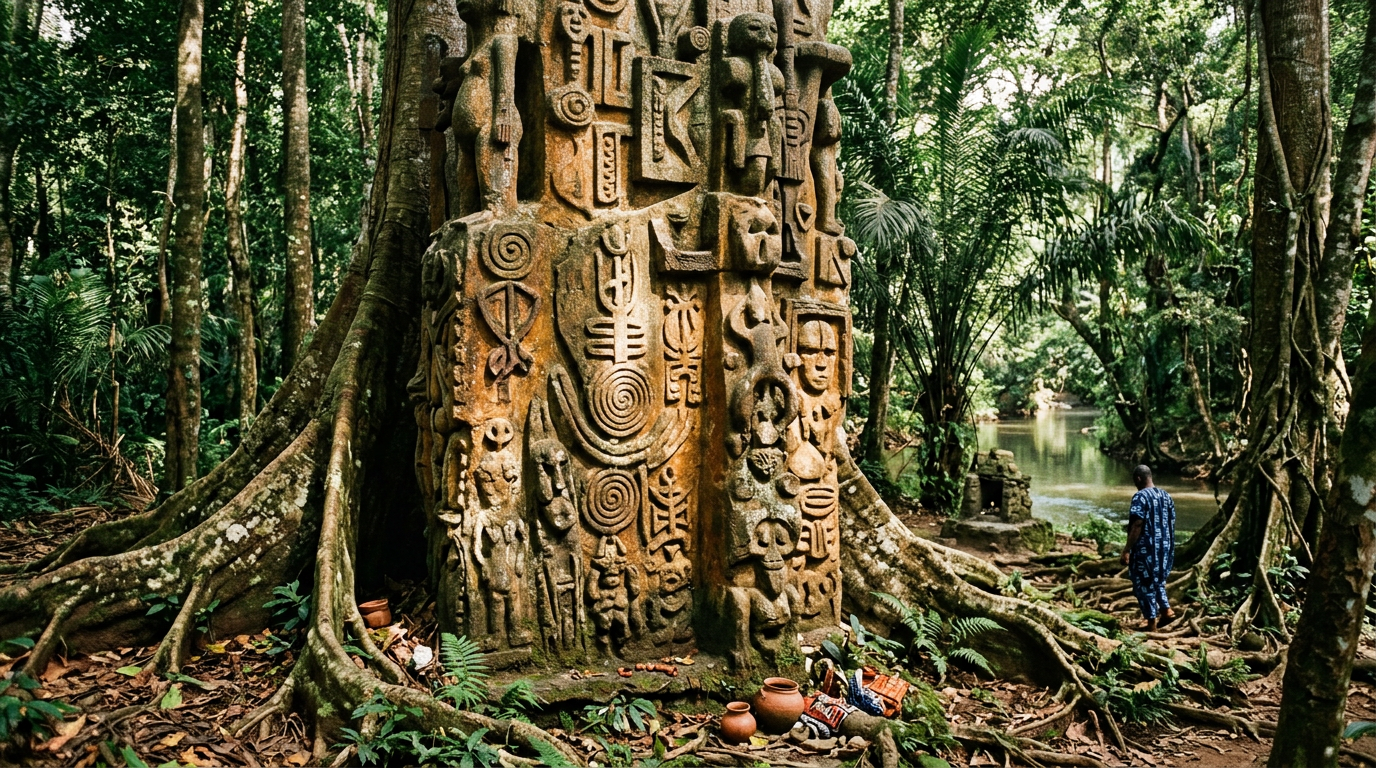
The Osun-Osogbo Sacred Grove covers 75 hectares on the outskirts of Òṣogbo and was inscribed as a UNESCO World Heritage Site in 2005 under cultural criteria ii, iii, and vi — criteria covering cultural interchange, testimony to a living tradition, and direct association with living traditions of outstanding universal significance. That inscription made official what the Yorùbá community had always understood: the grove is not an artifact. It is an active spiritual address.
Natural Features and Their Ritual Meaning
The grove’s towering trees, shrines, and the Òṣun River flowing through it are read as Òṣun’s own body by practitioners. The water is not symbolic of her — it is understood as her literal presence. Specific trees are associated with specific shrines; specific clearings are sites of distinct ritual acts. The grove functions as a Yorùbá sacred site and spiritual geography in the most literal sense: the ecosystem itself is a theological text, legible to those trained to read it.
Sculptural Works of Suzanne Wenger and Yorùbá Artists
By the 1950s, urbanization and religious change had left many of the grove’s shrines in disrepair. The restoration that followed came from an unexpected quarter. Susanne Wenger, an Austrian-born artist who had undergone Yorùbá religious initiation and taken the name Adunni Olorisha, founded the New Sacred Art Movement in the early 1960s. Her collaborators were Yorùbá artists — many of them former manual laborers from Òṣogbo — whom she organized to restore existing shrines and create new monumental sculptures drawn directly from Òrìṣà cosmology.
Wenger’s role in this story is sometimes overstated in Western art-history accounts. The restoration was a collaboration, and the Yorùbá artists, the Atáója’s authorization, and the community’s sustained engagement are what gave the project its legitimacy. Centering Wenger as the sole protagonist would distort the record. What she brought was resources, international networks, and an outsider’s indifference to the social pressures that had kept local restoration from happening; what the Yorùbá artists brought was the actual knowledge and the actual hands. The sculptures that resulted — now iconic features of the grove — belong to both contributions.
UNESCO World Heritage Recognition
UNESCO’s 2005 designation of the grove recognized it as a symbol of identity for all Yorùbá people, not merely for Òṣogbo or Osun State. The inscription explicitly noted the grove as probably the last of its kind in Yorùbá culture, which had once maintained sacred forest spaces outside every settlement. That designation brought international visibility — and, with it, the complications that institutional recognition always brings to living traditions.
Since 2005, the Adunni Olorisha Trust and Nigeria’s National Commission for Museums and Monuments have led community-based conservation efforts. In 2022, Google Arts & Culture partnered with the Adunni Olorisha Trust and CyArk to produce the first large-scale digital preservation library of the site, ensuring that even if physical damage occurs, a detailed record survives.
The Festival in the Diaspora
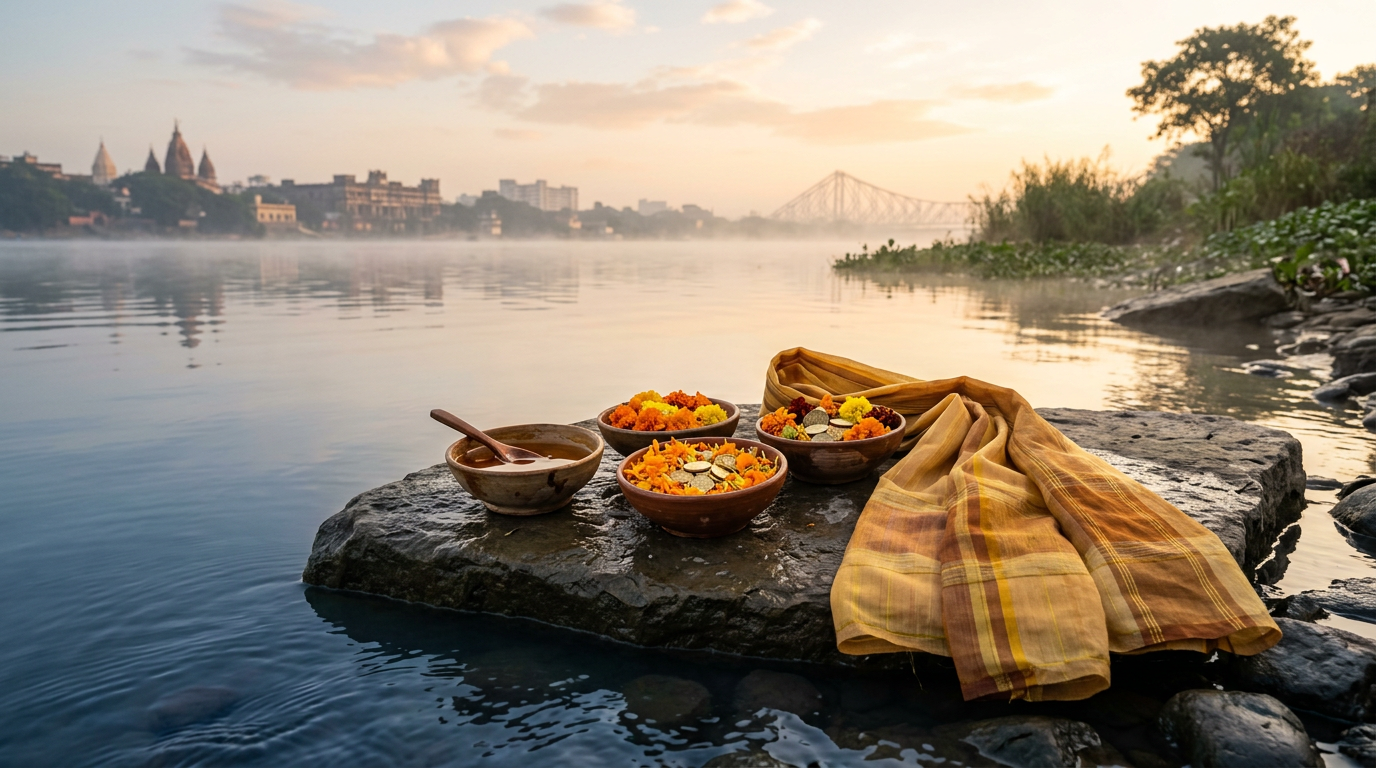
The Òṣun-Òṣogbo Festival’s energy does not stop at Nigeria’s borders.
Parallel Observances in Cuba, Brazil, and North America
In the Cuban Lucumí tradition (commonly called Santería), Òṣun is known as Oshún and is syncretized with Our Lady of Charity, La Virgen de la Caridad del Cobre — Cuba’s national patroness. In Brazilian Candomblé and Umbanda, she is worshipped as Oxum, associated with love, wealth, and beauty. These are not distant cousins of the Yorùbá original; they are the same àṣẹ, transmitted across the Atlantic through the trauma of enslavement and reconstructed in new environments with extraordinary fidelity and creativity. Òṣun in the diaspora traditions of Lucumí and Candomblé traces those transmission lines in detail.
Diaspora communities observe their own versions of the August festival — riverfront ceremonies, communal feasting, offerings of honey and gold — and an increasing number of Oshún and Oxum devotees from Brazil, Cuba, Trinidad, and North America make pilgrimage to Òṣogbo itself for the festival each year. The gathering has become, in effect, a global convergence of African diasporic spiritual practice held in a 75-hectare forest in Osun State.
Syncretism, Adaptation, and Continuity
How one evaluates diaspora syncretism depends significantly on where one stands. Some practitioners in the Yorùbá homeland view the Cuban and Brazilian forms as adaptations that have drifted from the original — the Catholic overlay of Oshún-as-Virgin carries associations that the Yorùbá concept of Òṣun does not. Others, including many diaspora practitioners and some scholars, understand syncretism as a survival strategy of extraordinary sophistication: Yorùbá spiritual intelligence was not erased by enslavement; it hid inside the colonizer’s religion and re-emerged intact. Both perspectives deserve serious engagement, and neither fully cancels the other. What is clear is that the festival’s annual renewal in Òṣogbo provides the diaspora with a living original to orient toward — not as a corrective authority, but as a continuous source.
Challenges to Preservation and Cultural Integrity
The Òṣun-Òṣogbo Festival faces pressure from three overlapping directions, and understanding all three is necessary for anyone who wants to support the tradition honestly.
Commercialization and Touristic Pressures
UNESCO recognition brought the grove international attention and, predictably, international tourism. That traffic generates revenue but also generates the conditions under which a living ritual can be slowly converted into a spectacle. When visitors come primarily for the visual experience — the procession, the costumes, the grove’s atmosphere — rather than as participants in a spiritual act, the festival’s internal logic begins to compete with its external image. Community leaders have publicly debated how to manage visitor numbers, behavior, and media access without compromising the ritual’s integrity, and that debate is ongoing.
Commercial interests have extended further. Attempts to patent or commercially brand elements associated with the festival have been reported and contested within the community. The Nigerian state government’s tourism promotion framing of the festival, while well-intentioned by its own lights, does not represent the authoritative voice on what the festival is for — and practitioners have said so plainly.
Religious Opposition and Political Dynamics
Christian and Islamic expansion across Yorùbáland over the past century has complicated the festival’s social environment. Some families whose members have converted regard participation in Òṣun veneration as religiously incompatible with their new faith commitments. This is not a new tension, but it has intensified in some communities. Political dynamics at the state and federal level also affect the festival’s resourcing and visibility — the degree to which a sitting governor treats the festival as a cultural asset worth funding has varied considerably.
Community-Led Conservation Efforts
The most durable preservation work has come from within. The Adunni Olorisha Trust, the Atáója’s court, and the network of Òṣun priestesses represent institutional knowledge that no government body or international organization can replace. The CyArk digital preservation partnership completed in 2022 is meaningful precisely because it was initiated in collaboration with those community custodians rather than as an external extraction of heritage data.
The festival’s continued vitality depends less on tourism revenue or UNESCO status than on the willingness of young people in Òṣogbo and across the diaspora to apprentice themselves to the tradition’s knowledge systems. That transmission is happening — but it requires active, deliberate support.
Why the Òṣun-Òṣogbo Festival Matters Today
The Òṣun-Òṣogbo Festival persists because the questions it addresses have not gone away: How does a community maintain its covenant with the living world? Who carries the weight of collective need when institutional structures fail? What does it mean to renew an agreement across generations?
These are not archaic questions. The festival provides a structured, annually renewed answer to each of them, and that structure has proven robust enough to survive colonization, urbanization, religious conversion campaigns, and the Atlantic diaspora. The silent Arugbá walking toward the river represents something that neither tourism branding nor UNESCO criteria can fully capture: a community choosing, again, to keep its word.
For practitioners and students of the Ifá and Òrìṣà traditions, the festival is both source material and living proof that the tradition is not merely historical. For diaspora communities in Cuba, Brazil, and North America, the annual gathering in Òṣogbo is a confirmation that what they maintain in their own riverfront ceremonies connects to something unbroken. For anyone concerned with the intersection of cultural heritage and ecological preservation, the grove itself — 75 hectares of primary forest maintained sacred by communal obligation for roughly six centuries — is evidence that indigenous spiritual commitments can do conservation work that policy alone cannot.
The tradition is not fragile. But it is not automatic either. It requires the same thing it has always required: people willing to carry the calabash.