Yorùbá Ifá and African Traditional Religion: Finding Its Place
Most people who first encounter Ifá do so sideways — a reference in a diaspora context, a term overheard in conversation, a search that leads somewhere unexpected. What they rarely find is a clear map showing where Ifá sits within Africa's broader spiritual landscape. This article builds that map, starting with what African traditional religions actually share, moving through the specific cosmological logic of Yorùbá thought, and arriving at why Ifá deserves to be understood as a complete, living tradition rather than a regional curiosity.
What We Mean by African Traditional Religion
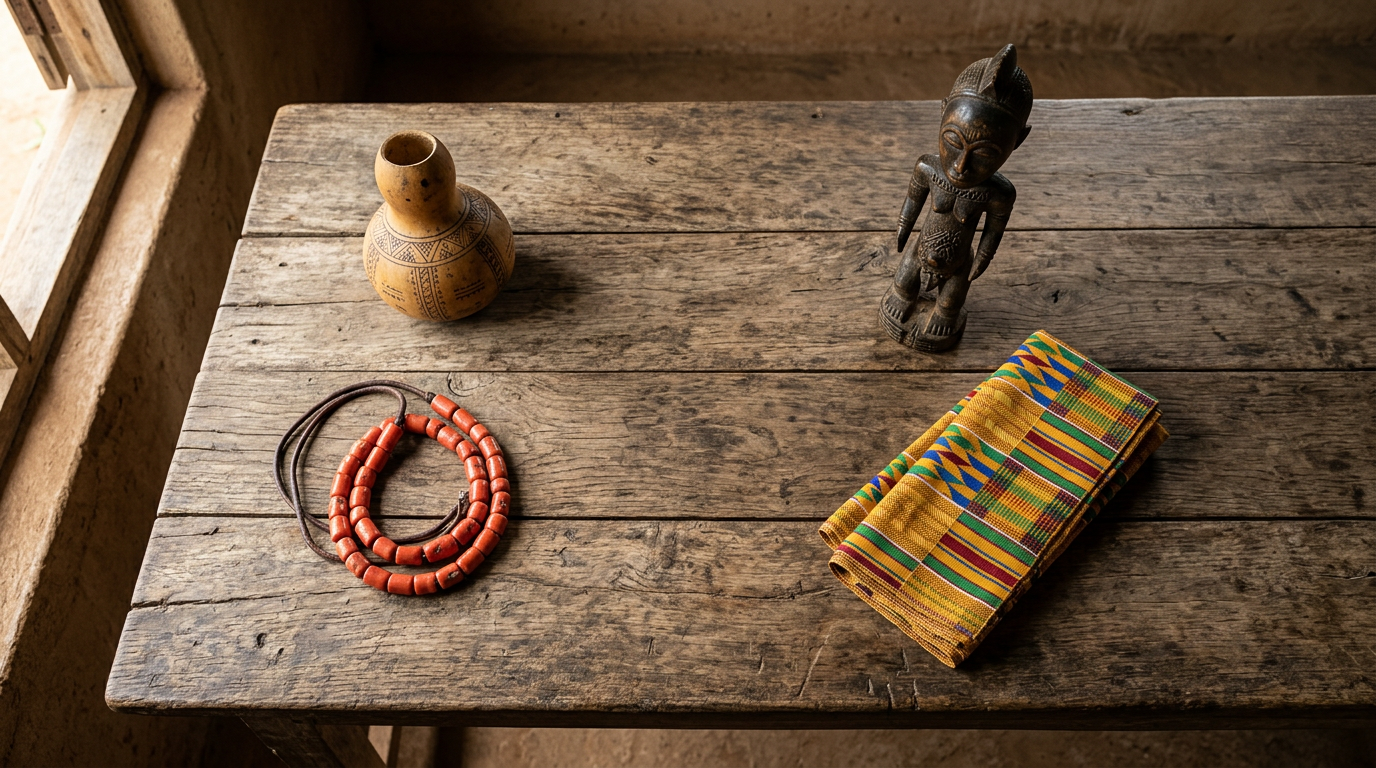
"African traditional religion" is a useful shorthand that, taken too literally, misleads almost immediately. The continent holds over a billion people, thousands of ethnic groups, and hundreds of distinct spiritual systems. No single creed, scripture, or ecclesiastical body unifies them.
Common Features Across the Continent
Despite that diversity, scholars widely observe structural patterns that recur across many African spiritual traditions. These systems tend to be oral rather than scriptural, transmitting theology, ethics, and cosmology through ceremony, proverb, and living memory. African traditional religions include beliefs in spirits, a supreme being, and ancestor veneration, with practices varying significantly across ethnic groups. Another common pattern: a creator God who, after setting the world in motion, withdrew from daily involvement, with prayers and offerings directed instead toward secondary divinities who mediate between the divine and human realms. Britannica's overview of African religions notes this as a widespread structural tendency, not a universal rule — an important distinction.
What unites these traditions is less doctrinal and more relational: a concern with maintaining right relationship between the living, the dead, and the divine; an understanding of illness and misfortune as spiritual disruption requiring ritual address; and an ethics rooted in community rather than individualism.
Why the Singular Label Can Be Misleading
The phrase "African traditional religion" entered wide circulation partly through colonial and missionary frameworks that needed a container for everything that wasn't Christianity or Islam. Terms like "animism" and "paganism" carried the explicit suggestion of primitiveness, failing entirely to capture the philosophical sophistication of traditions that had sustained complex societies for millennia. Scholars studying colonial framing of African religion point out that these categories were imposed from outside and reflect the worldview of the categorizers more than the categorized.
Contemporary scholars — and many practitioners — prefer "African indigenous religions" in the plural. Some Yorùbá practitioners specifically use the term Isese to name their tradition on its own terms, shedding classifications that were never theirs to begin with. The singular ATR label is a convenience. Handle it like one.
The Yorùbá Spiritual Universe at a Glance
Yorùbá religion is one of the most widely practiced indigenous traditions on the planet, with roots in what is now southwestern Nigeria and a diaspora presence extending across the Americas and Europe. Understanding it begins with three interlocking concepts: the supreme creator, the divine intermediaries, and the personal soul.
Olódùmarè, Òrìṣà, and the Visible World
At the apex of the Yorùbá cosmological order stands Olódùmarè, the Supreme Being and ultimate source of all existence. Olódùmarè is not worshipped through direct, transactional prayer in the way a deity in some other traditions might be; the divine is understood as too complete, too foundational, for that kind of direct petition. Instead, the Òrìṣà and Yorùbá cosmology provide the active relational layer — divine forces, each governing a specific domain of existence (iron and war, the ocean, thunder, healing, and so on), who receive offerings and intercede on behalf of the living.
Think of it structurally: Olódùmarè is the ground from which everything grows. The Òrìṣà are the roots and branches that channel that ground's energy into the world you can see and touch.
The Central Role of Orí and Destiny
If the Òrìṣà represent cosmic forces, Orí represents something even more intimate: the self. Literally translated as "head," Orí in Yorùbá tradition refers to one's spiritual intuition and chosen destiny — the reflective spark of consciousness that each person selected before birth. Orí is personified as an Òrìṣà in its own right, sometimes considered the most important one, because no external divine force can override what a person's Orí has chosen.
This has practical consequences. Success, struggle, and the direction of a life are not simply products of external fortune; they are bound up with what the individual soul committed to before incarnating. Ifá divination, as we will see, speaks directly to this pre-birth pact.
Ifá as the Intellectual and Divinatory Heart of Yorùbá Tradition
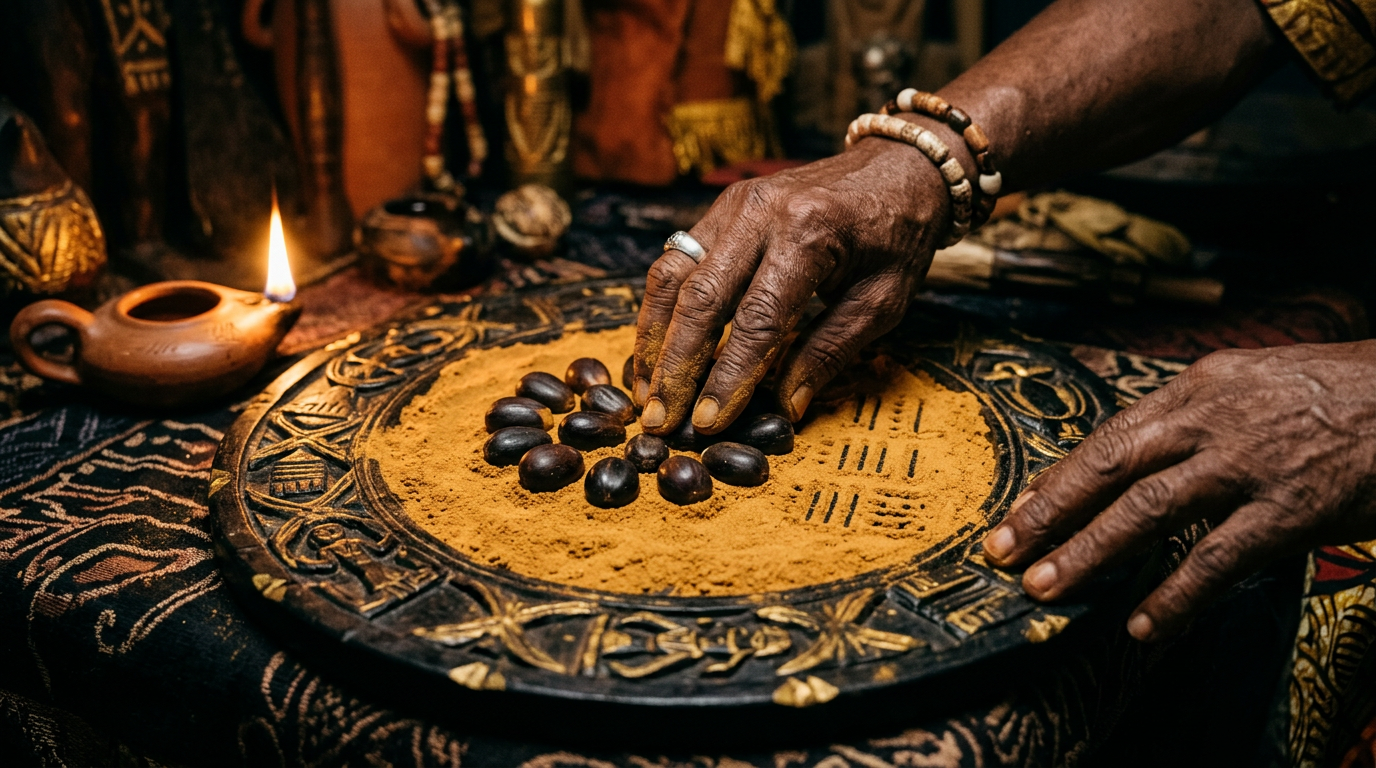
Among all the elements of Yorùbá religious life, Ifá occupies a singular position — not simply as a divination rite but as the tradition's intellectual infrastructure, the organizing framework through which the community interprets experience, resolves disputes, and aligns with cosmic order.
Ọ̀rúnmìlà, the Prophet of Ifá
Ọ̀rúnmìlà in Yorùbá tradition is the Òrìṣà of wisdom and the patron of Ifá. What distinguishes Ọ̀rúnmìlà from other Òrìṣà is not just his domain but his position in the cosmic story: Ọ̀rúnmìlà was present at the ordering of the universe and witnessed the cosmic laws governing destiny. This is why consulting Ifá is understood, in theological terms, as consulting the figure closest to the source of all knowledge. Ọ̀rúnmìlà did not simply learn about destiny — he watched it being set in place.
That origin story makes Ifá something other than fortune-telling. When a Babáláwo opens a consultation, the premise is that Ọ̀rúnmìlà's witnessing of primordial creation is encoded in the Odù, available for application to any human situation.
Odù Ifá: The Sacred Literary Corpus
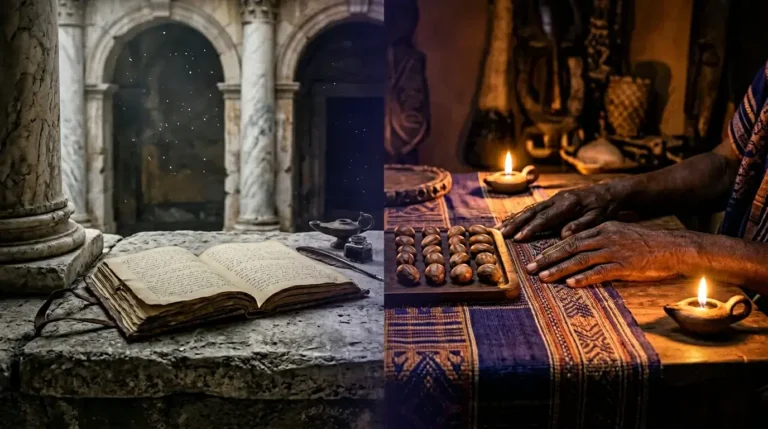
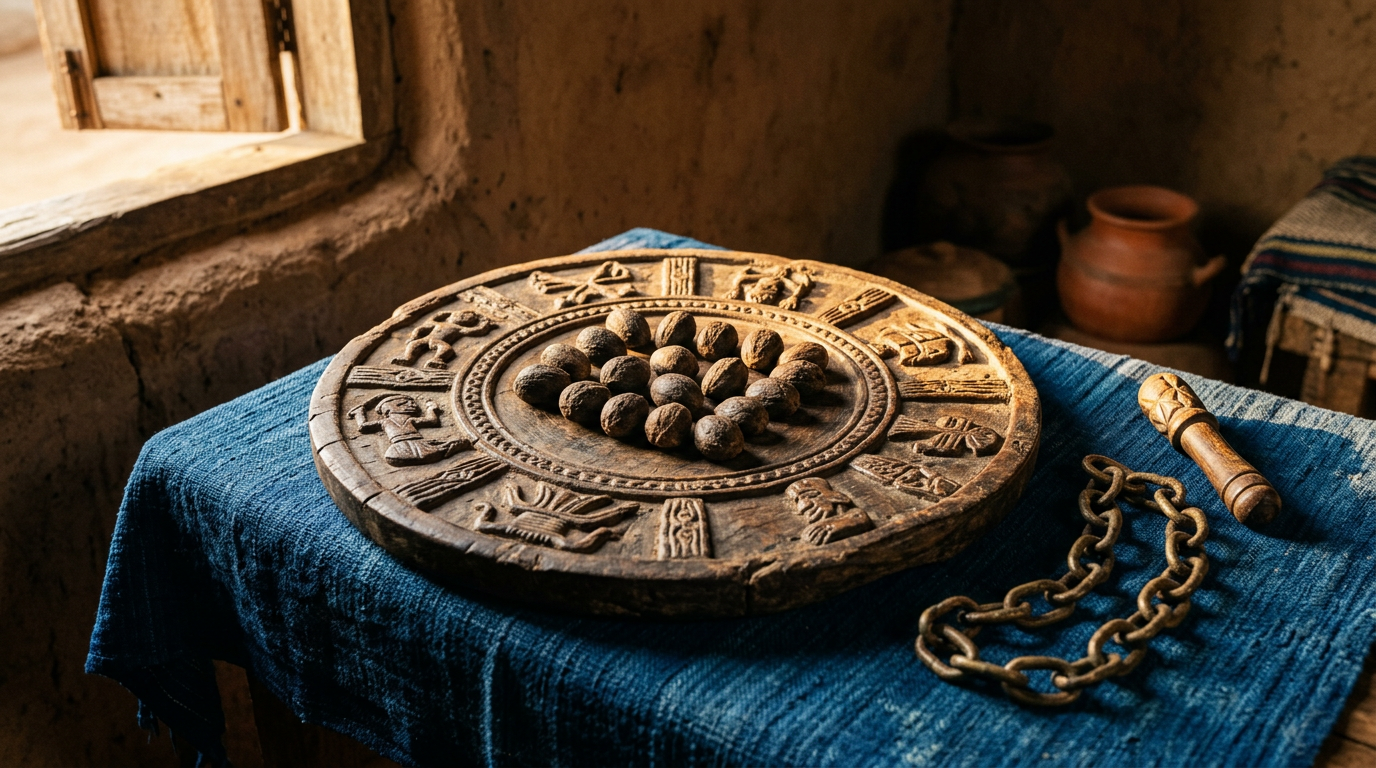
The Odù Ifá corpus is vast. UNESCO's registration record for the Ifá divination system describes it: the corpus consists of 256 Odù, each subdivided into verses called ese, with approximately 800 ese per Odù. The corpus is not static — it grows as Babalawos add new ese drawn from their consultations and lived experience.
What makes the Odù comparable in scope to major world literary traditions is its range. The verses contain history, philosophy, ethical instruction, herbal medicine, myth, and cosmological teaching. UNESCO explicitly frames Ifá as a repository of Yorùbá knowledge encompassing all of these dimensions, not merely a ritual for predicting outcomes. A single Odù might address governance, ecological relationship, proper mourning, or the resolution of conflict — which is one reason Babalawos train for years before they are considered competent to interpret it.
The Babáláwo and the Practice of Divination
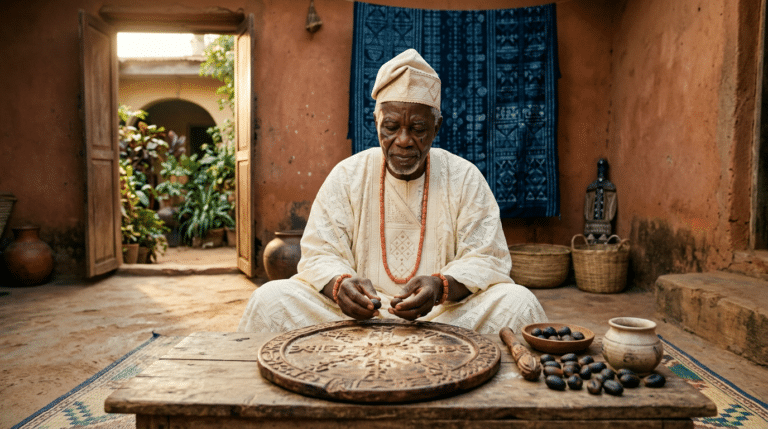
The role of the Babáláwo in Ifá practice is defined by the system itself. Crucially, Ifá divination does not operate through spirit mediumship or personal oracular powers; the Babáláwo interprets a precise system of signs drawn from the Odù corpus. This makes Ifá structurally different from traditions that rely on trance-based channeling. The Babáláwo's authority comes from learning — extensive memorization of hundreds of Odù verses, knowledge of herbal medicine, mastery of ritual performance, and deep engagement with Yorùbá spiritual philosophy, all achieved before formal initiation.
That training is long by design. The knowledge is too consequential for shortcuts.
Ifá Among Africa's Many Spiritual Traditions
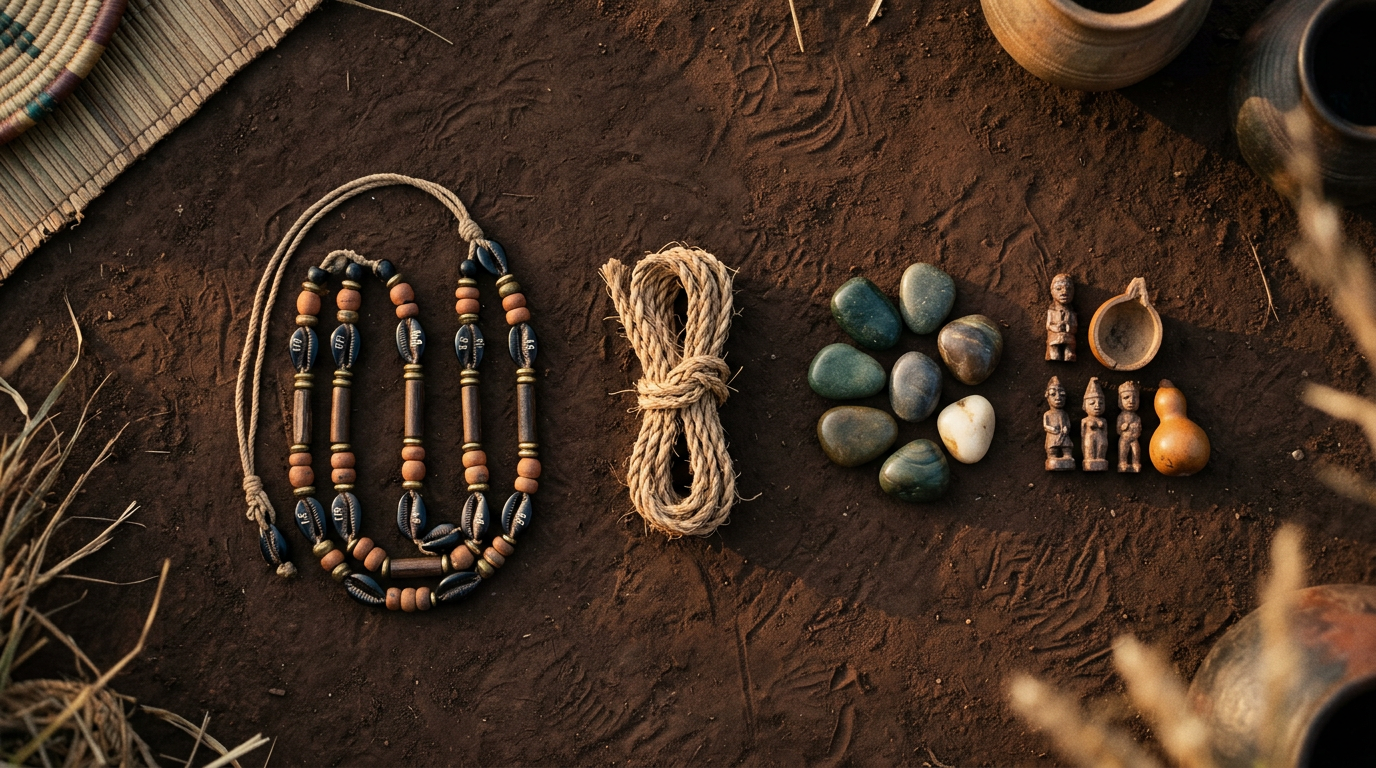
Ifá is distinctly Yorùbá in its theology, its literary corpus, and its priestly lineage. Yet it does not exist in isolation from the broader West African spiritual world.
Parallels With Other West African Divination Systems
The clearest evidence of Ifá's regional embeddedness is the family of cognate systems found across coastal West Africa. The Fon people of Benin practice a related system called Fá; the Ewe and Mina peoples call theirs Afa; the Urhobos know it as Epha. All share the structural foundation of the Yorùbá Ifá system. Whether these systems derived from Yorùbá Ifá or developed through parallel regional exchange is a question scholars debate — some Igbo and Ewe scholars contest any simple Yorùbá-origin narrative — but the family resemblance is unmistakable. The same 256-signature binary structure, similar interpretive principles, analogous roles for the diviner. The divergences are real and significant, but so is the kinship.
Shared Themes: Ancestors, Community, and Balance
Across these West African traditions, and across African indigenous religions more broadly, certain themes recur: the continuity between the living and the dead; the primacy of community over the isolated individual; the understanding that health, prosperity, and right relationship are maintained through active ritual attention rather than passive belief. Ifá shares all of these. Its ethical core — expressed through the concept of Iwa-pele, gentle and good character — positions the tradition not as a set of transactions with the divine but as a comprehensive framework for how to live well among other people and other beings.
Iwa-pele threads through the Odù corpus. It is, in some readings, the whole point: the divinatory system exists to help practitioners align their actions with good character and with the destiny their Orí chose. That ethical dimension distinguishes Ifá from any reductive characterization of African religion as ritual magic or superstition.
Why Ifá Is Not a Subset but a Living Tradition
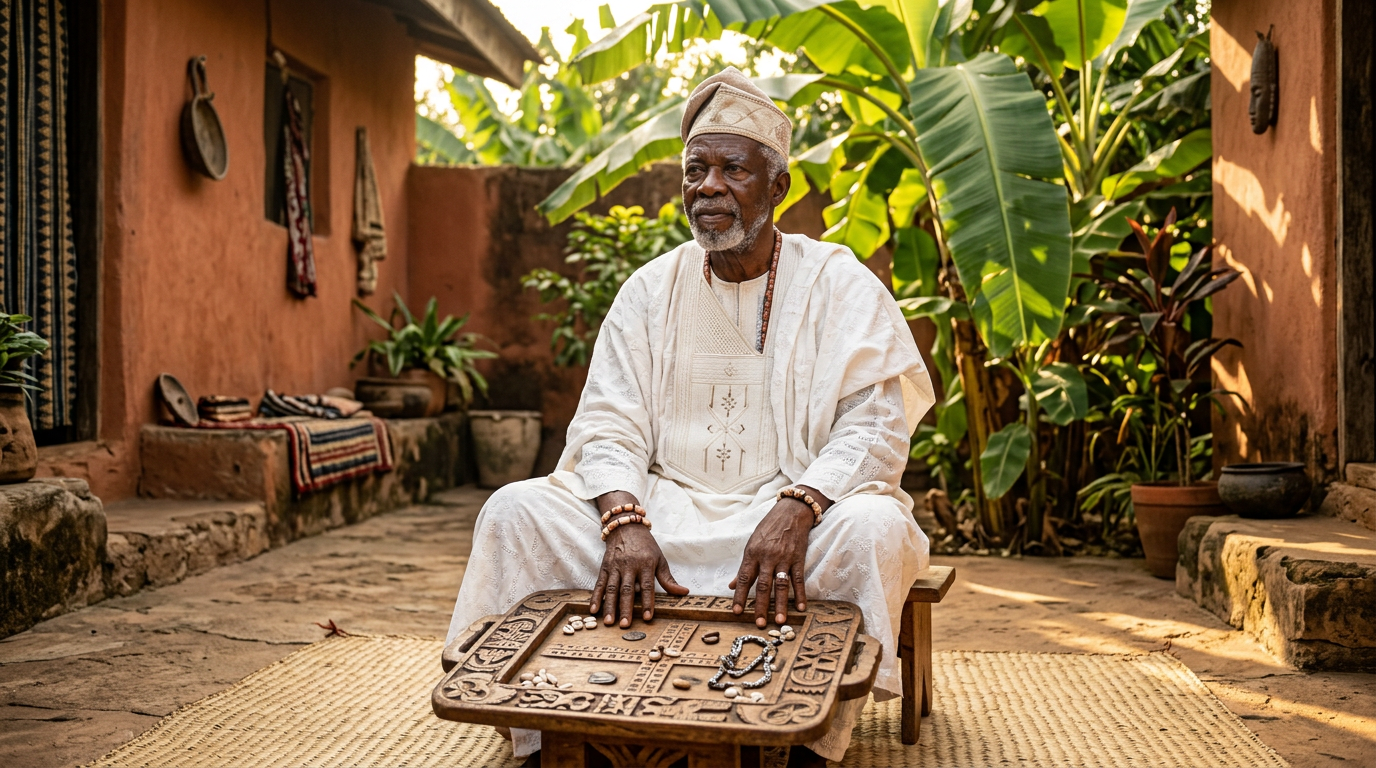
A persistent mistake in popular accounts is treating Ifá as a component of some larger "African religion" — a regional variation, a subset, a local flavor of a generic continental tradition. This misses the mark in at least two directions.
Resisting Colonial Categories
The idea that African spiritual systems require validation against Western religious categories is itself a colonial inheritance. Ifá has its own theology (centered on Olódùmarè, the Òrìṣà, and Ọ̀rúnmìlà), its own sacred literature (the 256-Odù corpus), its own priestly hierarchy (Babalawos trained in lineage-specific protocols), and its own ethical philosophy (Iwa-pele and the guidance of Orí). By any standard used to recognize other world traditions as complete systems, Ifá qualifies.
The diasporic arc makes the point with particular force. Through the Atlantic slave trade, Ifá traveled to Cuba, Brazil, Trinidad, and the wider Caribbean, where it influenced or merged with traditions including Santería, Candomblé, and Lucumí — while retaining core structural elements such as Ọ̀rúnmìlà (known in some diaspora contexts as Orula) and the 256-Odù framework. Diaspora adaptations are distinct traditions in their own right and should not be conflated with Yorùbá Isese. But the survival itself is evidence of something robust enough to cross an ocean and anchor itself in new soil.
UNESCO Recognition and Global Relevance
In November 2005, UNESCO proclaimed the Ifá divination system one of the world's Masterpieces of the Oral and Intangible Heritage of Humanity; it was formally inscribed on the Representative List in 2008. The recognition is significant not because external institutional approval is required to validate Ifá, but because UNESCO's framing — positioning the Odù as a knowledge repository comparable in scope to major world literary traditions — gives international scholarly language to what practitioners have always known.
Professor Wándé Abímbọ́lá, a globally recognized Ifá scholar and the Chief Àwísẹ Àwo Àgbàyé (global spokesperson of Ifá), was central to the documentation process leading to that inscription. His work demonstrates how the tradition's own authoritative voices, not outside interpreters, defined its terms for the world stage. Some practitioners have since raised thoughtful concerns about whether institutional recognition risks bureaucratizing or commodifying a living spiritual tradition — a tension worth holding honestly as global interest in Ifá continues to grow.
Approaching Ifá With Respect and Accuracy
Understanding where Ifá fits within African traditional religion is a starting point, not a destination. The system is deep enough that years of study only open more doors.
A few practical principles for moving forward with integrity. First, prioritize sources connected to lineage holders — practitioners trained within recognized initiatory lines who carry the tradition's knowledge as a living responsibility, not as academic content. The what is Ifá divination foundational literature available from communities like this one is a reliable starting place. Second, hold the distinction between Yorùbá Isese and its diaspora cognates. Santería, Candomblé, and Lucumí are serious traditions deserving their own respectful study; conflating them with Yorùbá Ifá diminishes all of them.
Third, be cautious with secondary sources that don't name their lineage or community ground. Much of what circulates online about Ifá was written at a distance from the tradition. The Odù corpus itself — vast, orally transmitted, and continuously growing — is not a text you simply read your way into. Engagement with living practitioners is not optional for serious understanding.
The questions worth asking aren't "Is this African enough?" or "Does this match what I read somewhere?" They're simpler: Who holds this knowledge? How did they receive it? What do they say it means to live well? Those questions, more than any framework, will take you closer to what Ifá actually is.
Where to Go From Here
Yorùbá Ifá sits within the landscape of African traditional religions the way a great river sits within a watershed — recognizably part of the same terrain as its neighbors, shaped by the same larger forces, but following its own course with its own depth and direction. The shared themes across African indigenous traditions (creator deity, divine intermediaries, ancestor relationship, communal ethics) provide the family context. The specific theology of Olódùmarè and the Òrìṣà, the vast 256-Odù literary corpus, the trained Babáláwo, the guiding concept of Iwa-pele — those are Ifá's own, carried intact across millennia and across oceans.
Approaching it means shedding the colonial categories that framed African religions as primitive and recognizing instead a sophisticated knowledge system that has nourished communities from Ile-Ife to Havana to the living rooms of people reading articles like this one. Start with the cosmology. Sit with the Odù. Find the lineage holders. The tradition can hold your questions.