Ọ̀pẹ̀lẹ̀ vs. Ikin: How Ifá Divination Tools Work and When Each Is Used
Most people who come to Ifá divination for the first time notice the tools before anything else — a chain hitting a mat, or a priest quietly passing palm nuts between his hands. What they’re witnessing are two distinct instruments with very different ceremonial standing: the Ọ̀pẹ̀lẹ̀ and the Ikin. Understanding how each works, and why tradition prescribes one over the other in specific contexts, is foundational knowledge for any serious student or practitioner of Ifá.
What Are the Primary Tools of Ifá Divination?
Ifá divination uses two primary instruments to identify the Odù — the signature pattern drawn from a corpus of 256 figures, each carrying roughly 16 poetic verses called ese — that addresses a client’s situation. Every tool in the ensemble has a defined role, and none is interchangeable.
The Ọ̀pẹ̀lẹ̀ (Divination Chain)
The Ọ̀pẹ̀lẹ̀ is a linked chain of eight seed-pods or shells. When the Babalawo casts it onto the divination mat, each of the eight segments lands in one of two orientations — concave or convex, open or closed — and the resulting pattern directly encodes an Odù in a single throw. Think of it as eight simultaneous binary decisions, each resolving instantly.
The physical form varies by region. In Cuban Lucumí practice, for instance, the chain is often made from coconut shells and called ekuele or ocuele. The underlying mechanism; eight linked segments, two possible faces each remains consistent across diaspora traditions, even where materials differ.
The Ikin Ifá (Sacred Palm Nuts)
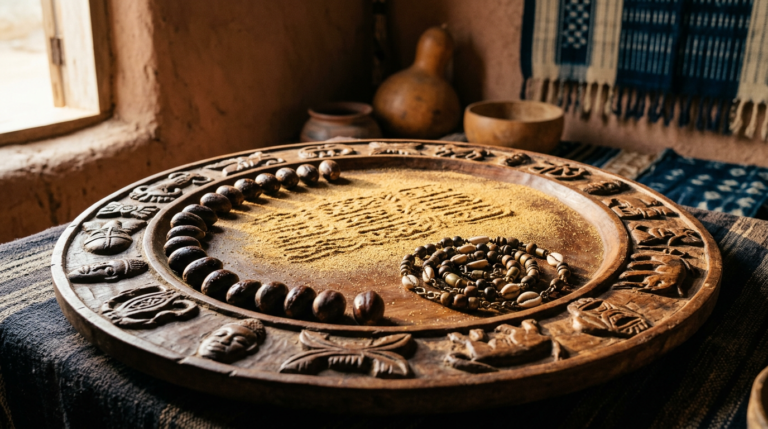
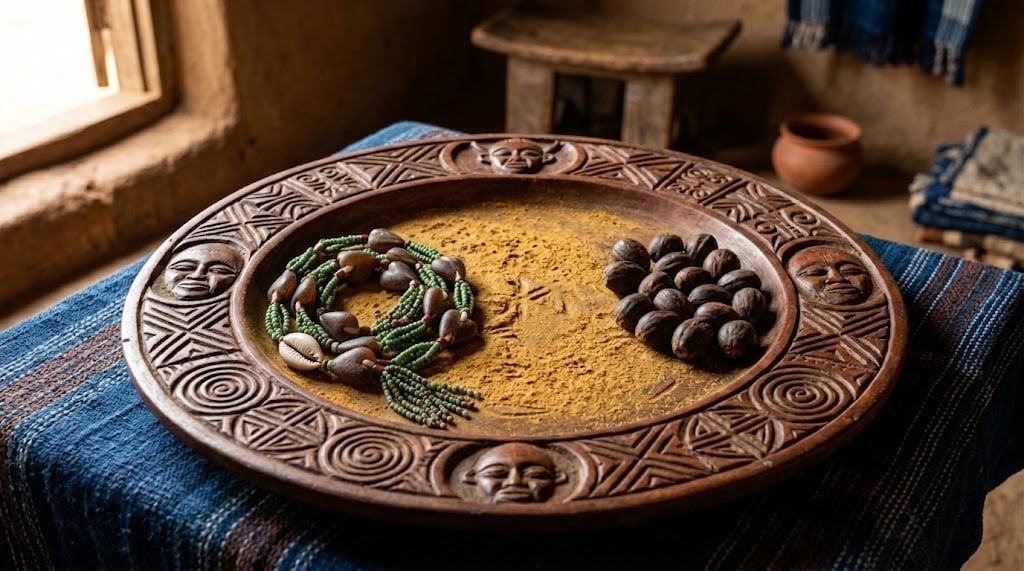
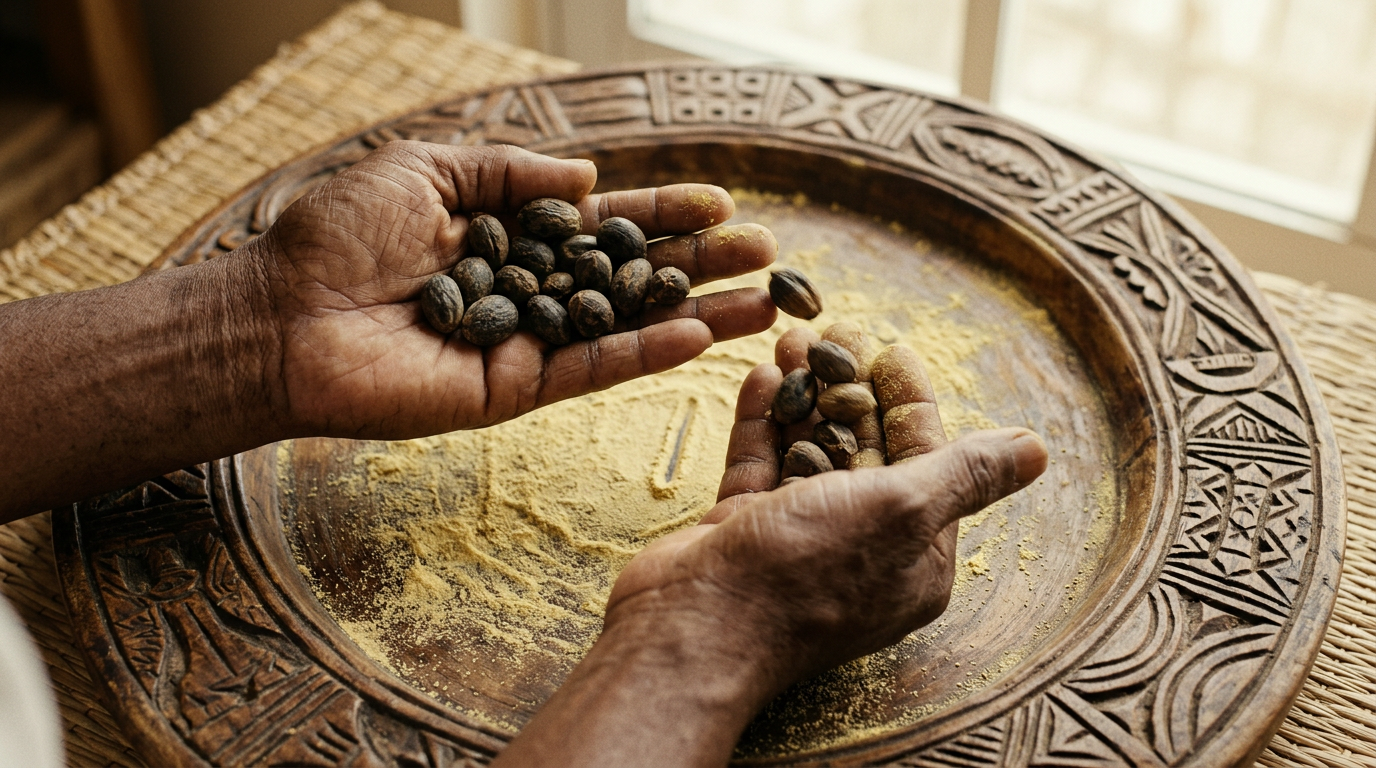
The Ikin are sixteen sacred palm nuts, and selection is precise: only nuts bearing four “eyes” (the small indentations at the base) are acceptable for divination. This is not aesthetic preference. The Ikin are regarded within the tradition as the physical embodiment of Ọrúnmìlà himself; the Yorùbá deity of wisdom and divination — which is why the criteria for their selection are exacting.
Because the Ikin are Ọrúnmìlà rather than merely representing him, they occupy a categorically different standing than any other instrument in the Babalawo’s kit. Scholars including Wándé Abímbọ́lá have documented the four-eyes criterion as a consistent requirement across Yorùbá lineages, though minor variations exist in edge-case practice.
Supporting Instruments: Ọpọ́n Ifá, Ìyẹ̀rosùn, and Ìbò
The Ọpọ́n Ifá is the carved wooden divination tray on which the Babalawo records each mark during Ikin consultation. Before divination begins, the Babalawo dusts its surface with Ìyẹ̀rosùn — a sacred yellow-reddish powder produced from the dust of the Irosun tree, specifically the portion processed by termites. As each mark of the emerging Odù is drawn into this powder, the tray becomes a living record of Ọrúnmìlà’s communication.
The Ìbò — typically including paired cowrie shells and a piece of bone — come into play after the Odù has been identified. They answer yes-or-no questions about which prescribed remedy or path applies. The cowries generally signal affirmation; the bone signals negation. Together these secondary objects complete the interpretive process that the primary tools begin.
How the Ọ̀pẹ̀lẹ̀ Works in Ifá Consultation
The Ọ̀pẹ̀lẹ̀ is fast. That speed is by design, not accident, and understanding the mechanics shows why.
Anatomy of the Ọ̀pẹ̀lẹ̀ Chain
A standard Ọ̀pẹ̀lẹ̀ divides its eight segments into two groups of four — four on the left arm of the chain and four on the right — joined at a central link the Babalawo holds during the cast. Each segment produces one binary mark. Four marks on the left form the first half of the Odù; four on the right form the second. The entire signature emerges at once.
The chain is consecrated before use and belongs to the Babalawo personally. It is not shared between priests, and its relationship to its owner is understood as relational, not transactional.
Casting Technique and Reading the Odù
The Babalawo holds the Ọ̀pẹ̀lẹ̀ at its center link, allows the eight segments to hang freely, and casts it outward onto the Ọpọ́n Ifá or a clean mat. Reading is immediate: the priest observes which segments landed open and which landed closed, left side and right side separately, and recognizes the resulting Odù pattern. Because all 256 Odù are part of an introduction to Odù Ifá and the 256 figures a trained Babalawo has internalized through years of study, recognition is instantaneous.
The ease of reading is part of the Ọ̀pẹ̀lẹ̀’s purpose. It allows a practitioner to consult Ifá efficiently when a client needs guidance without the full ceremonial apparatus of an Ikin session.
Spiritual Relationship Between Babalawo and Ọ̀pẹ̀lẹ̀
Within Ifá cosmology, the Ọ̀pẹ̀lẹ̀ functions as a messenger or assistant of Ọrúnmìlà — a reliable intermediary, but not Ọrúnmìlà’s direct presence. This cosmological position shapes everything about appropriate use. The Ọ̀pẹ̀lẹ̀ carries real spiritual authority; it is simply a different order of authority than the Ikin command.
How the Ikin Ifá Works in Ifá Consultation
If the Ọ̀pẹ̀lẹ̀ is built for clarity at speed, the Ikin is built for depth at cost. The process is deliberate, physically demanding, and by design unhurried.
Selecting and Consecrating the Ikin
A Babalawo’s Ikin are acquired through initiation and consecrated as part of that process. They are not purchased off a shelf and activated; their consecration binds them to a specific lineage and priest. Between sessions, the Ikin are stored in an Agere Ifá — a carved wooden or ivory vessel that serves as their ritual home and keeps their spiritual presence intact.
Only a properly initiated Babalawo or Ìyánífá (female Ifá priest) should handle consecrated Ikin for divination purposes. Widely cited accounts within the tradition describe handling these objects without proper initiation as spiritually harmful, both to the uninitiated person and to the sacred objects themselves. This is a firm traditional boundary, not a formality.
The Manipulation Technique: From Palm Nuts to Marks on the Ọpọ́n
The Babalawo holds all sixteen Ikin loosely in the left hand. With the right hand, he scoops as many nuts as possible in one motion. What remains in the left hand determines the mark: if one nut remains, the Babalawo makes two vertical lines in the Ìyẹ̀rosùn on the Ọpọ́n; if two remain, he makes one line. Any other count is disregarded and the scoop is repeated.
This single scoop-and-mark produces one of the eight marks needed for a complete Odù. The Babalawo then repeats the entire process — gather, scoop, count, mark — until all eight positions are filled. The History Today archive on Ifá divination documents this technique in detail, noting that completing a full Odù with Ikin may require upward of thirty scoops to produce eight valid marks.
How an Odù Emerges from the Ikin Process
Once all eight marks are recorded in the Ìyẹ̀rosùn, the completed figure on the Ọpọ́n is the Odù for that consultation. The Babalawo reads it exactly as he would an Odù produced by the Ọ̀pẹ̀lẹ̀ — by matching the pattern to the appropriate body of ese from the Ifá literary corpus. The difference is not in the Odù itself but in the quality of spiritual connection the process established to produce it.
Key Differences Between Ọ̀pẹ̀lẹ̀ and Ikin
Both tools produce valid Odù. The differences between them are not about accuracy — they are about speed, ceremonial standing, and the depth of the dialogue being opened with Ọrúnmìlà.
Speed and Practicality
The contrast is stark. The Ọ̀pẹ̀lẹ̀ produces a complete Odù signature in a single cast. The Ikin requires the Babalawo to repeat the manipulation technique eight times for eight marks, with each repetition potentially requiring multiple scoops to yield a valid count. A consultation that takes thirty seconds with the Ọ̀pẹ̀lẹ̀ may take twenty or thirty minutes with the Ikin.
This is not inefficiency in the Ikin — it is the point. The extended process creates an extended period of focused ritual communication with Ọrúnmìlà, appropriate for occasions that warrant it.
Spiritual Weight and Hierarchical Standing
The Ikin are Ọrúnmìlà. The Ọ̀pẹ̀lẹ̀ carries Ọrúnmìlà’s message. This distinction, which appears consistently across Nigerian Yorùbá and diaspora tradition sources alike, is the axis on which every protocol decision turns. Consulting the Ikin is understood as speaking directly with the deity; consulting the Ọ̀pẹ̀lẹ̀ is understood as receiving a reliable relay of that deity’s counsel.
Neither framing diminishes the Ọ̀pẹ̀lẹ̀. A trusted messenger brings true messages. But when the stakes are highest — initiation, illness, matters of life and death — tradition calls for the direct line.
The Nature of Communication with Ifá
Ifá divination, as UNESCO’s intangible cultural heritage inscription documents, operates as a systematic interpretive practice rather than a personal oracular gift. The Babalawo does not channel spirits or enter trance; he reads signs the tools produce and interprets them through the memorized corpus of ese. Both instruments engage this same process. Where they differ is in how directly each one is believed to carry Ọrúnmìlà’s own attention in a given session.
When to Use the Ọ̀pẹ̀lẹ̀ and When to Use the Ikin
The protocols here are traditional and practical, though practitioners should be aware that specific lineages — including several Afro-Cuban/Lucumí traditions — may apply these guidelines with some variation. What follows reflects the widely documented Yorùbá norm.
Everyday Consultations and the Role of Ọ̀pẹ̀lẹ̀
The Ọ̀pẹ̀lẹ̀ is the workhorse of daily Ifá practice. Babalawos use it for the great majority of consultations: routine guidance questions, business decisions, relationship concerns, health inquiries that are not acutely critical, and any situation where a client needs Ifá’s counsel without a major ceremonial context. Its speed makes it practical for the volume of consultations a working Babalawo handles.
If you are preparing for an Ifá consultation for the first time with a relatively focused personal question, the Ọ̀pẹ̀lẹ̀ is almost certainly the instrument your Babalawo will reach for.
Critical Life Matters and Ceremonial Contexts Requiring Ikin
The Ikin come out for situations whose weight matches their standing. Initiations — including the Itefa ceremony — require Ikin divination. Life-path determinations, where a person’s foundational Odù (their Odù Àṣà) is being established, require Ikin. Serious illness, when the question being asked has genuine life-or-death stakes, typically calls for Ikin. Any major communal ceremony — festivals, consecrations, significant offerings — falls in this category as well.
The guiding principle: when the occasion is one you would bring to the highest authority rather than a reliable deputy, use the Ikin.
Situations Where Both May Be Used Together
Some consultations begin with the Ọ̀pẹ̀lẹ̀ to identify the presenting Odù, then shift to the Ikin for confirmation or for the deeper interrogation of a particularly weighty matter that the initial cast flagged. This sequential approach is not contradictory — it uses each tool according to its strengths. The Ọ̀pẹ̀lẹ̀ opens the door efficiently; the Ikin steps through it with full ceremonial presence.
Common Misconceptions About Ọ̀pẹ̀lẹ̀ and Ikin
A few persistent misunderstandings circulate even among sincere students of Ifá, and they’re worth addressing directly.
“Ọ̀pẹ̀lẹ̀ Is Less Accurate Than Ikin”
The Ọ̀pẹ̀lẹ̀ is not less accurate. Both tools, when used by a properly trained and initiated Babalawo, produce valid Odù. The difference between them is ceremonial hierarchy, not reliability. Saying the Ọ̀pẹ̀lẹ̀ is less accurate because it is subordinate to the Ikin is like saying a skilled diplomat’s message is less true because it came through an envoy rather than directly from the head of state. The message is the message.
What is true is that the Ikin are reserved for contexts requiring direct divine engagement at the highest level. That distinction of appropriateness should not be confused with a difference in the truth-value of what each tool reveals.
“Anyone Can Use the Ikin”
The Ikin are not a tool anyone can pick up and use. They must be received through initiation, consecrated within a recognized lineage, and handled only by initiated Babalawo or Ìyánífá. Tradition widely describes the use of consecrated Ikin by uninitiated individuals as spiritually dangerous — to the person and to the objects. This is not gatekeeping; it reflects the understanding that the Ikin are Ọrúnmìlà’s embodied presence, and that presence requires a properly prepared vessel to engage.
This is also why lineage integrity matters. The role and training of a Babalawo is not a formality preceding access to the tools; it is the preparation that makes the tools’ proper function possible.
Caring for Your Divination Tools
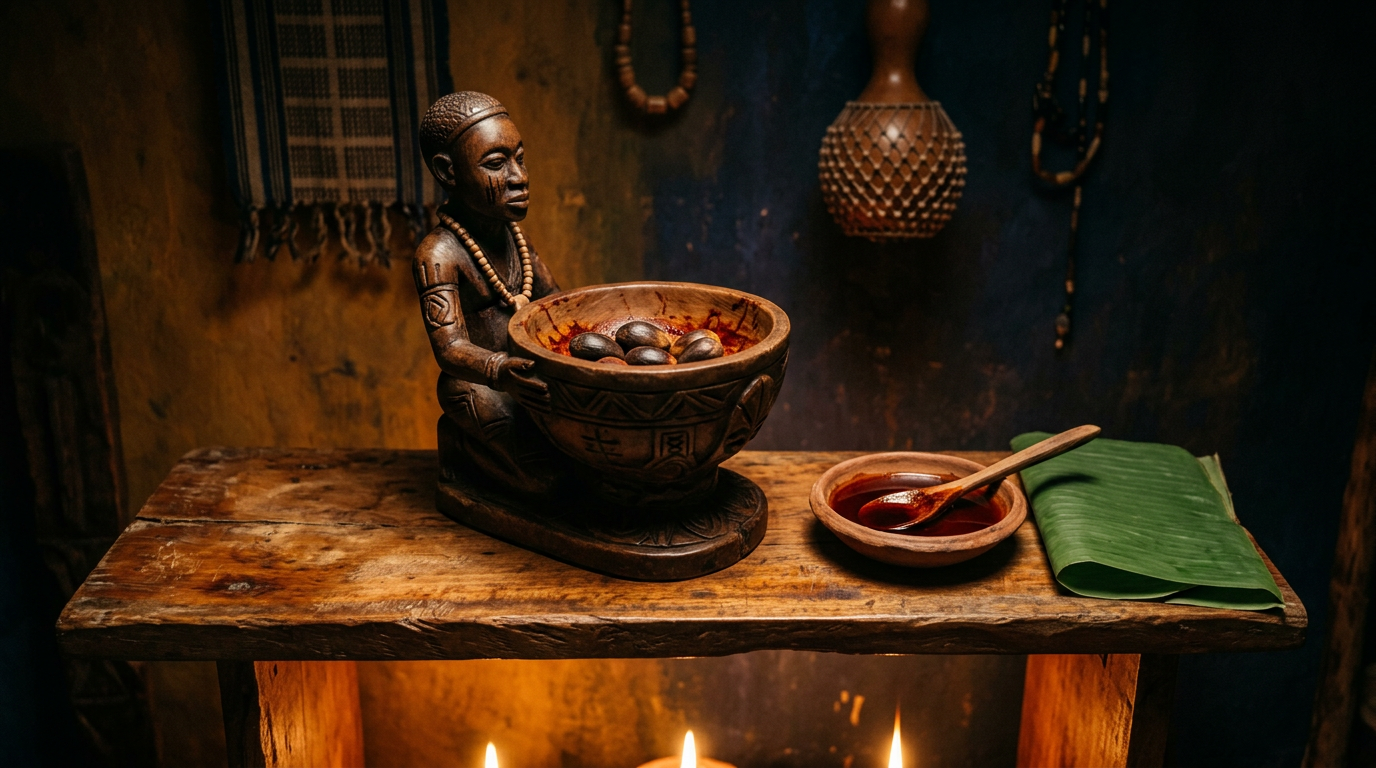
The Ọ̀pẹ̀lẹ̀ and Ikin are not passive objects that wait between sessions. They are understood as active spiritual presences requiring regular attention.
Storage, Feeding, and Spiritual Maintenance
The Ikin live in the Agere Ifá between divinations. This carved vessel is not simply a box; it is their home, and keeping them there maintains the continuity of their consecrated state. Both the Ikin and their Agere should be kept in a clean, respectful space — not in contact with the floor, not near spiritually disruptive materials.
“Feeding” the tools refers to the ritual offerings — typically palm oil, specific leaves, and prayer — made at intervals prescribed by the Babalawo’s lineage tradition. These offerings are understood as reciprocal maintenance of the relationship between the diviner and the divine. The Ọ̀pẹ̀lẹ̀ receives similar care, though the specific protocols vary by lineage. When in doubt, ask your initiating Babalawo for the feeding schedule that belongs to your lineage’s practice.
Signs That a Tool Needs Re-consecration
A tool that has been physically damaged, exposed to spiritually impure environments, handled by uninitiated persons, or that begins to produce consistently confusing or contradictory results in sessions may require reconsecration. This is not a failure of the tool but a disruption of its relationship with the priest or with the sacred. Re-consecration should be performed by a qualified Babalawo, not attempted independently. Some lineages also prescribe periodic refreshing of the Ọ̀pẹ̀lẹ̀ as routine maintenance, not just in response to problems.
Deepening Your Understanding of Ifá Divination
Learning to distinguish between the Ọ̀pẹ̀lẹ̀ and Ikin — their mechanics, their standing, their appropriate contexts — is one step in a much longer education. Ifá’s 256 Odù each carry around 800 ese, a literary corpus of enormous depth that Babalawo spend years, sometimes decades, committing to memory. The tools themselves are only the mechanism that opens the door to that body of knowledge.
If you are new to this path, building familiarity with Òrìṣà and their connection to Ifá practice will help you understand why the Ikin’s identity as Ọrúnmìlà’s embodiment carries such weight. If you are more advanced, studying the glossary of Yorùbá terms used in Ifá tradition can sharpen your understanding of the conceptual vocabulary that experienced practitioners take for granted.
Above all, seek learning within a recognized lineage. These tools were not designed for solo study; they were designed for use within an ongoing relationship between teacher and student, priest and community. The most accurate article about the Ọ̀pẹ̀lẹ̀ and Ikin is still only a map. The territory is found in practice.