Ògún: Òrìṣà of Iron, Labor, and the Warrior’s Path
Before a single god could walk on earth, before hunters found forest paths or farmers turned soil, there was an impenetrable thicket — and one Òrìṣà willing to cut through it. This article covers everything a serious student or devotee needs to understand Ògún: his cosmic identity, his foundational myths, his presence in the Odù Ifá corpus, the full breadth of his domains, how he is properly honored, and what his path demands of those who walk it.
Who Is Ògún in the Yorùbá Tradition
Ògún is not simply a war deity. Among the Yorùbá, he is the divine principle governing iron itself — and through iron, every tool, every weapon, every act of skilled labor that separates civilization from raw wilderness. His àṣẹ (divine power, the animating force unique to each Òrìṣà) saturates the material world in ways most people never consciously register. Every time a surgeon lifts a scalpel, a mechanic turns a wrench, or a farmer raises a machete, Ògún’s energy is present.
Ògún’s Place Among the Òrìṣà
Widely cited tradition describes Ògún as Òṣìn Ìmọlẹ̀, meaning “first of the primordial Òrìṣà to come to Earth.” That title matters. He did not arrive after the world was prepared for him — he was the one who made arrival possible for everyone else. His position is therefore not simply one of seniority; it is foundational in the most literal sense.
Within Yorùbá cosmology and the relationship between Òrun and Ayé, the Òrìṣà are understood as divine forces that mediate between the invisible realm of Òrun and the material world of Ayé. Ògún occupies a particular station among them — closer to the raw, unmediated force of creation than most, comfortable in the deep forest and on the battlefield alike, yet indispensable to the ordinary human life of honest work.
The Etymology and Praise Names of Ògún
The name Ògún is most directly associated with iron and metal work. Among his praise names (oríkì) are phrases that invoke his ferocity, his protective power, and his unyielding nature — “the one who cannot be appeased with cool water” appears across oral traditions, pointing to the fire and forge at the heart of his character. Hunters address him before entering the forest. Blacksmiths invoke him before striking an anvil. Drivers in Yorùbá communities often keep iron near their vehicles as acknowledgment of his guardianship over the road.
These oríkì are not decorative. In Yorùbá devotional practice, praising an Òrìṣà by name and title is a form of active engagement with their àṣẹ — an assertion of relationship, not mere description.
The Mythology and Sacred Narratives of Ògún
Ògún’s mythology does not present a tidy hero’s journey. His stories are morally complex, sometimes violent, always instructive. They reveal a divine force of tremendous creative and destructive potential — one that requires wisdom to approach.
Ògún’s Descent from Òrun to Ayé
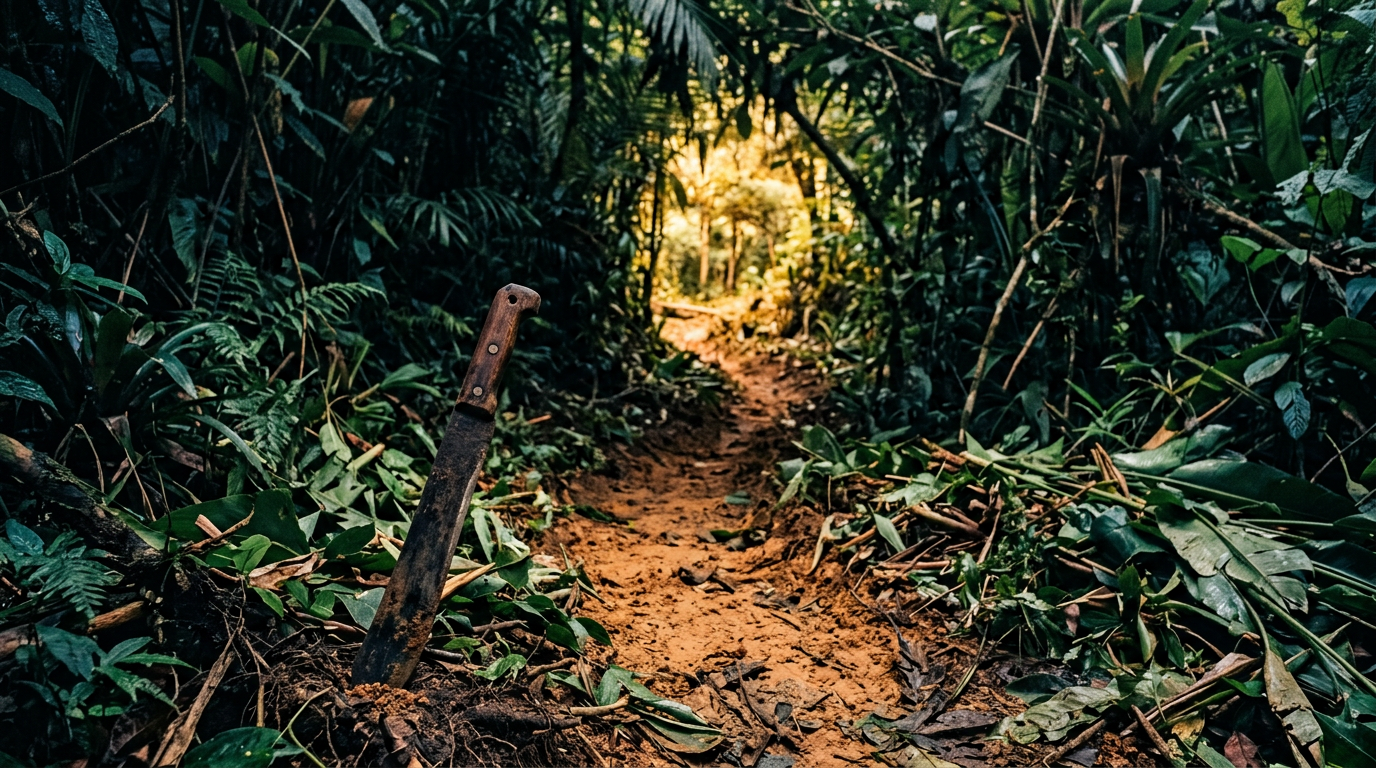
When the Òrìṣà first descended from Òrun to Ayé, they encountered an impenetrable thicket that blocked any further passage. No other divinity could break through. Ògún alone took up his machete and cut the path forward, allowing all the Òrìṣà — and by extension, humanity — to enter the world. This is not metaphor for the tradition. It is the foundational event that explains why Ògún must be acknowledged before any new endeavor, why roads require his blessing, and why iron tools carry spiritual weight.
That first act was not conquest. It was service.
Ògún and the Clearing of the Path for the Òrìṣà
The clearing narrative does more than establish Ògún’s power — it establishes his role. He is always the one who goes first, into difficult terrain, doing the necessary work that makes everything else possible. Blacksmiths honor him because their craft requires entering dangerous proximity to fire and molten metal. Hunters honor him because moving through the forest means moving through his domain. Surgeons, in traditions that have adapted Ògún’s patronage to modernity, honor him because cutting into a body to heal it carries the same essential duality: destruction in service of restoration.
The list of those under Ògún’s guardianship is remarkably wide — blacksmiths, hunters, barbers, butchers, goldsmiths, surgeons, mechanics, and all workers in iron and steel. What connects them is not just the material they work with, but the quality of focused, skillful labor under conditions of risk.
Ògún’s Oath and Retreat into the Forest
The most sobering of Ògún’s sacred narratives centers on a feast at Ire-Èkìtì. Ògún returned from battle hungry, to find his people celebrating. What happened next depends on which lineage tells the story — but in most accounts, he fell into a destructive fury, attacking those around him before realizing what he had done. Overcome with what the tradition describes as horror at his own violence, he plunged his sword into the earth and disappeared into the forest, swearing never to return to human society.
A sacred grove at Ire-Èkìtì in Ekiti State, Nigeria, marks the place where he is said to have entered the earth. This is not merely legend — the grove is a recognized sacred site, and the Ire-Èkìtì community maintains it as such. The story carries a specific teaching: raw power, untempered by wisdom and restraint, becomes dangerous even to those it loves.
Ògún in Odù Ifá
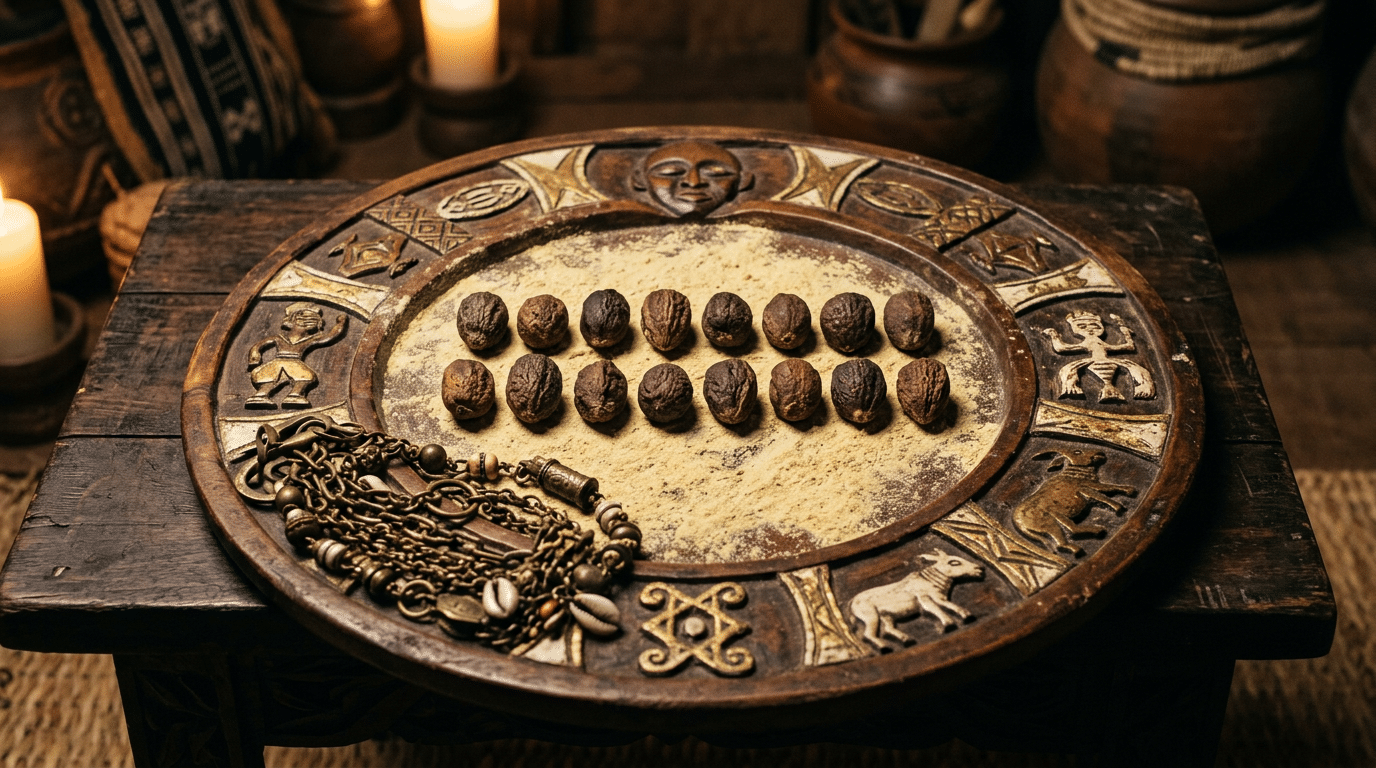
Ògún’s presence runs through many of the 256 Odù of the Ifá corpus, but one stands above the others in direct association.
Key Odù That Reference Ògún
Ogúndá Méjì is the Odù most directly linked to Ògún, and it appears among the 16 principal Odù of the Ifá sacred corpus as a major divination framework. Scholars of the tradition and practitioners alike treat Ogúndá Méjì as the Odù of clearing, disciplined action, and the righteous use of force. The name itself — Ogúndá — is linguistically rooted in Ògún, signaling the connection explicitly.
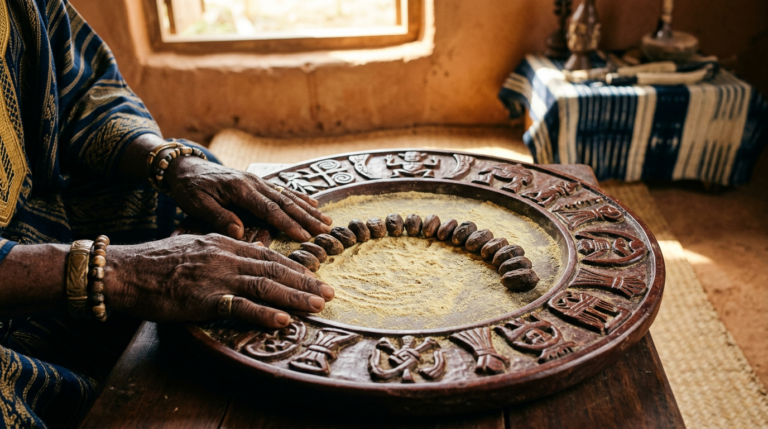
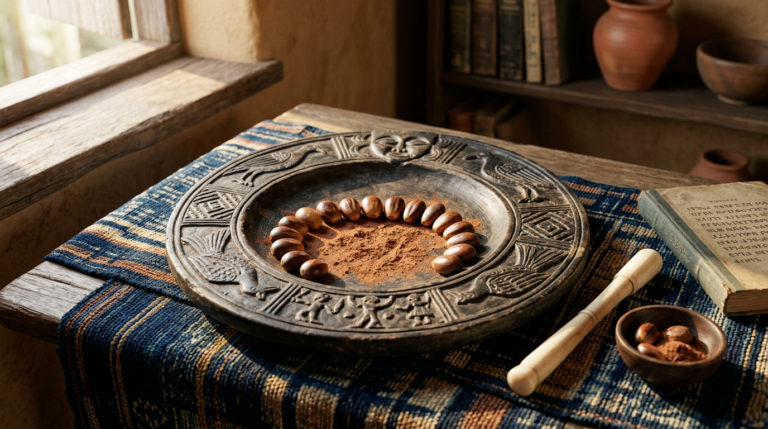
Ogúndá Méjì is the Odù most invoked when practitioners seek Ògún’s guidance through the Ifá divination process and tools, particularly when obstacles are blocking progress or when decisive action carries moral stakes.
Lessons and Prescriptions Connected to Ògún
Practitioners commonly note that Ogúndá Méjì emphasizes one central teaching: strength must be tempered with wisdom. Progress often requires removing obstacles — physical, relational, or spiritual — but the manner of removal matters as much as the act. The Odù warns against reckless application of force and against allowing righteous anger to curdle into indiscriminate destruction.
Prescriptions that emerge from Ogúndá Méjì in divination often involve physical action (clearing land, finishing unfinished work, resolving long-delayed confrontations), alongside spiritual work to ensure Ògún’s energy is channeled constructively. The Odù is not passive; it asks something of the person consulting it.
Domains of Ògún: Iron, Labor, War, and Innovation
To list Ògún’s domains is almost to list the infrastructure of human civilization.
Ògún as Patron of Blacksmiths and Artisans
Before the forge existed, the forest was all there was. Ògún stands at the threshold between raw nature and human craft. Every iron tool — a plow, a needle, a nail — represents an act of transformation that belongs to his domain. Blacksmiths in Yorùbá communities traditionally begin their work with invocations to Ògún, and the anvil itself is sometimes treated as a portable shrine, a point of contact with his àṣẹ.
This patronage extends across all artisan and craft traditions that involve cutting, shaping, or refining — barbers, goldsmiths, butchers. The skill required by each of these trades, the precision and controlled force, mirrors Ògún’s own character when it is properly expressed.
Ògún’s Role in Warfare and Justice
War and justice are not opposites in Ògún’s cosmology. He is the force that enforces covenants sworn on iron. In Yorùbá communities, oaths sworn in Ògún’s name carry binding spiritual force — swearing falsely before him is understood to invite swift retribution. This oath-keeping function means Ògún also governs the domain of justice: he punishes perjury, enforces agreements, and holds liars accountable in ways that operate outside any court.
Warriors invoked him before battle not simply for courage, but for the righteous clarity needed to fight without becoming what they oppose.
Ògún and Modern Technology
Ògún’s àṣẹ reaches into domains his ancient worshippers could not have imagined specifically, but which follow naturally from the logic of his patronage. Modern surgery depends on metal instruments entering a body to heal it. Automotive transport depends on engines, chassis, and hundreds of metal components. Industrial manufacturing is iron and steel work at scale.
Across diaspora traditions — Candomblé in Brazil, Lucumí practice in Cuba and its diaspora, Haitian Vodou — Ògún’s patronage of modern technology is widely attested, with drivers leaving offerings before long journeys and surgeons honoring him before the operating theater. The specific ritual forms vary by lineage and geography, and homeland Yorùbá and diaspora practitioners may frame the extension to modernity differently. But the underlying logic is consistent: wherever iron does the work of human transformation, Ògún is present.
Sacred Symbols, Tools, and Animals of Ògún
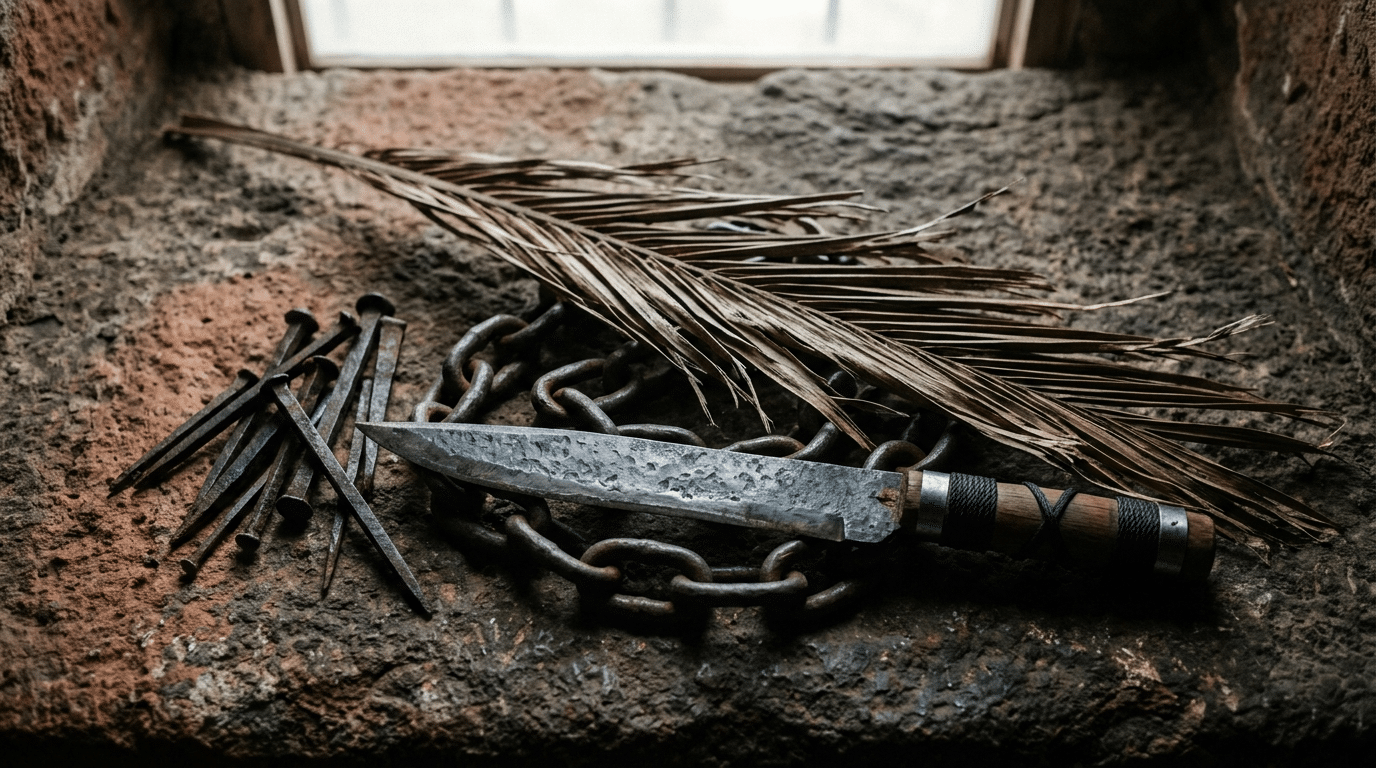
Ògún’s sacred objects are not decorative. Each carries specific spiritual meaning and serves a function in devotional practice.
Iron Implements and the Machete
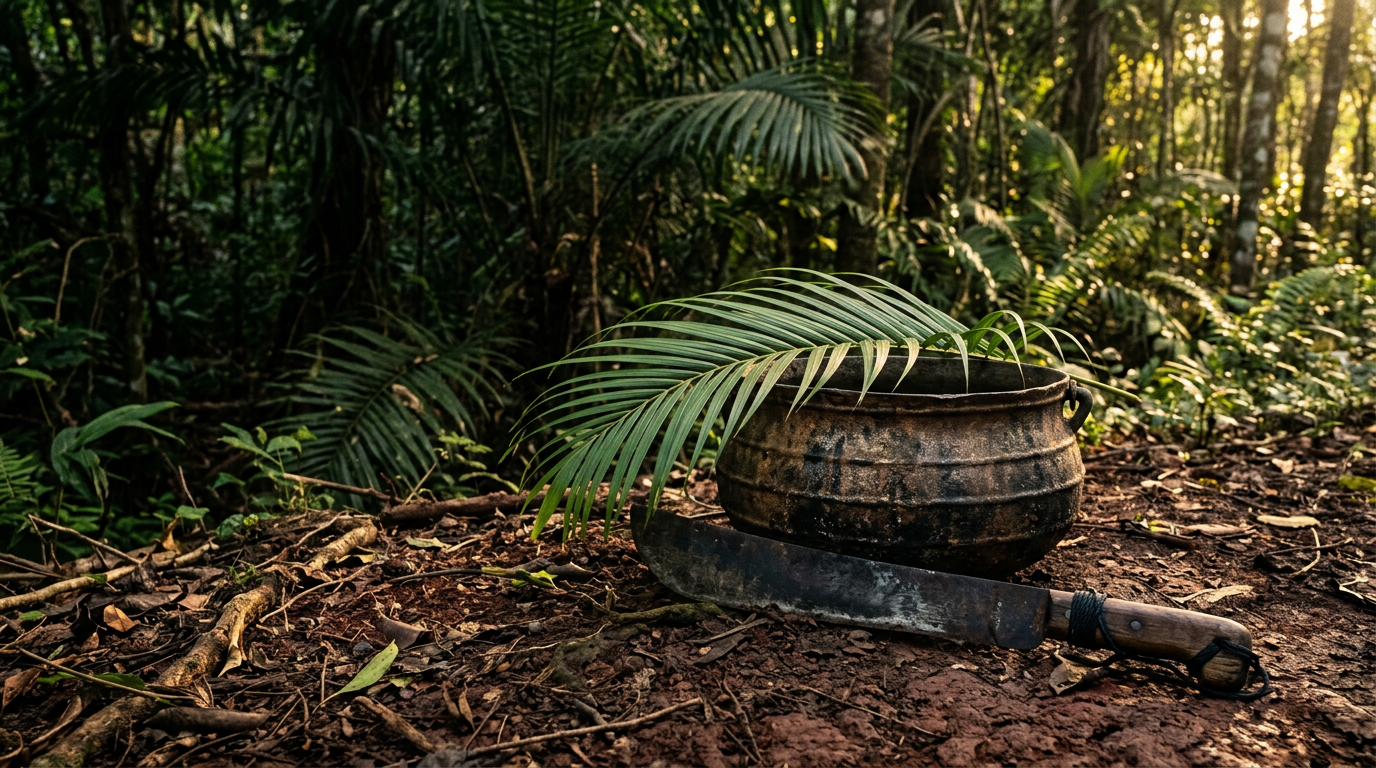
Iron is Ògún’s primary symbol — and not just iron in the abstract. The machete (àdá) holds special significance as the tool with which he cleared the primordial path. Shrines and altars dedicated to Ògún traditionally feature iron implements: blades, chains, nails, and agricultural tools. The material itself is the medium of communication with him.
An iron cauldron is perhaps the most recognized devotional object associated with Ògún across Yorùbá-homeland and diaspora traditions alike. Into this vessel, practitioners place iron tools, his symbols, and offerings. The cauldron is not merely a container — it represents the forge, the crucible of transformation where raw ore becomes useful metal.
The Dog, Palm Frond, and Other Associations
The dog occupies a complex and important place in Ògún’s symbolic world. Dogs are associated with loyalty, the hunt, and the liminal space between wilderness and settlement — which maps almost exactly onto Ògún’s own position in the cosmos. Dogs are used as sacrificial animals in certain traditional contexts, and the relationship between Ògún and the dog is one of the most consistent cross-cultural elements in his veneration.
The palm frond (mariwo) also figures prominently. It marks sacred space, serves as a boundary signal, and appears in Ògún festivals and initiations as a sign of his presence. Other associations include the color black (and sometimes green), the numbers three and seven (with variation by lineage), and forest locations — particularly crossroads and thicket edges, places where the cleared path meets what is not yet cleared.
How Ògún Is Venerated and Honored
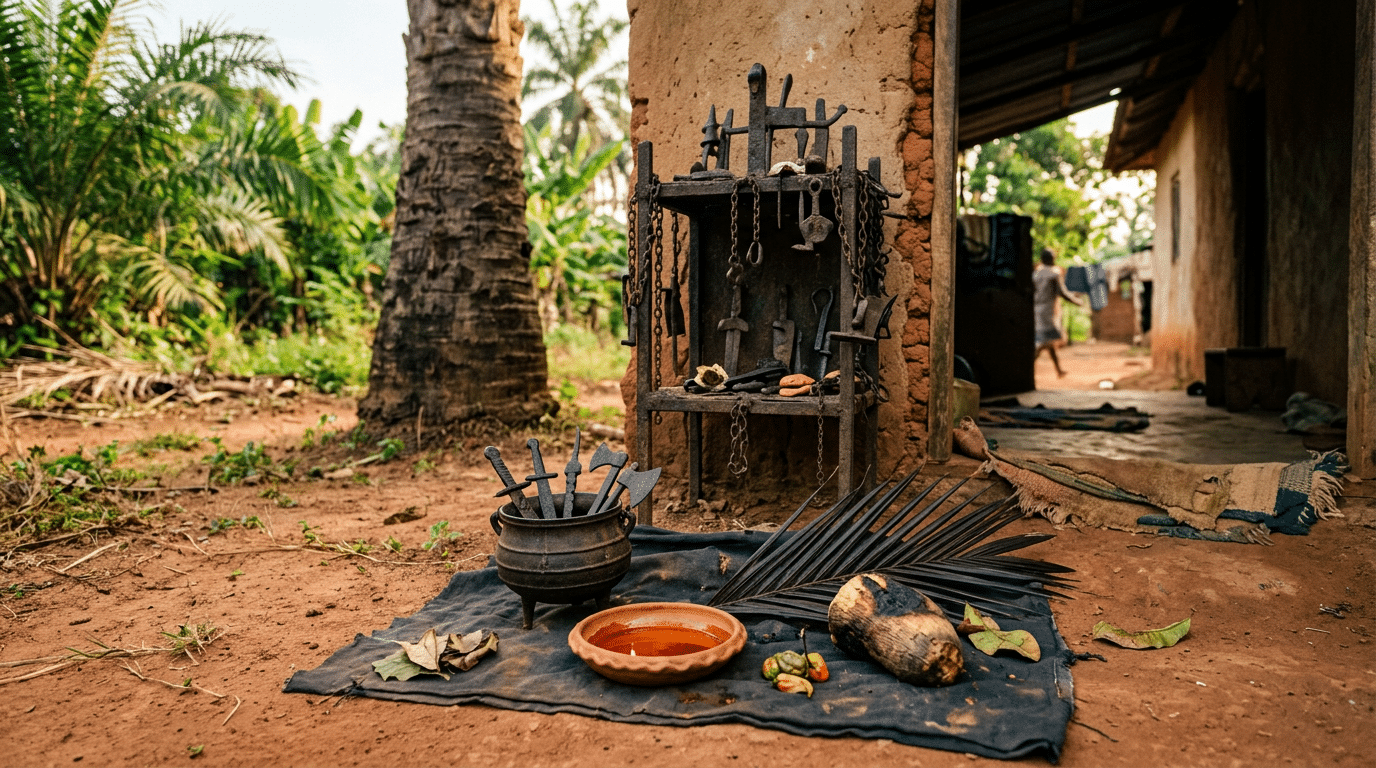
Ògún worship is not soft. It asks for directness, honesty, and genuine engagement.
Traditional Offerings and Taboos
Ògún’s preferred offerings include palm wine, gin (particularly locally distilled spirits), roasted yam, smoked fish, and in appropriate ritual contexts, animal sacrifice — particularly the dog and the cock. Palm oil is frequently used in his veneration. Offerings are typically placed at the shrine, at the base of a palm tree, or at roadsides.
His taboos are equally instructive about his character. Ògún is said to despise laziness and deception — two qualities that represent the opposite of disciplined, honest labor. Cowardice in the face of necessary action is also antithetical to his nature. Devotees are expected to embody the qualities he represents, not only to appease him but to align with his àṣẹ.
Altars, Shrines, and Sacred Spaces
Ògún’s shrine is typically austere compared to those of other Òrìṣà — raw iron, a machete, chains, sometimes a small iron cauldron. There is nothing ornamental for its own sake. The shrine reflects the Òrìṣà it serves: functional, uncompromising, built for purpose.
Traditionally, Ògún’s shrine is placed at the threshold of the home, near the entrance, or at the forge or workshop. This placement reflects his role as guardian of passage and labor. In diaspora communities, Ògún’s iron cauldron is often kept near the door, and outside the home when space allows — again, at the threshold between what is domesticated and what is wild.
Festivals and Communal Observances
The Ògún Festival, also known as Ekimogun, is an annual observance held by the Yorùbá people of Ondo State, Nigeria. It spans multiple days of communal ritual, processions, prayers, and devotion — a public affirmation of Ògún’s role in the life of the community. Regional and lineage-based variation exists, so specific practices at Ekimogun may differ from observances in other Yorùbá communities or in the diaspora.
Festivals typically involve the recitation of Ògún’s oríkì, the performance of traditional dances, communal feasting, and the renewal of devotional relationships. They are not spectacles for outsiders but acts of covenant renewal between a community and the Òrìṣà who has always gone first on their behalf.
Ògún’s Relationship with Other Òrìṣà
No Òrìṣà operates in isolation. Each one’s àṣẹ is shaped and complemented by its relationships with the others.
Ògún and Ọ̀rúnmìlà
Ọ̀rúnmìlà is the Òrìṣà of wisdom and divination, the witness to all human destiny. Where Ògún acts, Ọ̀rúnmìlà sees. The pairing is essential: Ògún without Ọ̀rúnmìlà’s counsel risks the destructive episode of Ire-Èkìtì, force without wisdom. Ọ̀rúnmìlà without Ògún’s capacity for decisive action risks being all knowledge and no movement.
In the Ifá divination system, Ògún appears as a force that must be properly directed — and direction comes through Ifá itself. Practitioners who work with Ògún are frequently counseled through divination on how to properly channel his energy at specific life moments. The relationship between them is not hierarchical; it is complementary, each one making the other more effective.
Ògún and Ọ̀ṣun
In one widely shared narrative within the oral tradition, Ọ̀ṣun the Òrìṣà of rivers and fertility plays a pivotal role in restoring Ògún to human community after his retreat to the forest. After Ògún disappeared into the wilderness following Ire-Èkìtì, it was Ọ̀ṣun’s sweetness — her honey, her beauty, the irresistible quality of her àṣẹ — that drew him back to the edge of the forest and eventually back toward people.
This narrative, which appears across multiple tradition-aligned sources with significant variation in detail, carries an important teaching: the warrior’s force, when wounded or enraged, is not restored by more force. It requires something softer, something sweet. Ọ̀ṣun’s role here is not subordinate; it is essential. No amount of strength could have retrieved Ògún — only her particular power could.
Ògún and Èṣù
Èṣù Òrìṣà and the crossroads governs the opening of paths, the communication between realms, and the dynamic principle of movement through the world. Ògún clears the physical road. Èṣù opens the metaphysical crossing. Together, they make any new journey — any new endeavor — possible.
This is why both Èṣù and Ògún are typically honored at the outset of major undertakings. Practitioners commonly note that neglecting either one invites either the road being physically impassable (Ògún’s domain) or spiritually misaligned (Èṣù’s domain). The pairing is one of the most fundamental in Yorùbá cosmological practice.
Living the Warrior’s Path: Ògún’s Teachings for Devotees
Ògún’s path is not for the passive or the self-deceiving. It asks something real.
Discipline, Perseverance, and Honest Labor
Ògún is the Òrìṣà of honest work — and “honest” carries spiritual weight here, not just ethical. Work done without deception, without laziness, without cutting corners: this is what his àṣẹ rewards. Devotees who align with Ògún are expected to develop discipline in their practice, in their craft, and in their word. The oath-swearing function that makes swearing falsely before Ògún so spiritually consequential extends to all speech and covenant — his devotees are people of their word.
Perseverance under difficulty is his particular teaching. The primordial thicket did not yield easily. He cut through it because he kept cutting. Practitioners facing long, difficult, unglamorous work — the kind that does not yield quickly — often find Ògún’s àṣẹ most tangible precisely in those conditions.
When Ògún’s Energy Requires Balance
The Ire-Èkìtì episode is not a cautionary tale from outside the tradition — it lives at the center of how devotees understand the path they are walking. Ògún’s energy, when properly channeled, builds civilization. When it is uncontained — by pride, by trauma, by the absence of wisdom — it turns destructive, including toward those closest to the person carrying it.
Practitioners working closely with Ògún’s àṣẹ are typically counseled to maintain regular divination, to cultivate relationships with the Òrìṣà who complement and balance his force (Ọ̀rúnmìlà, Ọ̀ṣun), and to be honest about the moments when rest and softness are what the situation requires, not more action. The warrior who cannot stop fighting is not a warrior — he is a weapon without a hand on the hilt.
Where to Go from Here
Ògún’s presence in the Yorùbá tradition is not a chapter in history. He is actively consulted through Ifá divination, honored in annual festivals at Ire-Èkìtì and across Yorùbá communities worldwide, and invoked every time someone picks up an iron tool to do necessary work. His mythology holds the paradox of force and wisdom in a tension that does not resolve cheaply — and that is precisely what makes him worth studying carefully.
For practitioners seeking to deepen their relationship with Ògún, the path runs through Ifá. Regular consultation of Odù Ogúndá Méjì, proper construction of devotional space, honest reckoning with where discipline and restraint are needed — these are not preliminary steps before the real work begins. They are the work. Ògún was the one who went first, into terrain no one else would enter. His devotees are asked to do the same, in whatever form that clearing takes in their own lives.