Ifá Divination for Health and Life-Path Guidance
Most people who encounter Ifá for the first time carry a version of the same question: is this a religion, a medical system, a philosophy? The honest answer is that Ifá operates across all three registers simultaneously — and understanding how those threads weave together is the key to grasping why its divination practice speaks so directly to health concerns and life-direction questions. This article walks through the core framework, the mechanics of a consultation, and the practical ways Ifá wisdom can inform daily decisions about well-being and purpose.
What Is Ifá Divination?
This article is part of our comprehensive guide to Yoruba spiritual healing traditions — see the pillar for a full map of healing herbs, rituals, ancestral practices, and how divination fits into the broader Yoruba wellness framework.
Ifá is a structured system of divination, oral literature, and ethical philosophy originating among the Yoruba people of West Africa. UNESCO inscribed the Ifá divination system on its Representative List of Intangible Cultural Heritage in 2008, having first proclaimed it a Masterpiece of the Oral and Intangible Heritage of Humanity in 2005 — recognition that reflects the tradition’s extraordinary literary and philosophical depth. Ifá has also traveled far beyond its Yoruba homeland: it lives on in Candomblé in Brazil and in Lucumí (commonly called Santería) in Cuba, both distinct traditions shaped by the experience of the African diaspora yet sharing the same Yoruba roots.
At the center of the system is a vast literary corpus called the Odù. The corpus consists of 256 parts, each subdivided into verses called ese, with approximately 800 ese per Odù — making it one of the largest oral literary traditions anywhere in the world. Memorizing and interpreting that corpus is the life’s work of the priest who performs consultations.
The Role of the Babalawo
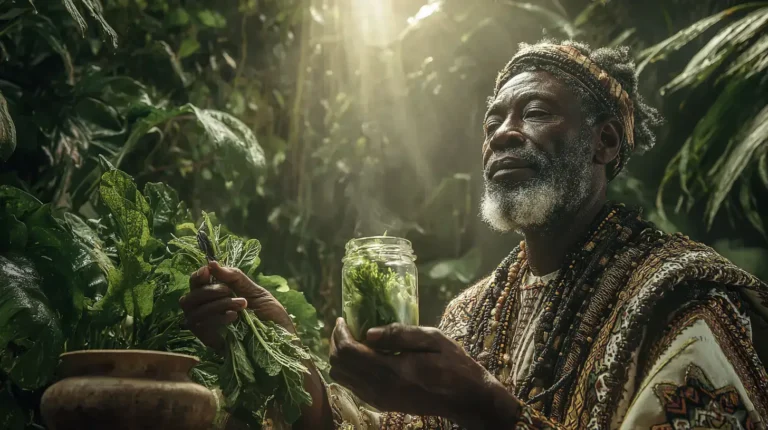
The Babalawo (literally “father of secrets”) is the initiated divination priest trained to perform Ifá readings. A Babalawo’s training is extensive, covering mastery of hundreds of Odù verses, herbal medicine, ritual performance, and the broader spiritual philosophy of Yoruba cosmology. Knowledge passes through apprenticeship and oral tradition rather than formal academic credentials. The role has historically extended beyond individual consultations: Babalawos have served as counselors on political decisions, arbiters of community disputes, and guides through major life transitions, placing health and life-path guidance within a relational, communal context rather than a purely private one.
Sacred Tools: Ikin, Ọpẹlẹ, and the Divination Tray
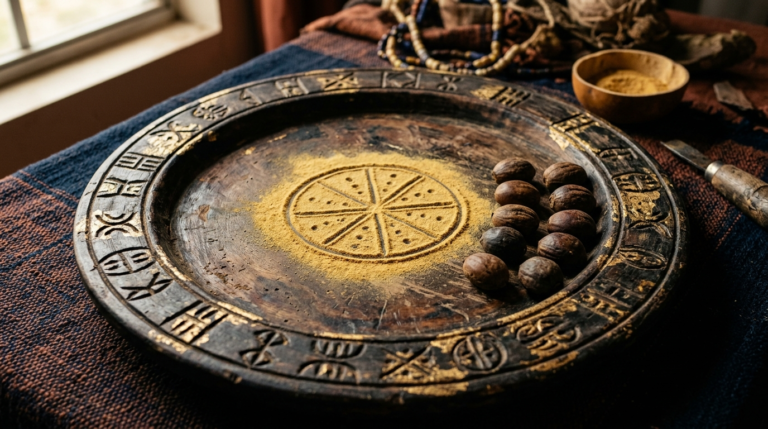
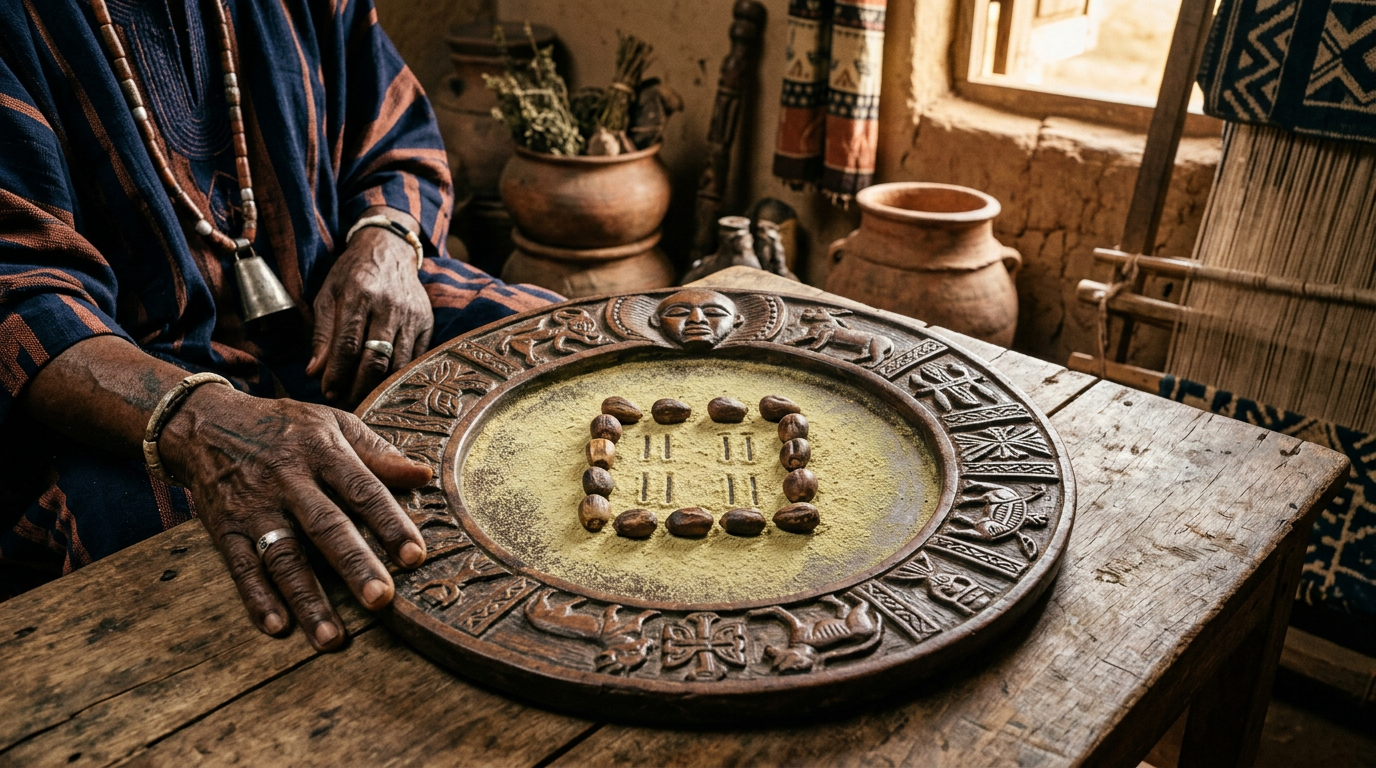
The physical objects of an Ifá consultation are precise and purposeful. The Babalawo casts either ikin (consecrated palm nuts) or the Ọpẹlẹ (a divining chain of eight lobes), noting the pattern that results. Each pattern corresponds to one of the 256 Odù. The result is marked on the Opon Ifá — the sacred divination tray — using Iyerosun, a fine yellow-ish wood dust. Simple tools. Remarkable precision. The marked sign then serves as the key that unlocks the relevant ese, which the Babalawo recites and interprets for the person seeking guidance.
Orí and Destiny: the Ifá View of Life-Path
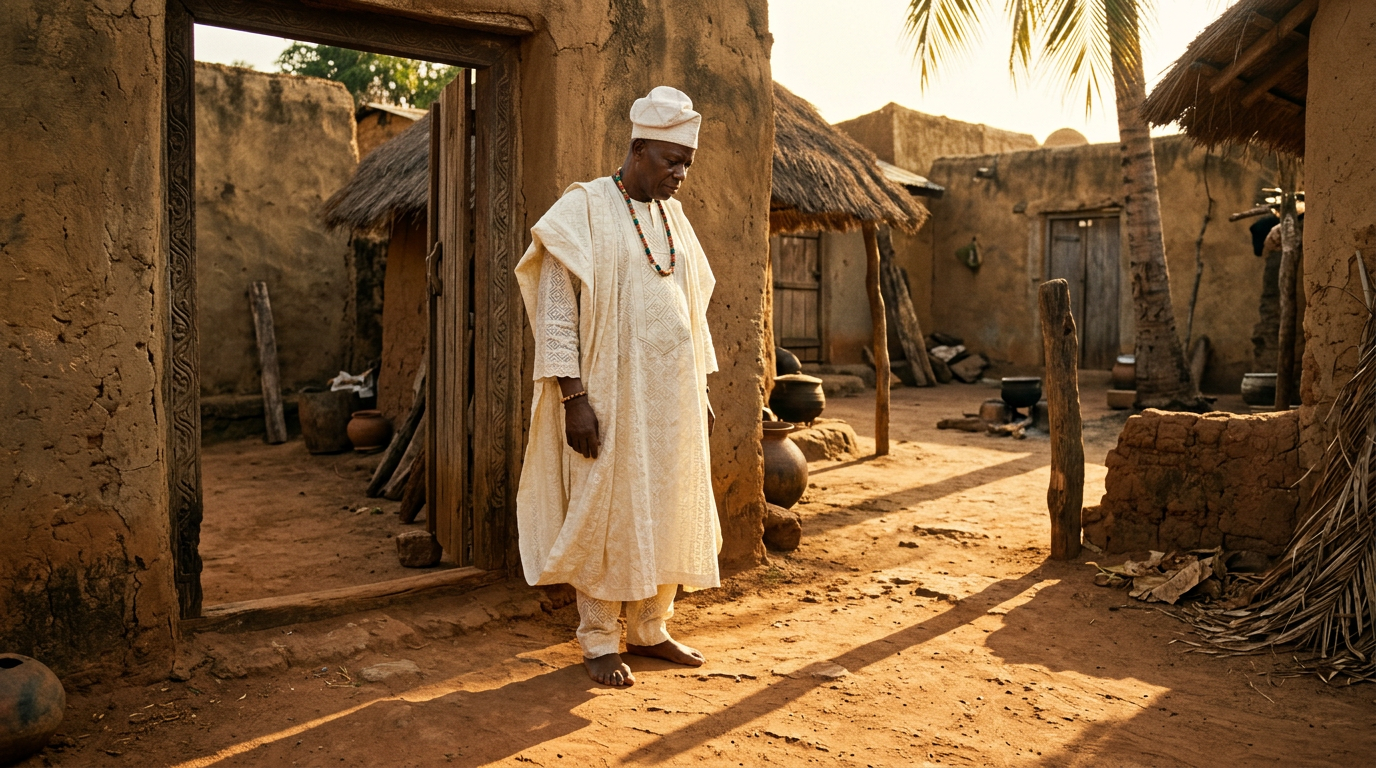
Ifá’s understanding of personal purpose begins with Orí, not with fate imposed from outside. In Yoruba philosophy, Orí (literally “head”) is the inner spiritual consciousness and seat of a person’s destiny — the core of human personality that guides all activity and choice. Before birth, according to Ifá teaching, each person chooses their own Orí, selecting the destiny they will live. This pre-birth choice is not a curse or a fixed sentence but a chosen path, and the task of life is to align one’s actions with that chosen direction.
Understanding orí as Inner Consciousness
Orí functions as both the spiritual essence of the individual and as a personal deity — one that practitioners regard as more intimately connected to their lives than any external Òrìṣà. The Yoruba understanding frames Orí as intrinsically tied to destiny: you cannot separate who a person is from the direction their life is drawn to take. For this reason, before any other Òrìṣà is invoked in a consultation, Orí is acknowledged. Life-path guidance in Ifá is, at its root, the work of helping a person understand, re-contact, and honor their own deepest self.
How Odù Ifá Reveals Personal Purpose
When a Babalawo casts for life-path guidance, the Odù that appears does not deliver a predetermined future. Rather, it surfaces a narrative context — a story drawn from the tradition’s vast corpus — that the querent and Babalawo interpret together as it applies to the person’s specific situation. The 256 Odù, each carrying hundreds of ese, offer an enormous repertoire of human situations, ethical dilemmas, and archetypal outcomes. Finding one’s Odù is less like receiving a verdict and more like being handed a detailed map, with the Babalawo’s interpretive help showing which roads are most relevant to where you currently stand.
How Ifá Addresses Health and Well-Being
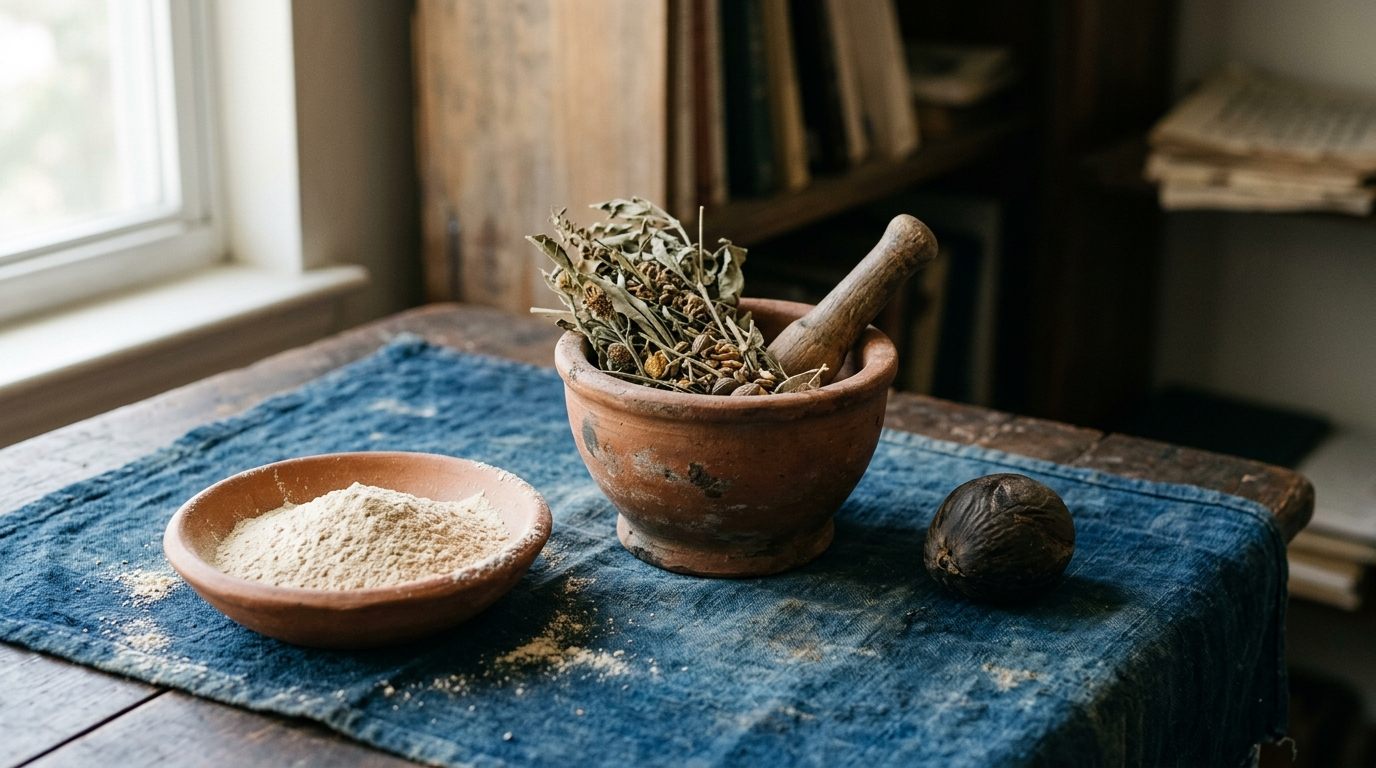
Ifá’s engagement with health is not a secondary feature added onto a primarily spiritual system. Practitioners frame Ifá as functioning simultaneously as a system of holistic medicine, preventive medicine using medicinal and dietary means, and a social system of ethics, psychology, and metaphysics — a self-description that reflects the tradition’s genuinely integrated view of the person rather than the compartmentalized model most Western wellness frameworks inherit.
The Holistic Model: Body, Mind, and Spirit
Within the Yoruba healing tradition, illness is understood as a condition of cosmic imbalance. Scholars who study Yoruba healing commonly note that ìwàpẹ̀lẹ́ (a state of measured composure and balance) describes both a moral and a physiological ideal. Herbal preparations exist alongside ritual prescription because, within the tradition, an herb’s healing power depends on its ritual activation, on the àṣẹ (vital force) brought to it by proper practice. A Babalawo assessing a health concern may ask about relationships, work, spiritual obligations, and diet in the same breath because the tradition does not recognize a clean boundary between those categories. Physical symptoms are read as messages from a larger system, not just mechanical failures in isolated tissue.
ẸBọ, Herbal Remedies, and Ritual Healing
When a divination session prescribes Ẹbọ (offering or spiritual prescription), practitioners understand it as the tradition’s mechanism for restoring balance, clearing blockages, and creating the conditions for destiny to unfold. That framing comes from inside the tradition itself, and it is worth holding as such rather than forcing it into an external diagnostic category. Crucially, Ẹbọ takes many forms. A prescription may involve dietary changes, specific prayers, a particular herbal preparation, charitable acts, or communal ritual. The full range spans the quietly personal to the ceremonially elaborate. Understanding Ẹbọ and spiritual offerings in Ifá as a spectrum prevents the misreading that every prescription involves dramatic sacrifice — a misreading that has distorted popular understanding of the tradition for generations.
The Connection Between Òrìṣà and Physical Health
In many Ifá lineages, specific Òrìṣà are associated with particular healing domains. Oshún is widely cited in connection with fertility and women’s health; Obaluaye with infectious and skin diseases; Yemoja with maternal health and the wellbeing of children. These associations vary across lineages and diaspora communities, so no single mapping should be treated as universal. What remains consistent is the structural logic: different Òrìṣà embody different dimensions of natural and human life, and the role of Òrìṣà in Yoruba spiritual practice means that addressing a health concern often involves understanding which Òrìṣà governs the affected domain and what relationship the person holds with that Òrìṣà.
What to Expect During an Ifá Consultation
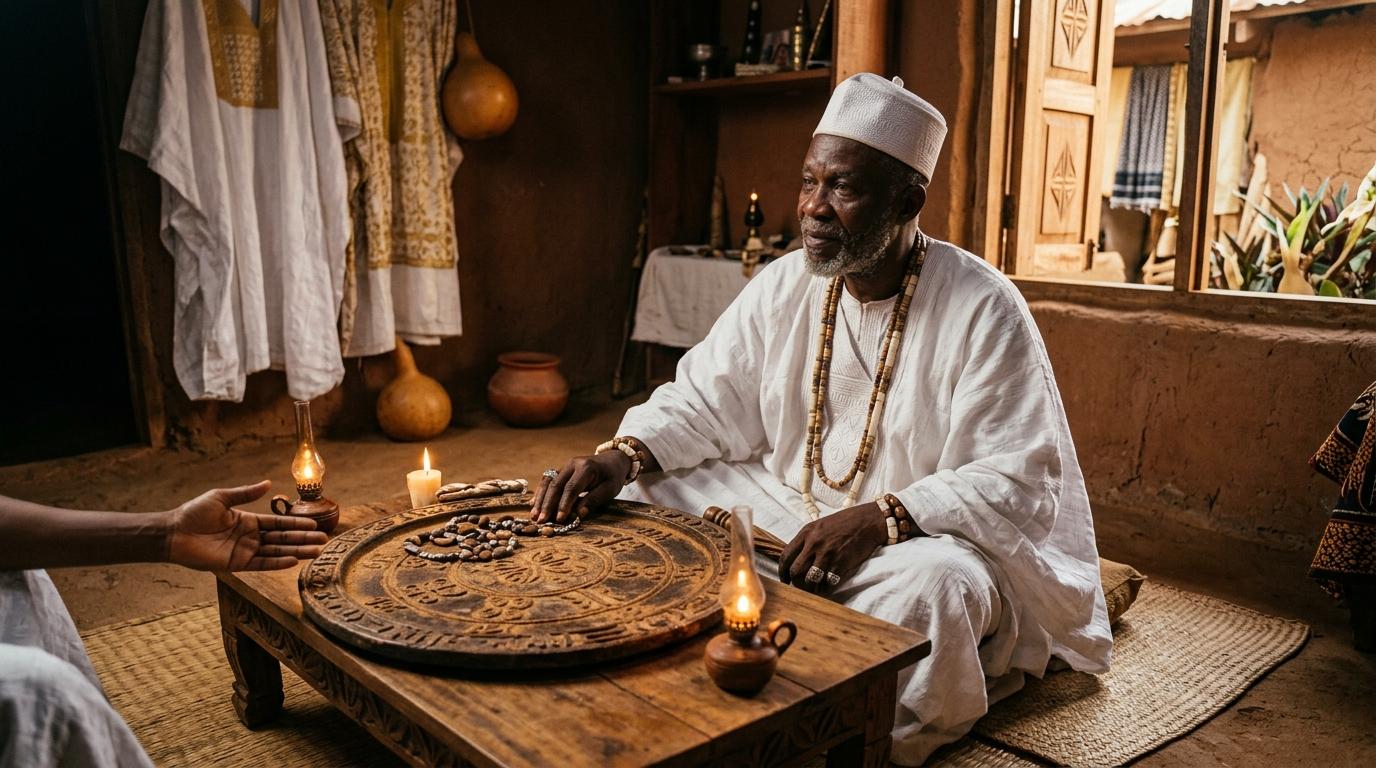
An Ifá consultation is a collaborative, conversational process that typically moves through invocation, casting, Odù identification, verse recitation, and prescription. Knowing that structure before you arrive removes most of the anxiety first-time seekers bring into the room.
Preparing for a Session
No elaborate preparation is required. Come with a clear sense of what you are asking about — a health concern, a crossroads decision, a persistent pattern you can’t resolve — because the more specific your question, the more useful the Odù’s narrative framework will be to your situation. Some practitioners request that querents abstain from alcohol the night before or arrive without certain foods consumed, but these specifics vary by lineage and Babalawo. The essential preparation is mental: bring honesty about what you are actually seeking, not what you think the appropriate question should be.
There is no performance expected of you. You observe, respond when asked, and reflect.
The Divination Process Step by Step
The session opens with prayers and invocations that acknowledge Orí, Ọrunmila (the Òrìṣà of wisdom who embodies Ifá), and the ancestors. The Babalawo then casts either ikin or the Ọpẹlẹ and studies the resulting Odù pattern. From there, the Babalawo recites ese relevant to your question. Sometimes several verses from different sub-sections of the Odù are recited and their significance explained. The conversation is real: you are not a passive recipient of pronouncements. Finally, if the Odù indicates it, the Babalawo prescribes Ẹbọ. The full session for a serious life-path or health question can run ninety minutes or considerably longer, depending on what the Odù surfaces and how much interpretive dialogue is needed.
Ifá Guidance in Everyday Life
Ifá divination functions best as an ongoing practice of alignment rather than a one-time crisis intervention. A single consultation can clarify a great deal — but the Odù surfaced in that session continues to carry meaning for the weeks and months that follow.
Applying Odù Wisdom to Daily Decisions
Each Odù carries ethical prescriptions and prohibitions, known as eewọ, that function as practical daily guidelines. A person whose consultation surfaces a particular Odù may be advised to avoid certain foods, pursue specific practices, or be alert to certain relational patterns. These guidelines are not arbitrary restrictions; each has a narrative logic within the corpus that connects it to the outcomes described in the relevant ese. Practitioners who engage daily with these prescriptions describe the experience less as constraint and more as calibration. In other words; a steady process of bringing choices into alignment with a known direction.
Maintaining Alignment with Your orí
Maintaining alignment with Orí is, in practical terms, the long work of Ifá practice. Regular consultation is part of that — annually or at major life transitions are common rhythms — but daily attention to Orí can be as simple as prayer, reflection before major decisions, or periodic conversation with one’s Babalawo about patterns that have emerged since the last formal reading. Because Yoruba philosophy holds that the relationship between a person and their Orí can strengthen or weaken depending on how one lives, ongoing practice has tangible stakes. Neglecting Orí is understood not as metaphorical neglect but as a genuine drift from one’s own deepest purpose.
Common Misconceptions About Ifá and Health
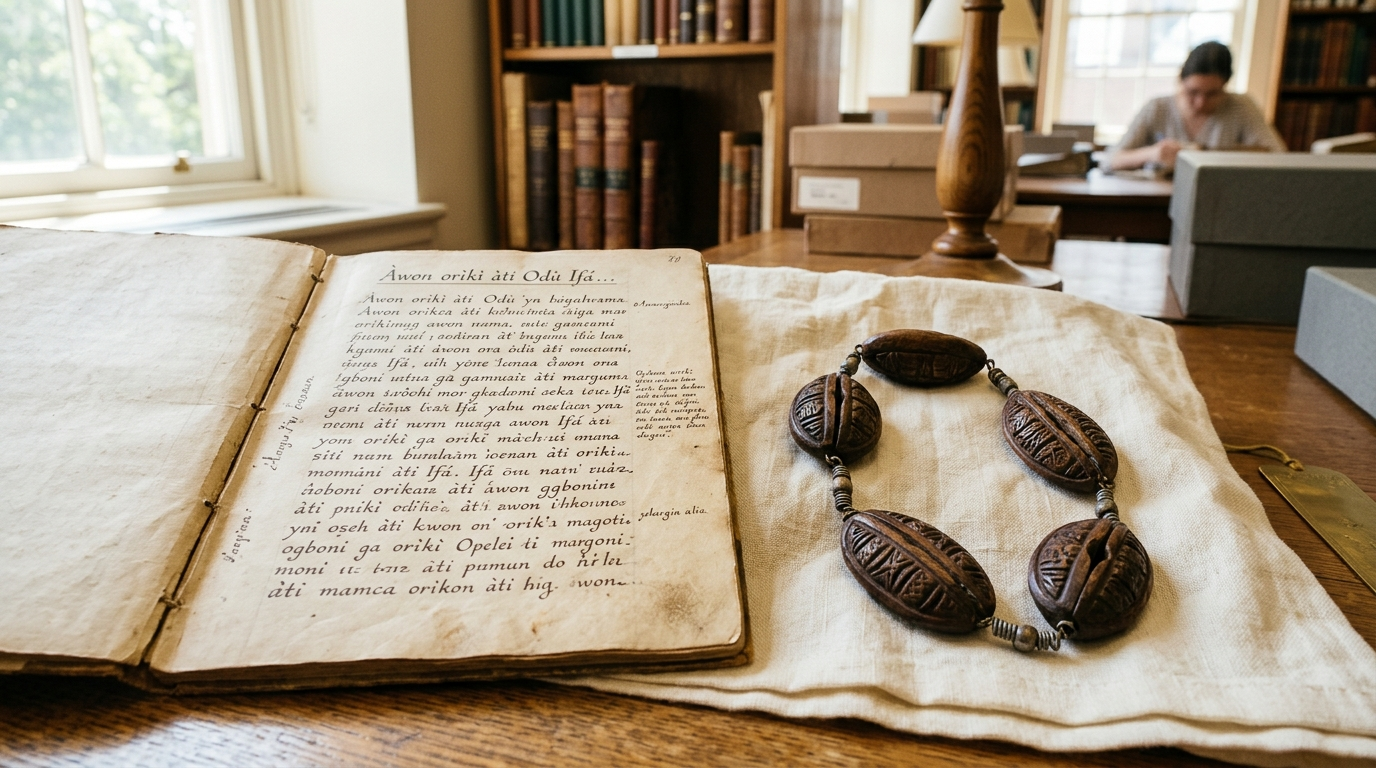
Misconceptions about Ifá persist largely because colonial-era missionary writings and administrative records became the dominant English-language sources on Yoruba religion — and those sources were not written in good faith. Colonial missionaries and administrators routinely labeled African spiritual systems, including Ifá, as devil worship, fetishism, or primitive superstition. Those characterizations were strategic distortions, designed to delegitimize indigenous knowledge systems and ease the project of cultural conversion. Post-colonial scholars of African religion — building on work like that of Wándé Abímbọ́lá, who holds the title of Àwísẹ Awo Àgbàyé (global ambassador of Ifá) — have worked extensively to document and counter these misrepresentations.
The most common misconception in health contexts is that Ifá prescriptions are magical thinking disconnected from physical reality. In practice, Ifá’s herbal pharmacopoeia is vast and has been studied by researchers interested in traditional African medicine. Another persistent confusion conflates Ifá with spirit possession practices, witchcraft, or simple fortune-telling. Ifá works through an extensive literary corpus and precise interpretive procedures — it is categorically distinct from any of those categories, as the foundational guide to Ifá divination makes clear. The system produces ethical guidance, not supernatural performances.
Ifá is also not, as sometimes framed by well-meaning outsiders, a “primitive” version of psychotherapy or a quaint cultural alternative to medicine. That framing misses the tradition’s sophistication entirely. The 256 Odù and their hundreds of ese constitute a philosophical and literary system of extraordinary complexity — one that UNESCO recognized as among humanity’s most significant intangible heritage, a designation earned on the same grounds as other world literary traditions.
Beginning Your Journey with Ifá
Finding a Trusted Babalawo
Lineage, training, and character all matter in identifying a trustworthy Babalawo. Initiatory lineage in Ifá is not ornamental — it connects a practitioner to a line of transmission that carries both knowledge and accountability. Ask about a Babalawo’s training lineage and how long they have practiced. Established community organizations within Yoruba traditional religion, as well as personal recommendations from practitioners you already trust, are more reliable starting points than internet searches alone. Finding a Babalawo or Ifá consultation services through a known community resource is the most direct path to a trustworthy first experience.
Expect to pay for a consultation. Babalawos have undergone years of demanding training, and their knowledge is not symbolic — it is professionally earned.
Ifá as a Complement to Modern Health Practices
Ifá and biomedical healthcare operate from different knowledge frameworks, and practitioners in both traditions can respect the other’s domain. Consulting a Babalawo about a health concern does not require abandoning a doctor. Many people who engage with Ifá continue conventional medical treatment for diagnosed conditions while also seeking Ifá guidance on the relational, spiritual, and psychological dimensions of illness that biomedical models typically set aside. The two approaches address different questions about the same person. Viewing this as two knowledge systems in dialogue rather than a hierarchy with one superior to the other reflects both the depth of Ifá’s own self-understanding and the lived practice of many contemporary seekers.
Where to Go from Here
Ifá divination for health and life-path guidance is not a shortcut or a supplement. It is a complete system for understanding the person — their physical condition, their relational world, their chosen destiny, and the daily choices that bring those into alignment or into conflict. Beginning a relationship with this tradition means accepting that depth. Show up with an honest question, find a trustworthy Babalawo, and approach the Odù that surfaces with the seriousness it deserves. The system will meet you there.