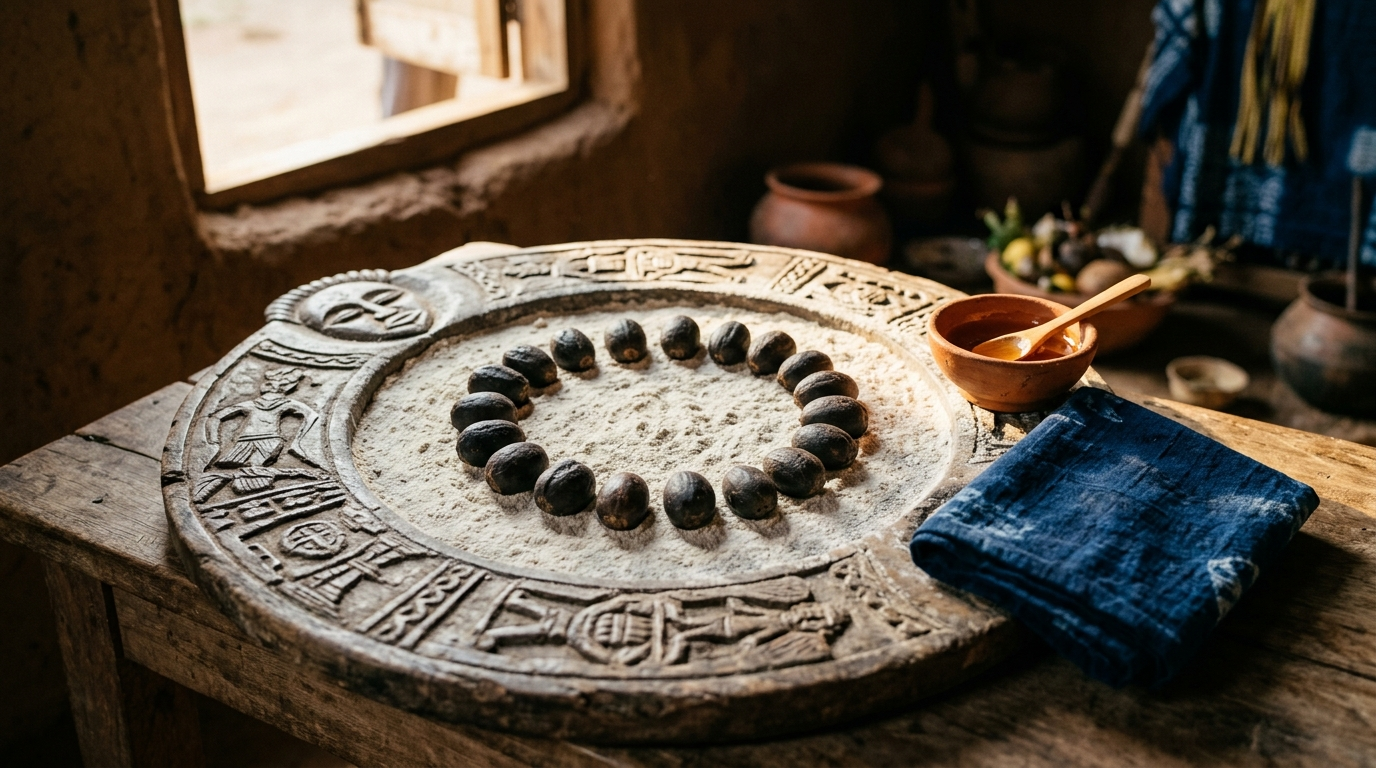
Ẹbọ in Yoruba Tradition: Offering, Sacrifice, and Spiritual Alignment
Most people who encounter the word “sacrifice” in a religious context carry assumptions shaped by centuries of mistranslation and deliberate misrepresentation. When those assumptions meet Ẹbọ, the Yoruba practice of offering and sacrifice, they almost always produce the wrong picture. This guide corrects that picture. Drawing on Ifá theology, practitioner sources, and the 256 Odù that constitute the living Ifá corpus, it explains what Ẹbọ actually is, why it exists, how it works, and what it demands of those who practice it honestly.
What Is Ẹbọ? Understanding Offering and Sacrifice in Yoruba Thought
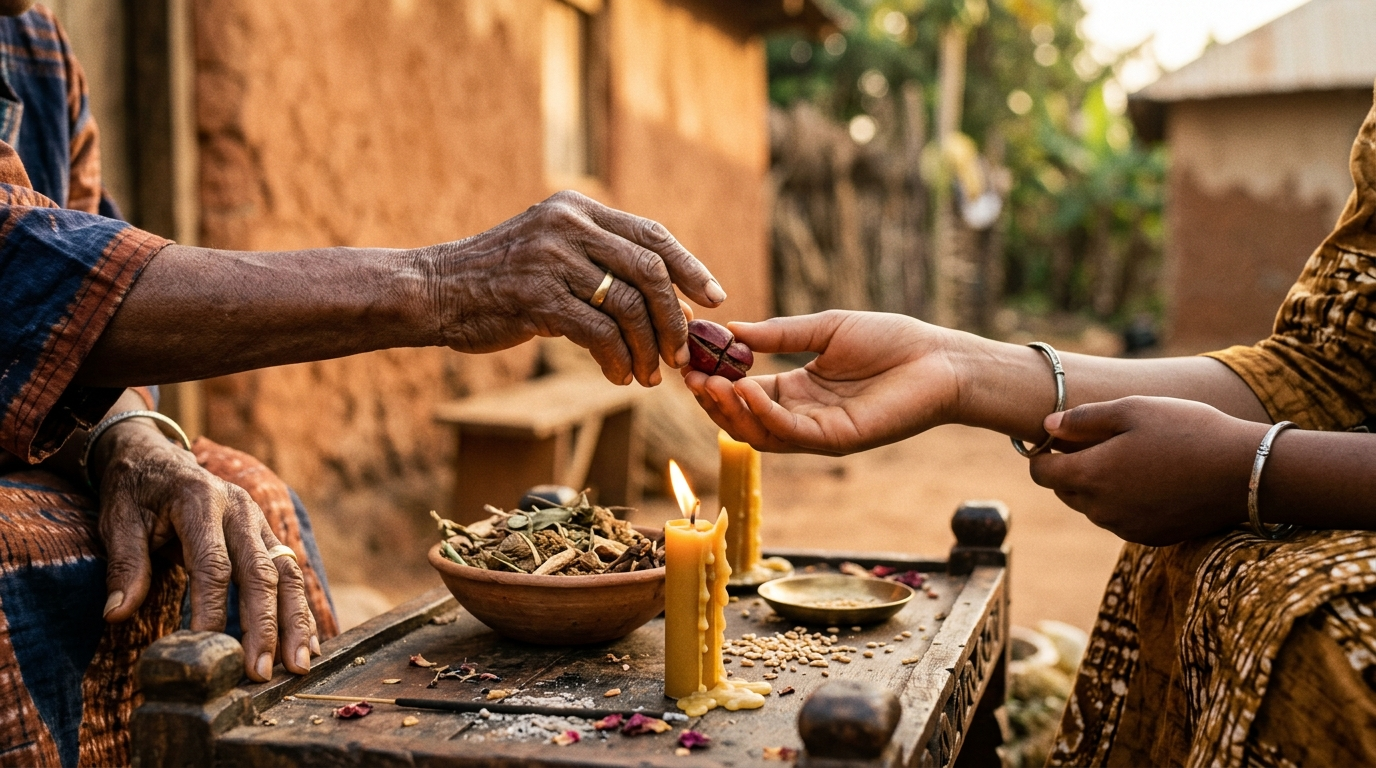
Ẹbọ is not simply sacrifice. The word carries a weight of meaning that its English translations consistently fail to hold.
The Literal and Spiritual Meaning of Ẹbọ
The Yorùbá word ẹbọ translates literally as “offering” or “sacrifice,” but that translation is barely an entry point. At its core, Ẹbọ embodies reciprocity — the recognition that life is a continual exchange of energy between human beings, ancestors, and the divine. To perform Ẹbọ is to participate consciously in that exchange, not to make a one-time payment and walk away.
Practitioner organizations across the tradition describe Ẹbọ as fundamental to Ifá precisely because it reinforces the principle that everything in the natural world is connected. Nothing thrives in isolation. When a person performs Ẹbọ, the act is understood to serve not only the individual but the larger web of relationships that person inhabits — family, community, lineage, cosmos. This relational framing is not incidental. It is the theological center of the practice.
Ẹbọ as Communication Between the Visible and Invisible Worlds
Ẹbọ operates as a form of dialogue across what Yoruba cosmology identifies as two interpenetrating realms: Aiyé (the visible, material world) and Òrun (the invisible, spiritual world). Physical offerings serve as vehicles — they carry intention, prayer, and àṣẹ (divine life-force) from the practitioner into a domain that human hands cannot reach directly.
Èṣù-Ẹlégbára occupies a structurally indispensable role in this process. As the divine messenger who moves between worlds, Èṣù ensures that an Ẹbọ reaches its intended destination. An offering made without acknowledging Èṣù is, in the tradition’s own formulation, an undelivered letter — prepared, sealed, but never received. This is why Èṣù is addressed first in virtually every ritual context, regardless of which Òrìṣà is the primary focus of the Ẹbọ.
Why Western Translations of “Sacrifice” Fall Short
The English word “sacrifice” carries a semantic history rooted primarily in Abrahamic contexts — appeasement, atonement, substitutionary punishment, the placation of an angry god. None of these concepts map cleanly onto Ẹbọ. They import a transactional logic and a theology of divine displeasure that is foreign to Yoruba thought.
Colonial-era missionary writing systematically reframed African sacrificial practices through this distorting lens, portraying Ẹbọ as primitive appeasement or, worse, as evidence of paganism that required correction. That framing was not accidental — it was ideological. Understanding Ẹbọ correctly requires setting it aside entirely and engaging the practice on its own terms.
The Philosophical Foundation of Ẹbọ in Ifá
Ẹbọ is not a ritual tacked onto the edge of Yoruba spiritual life. It is anchored in a specific cosmological logic that gives the practice its meaning and its necessity.
Reciprocity, Balance, and the Cosmic Order
Yoruba cosmological thinking is built on continuity and reciprocity among the living, the ancestors, and the yet-to-be-born. This is not a linear framework aimed at salvation or punishment in some final judgment; it is a circular, relational understanding of existence in which every being participates in maintaining balance. Ẹbọ is one of the primary mechanisms through which that balance is maintained and restored.
The IFA Foundation describes this plainly: Ẹbọ reflects the “normal give and take of life” — the kind of reciprocity that sustains any living relationship. A tree is watered. An ancestor is honored. A path is cleared. These are not dramatic acts of atonement. They are the ongoing maintenance of a relationship that would otherwise wither.
Ẹbọ and the Concept of Àṣẹ
Àṣẹ is the divine life-force given by Olódùmarè (the supreme divinity) that flows through all things — Òrìṣà, ancestors, nature, and humanity alike. Ẹbọ activates and channels àṣẹ. When an offering is properly prepared and presented with correct intention, prayer, and ritual knowledge, it functions as a concentrated point of àṣẹ that realigns the practitioner with their spiritual path and with the forces that govern their life.
This is why practitioners consistently emphasize that the physical materials in an Ẹbọ are not the point in themselves. A piece of fruit, a candle, an animal — these are vehicles. The àṣẹ they carry depends on the knowledge, intention, and relationship that surrounds them. Without those elements, the materials are just objects.
The Relationship Between Ẹbọ, Orí, and Destiny
Orí — literally “head” in Yorùbá — refers to the spiritual intuition and personal destiny that an individual chose before entering this life. Yoruba tradition holds that each person selects their destiny in Òrun before birth, but the challenges of Aiyé can lead a person out of alignment with that chosen path. Ẹbọ can be directed specifically to Orí to restore that alignment — to call a person back to the life they came here to live.
The concept of Orí and personal destiny in Yoruba tradition is its own rich subject, but its connection to Ẹbọ is direct and important: sacrifice in this tradition is never merely about external powers. It is also about recovering the self. That dimension gives Ẹbọ a psychological and existential depth that purely transactional readings completely miss.
Types of Ẹbọ in Yoruba Tradition
Ẹbọ is not one practice. It is a family of practices, each serving a distinct purpose within the practitioner’s spiritual life. While taxonomies vary across lineages and diaspora contexts, practitioners commonly recognize several functional categories.
Ẹbọ Ọpẹ́: Offerings of Gratitude
Gratitude is not an afterthought in Yoruba spiritual practice — it is a spiritual act. Ẹbọ Ọpẹ́, offerings of thanksgiving, are performed when a blessing has arrived, a prayer has been answered, or a favorable turn has held. When Ifá divination reveals a positive sign (Iré), the Ẹbọ prescribed reinforces and fortifies that good fortune, ensuring the practitioner honors what has been given rather than taking it in silence.
This category matters because it reshapes the entire frame of how Ẹbọ is understood. A tradition in which gratitude is ritualized and formalized is not a fear-based tradition. It is a tradition built on relationship maintenance — the same logic that leads a person to write a thank-you letter, return a favor, or show up consistently for people who have shown up for them.
Ẹbọ Ètùtù: Propitiatory Sacrifice
Ètùtù is a propitiatory or cleansing sacrifice, offered when forces of imbalance, disruption, or harm are at work. When divination reveals the Odu speaks of challenges, Ẹbọ is prescribed to avert or mitigate that difficulty. Ètùtù specifically addresses situations where a relationship with a divine force, an ancestor, or the community itself has been disrupted and requires active restoration.
It’s worth being precise here: ètùtù is sometimes used interchangeably with ẹbọ in everyday speech, and some practitioners draw sharp distinctions between the two terms while others treat them as overlapping. HARPER’s taxonomy above reflects a common working framework, not a universal schema. The specific application in any given case is always determined by the Odù revealed in divination, not by a generic category name.
Ẹbọ for Prevention, Healing, and Restoration
Some Ẹbọ are preventive — offered not because something has gone wrong but because divination has identified a vulnerability or obstacle on the path ahead. Others address healing: physical illness, emotional fragmentation, broken relationships, spiritual blockages. Restoration Ẹbọ rebuild what has been damaged — a practitioner’s relationship with their Orí, their Òrìṣà, or their community.
Widely cited practitioner sources describe a recognized category called Àdìmù — devotional food offerings made regularly to Òrìṣà or ancestors — and a fuller category, Ẹbọ Rirú, which encompasses complete ritual sacrifice. These are not separate traditions so much as different approaches to achieve a desired result within the same continuum of giving.
Communal and Seasonal Ẹbọ
Ẹbọ is not exclusively a private practice. Communities, villages, and lineage groups perform collective Ẹbọ at significant seasonal moments — planting, harvest, transitions in leadership, the honoring of founding ancestors. These communal offerings reinforce the social fabric of the group, acknowledge collective debts to the ancestors, and orient the community as a whole toward favorable outcomes in the season ahead.
The communal dimension is easily lost in Western individualist approaches to spirituality. Yoruba tradition does not make that separation cleanly. An individual’s health and fortune are understood as embedded in the health and fortune of their community, and communal Ẹbọ makes that interdependence explicit and actionable.
How Ẹbọ Is Prescribed Through Ifá Divination
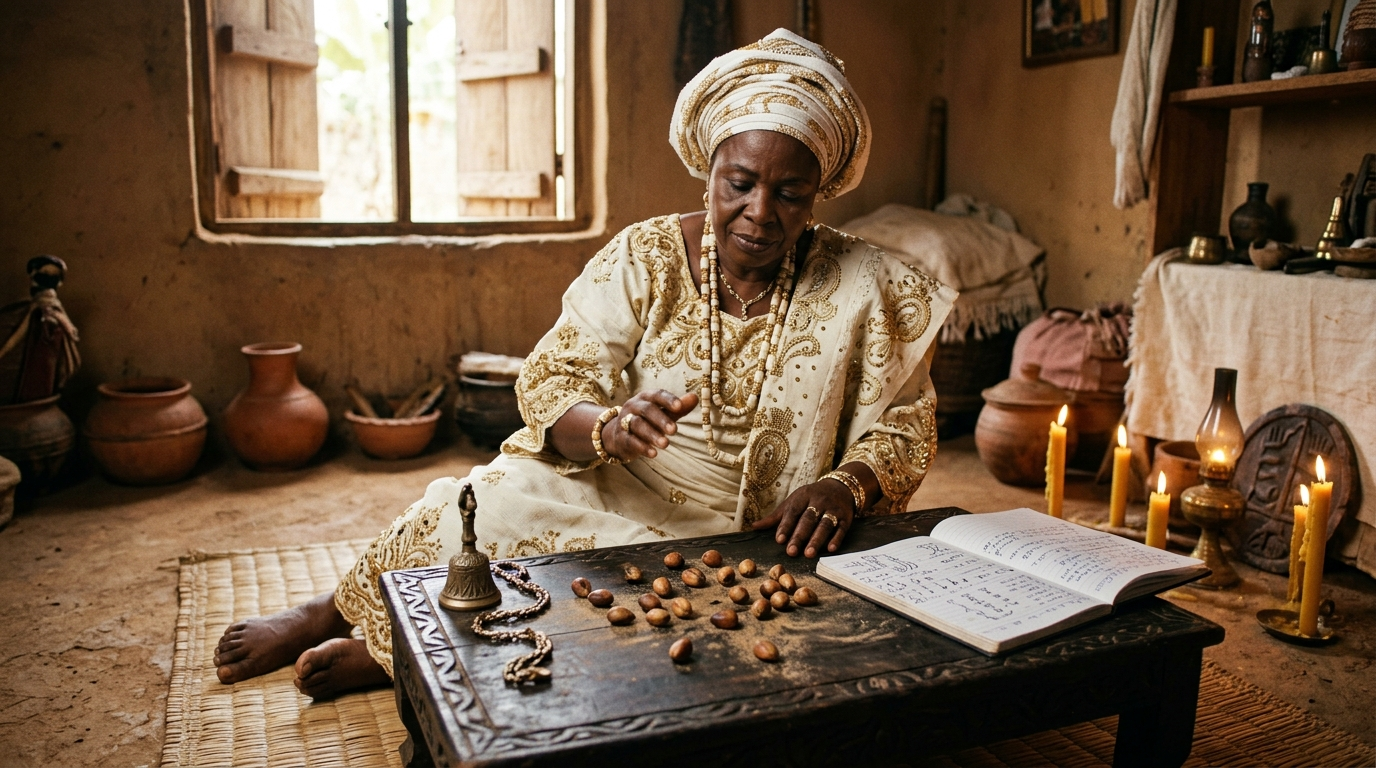
Ẹbọ is never self-prescribed. It emerges from a divination process — a structured spiritual consultation that surfaces the relevant Odù and its prescriptions.
The Role of the Babaláwo or Iyanifá in Prescribing Ẹbọ
The Babaláwo (literally “father of mysteries”) and the Iyanifá (female Ifá priestess) are trained specialists whose primary function is to interpret the Odù that appears during consultation and to prescribe the appropriate response — including Ẹbọ. Their training involves decades of memorizing thousands of verses from the Ifá literary corpus, learning the specific materials, timing, and ritual procedures associated with each Odù’s prescriptions.
The authority of the Babaláwo and Iyanifá to prescribe Ẹbọ is not a matter of personal power or charisma. It is a function of their mastery of the Odù, their relationship with Ifá as a living tradition, and the lineage transmission they carry. A valid prescription requires all three. The question of whether Iyanifá hold the same prescriptive authority as Babaláwo is contested between some traditional Nigerian lineages and diaspora communities — this is an ongoing conversation within the tradition, and no single answer can be universalized here.
How Odù Determines the Nature and Materials of Ẹbọ
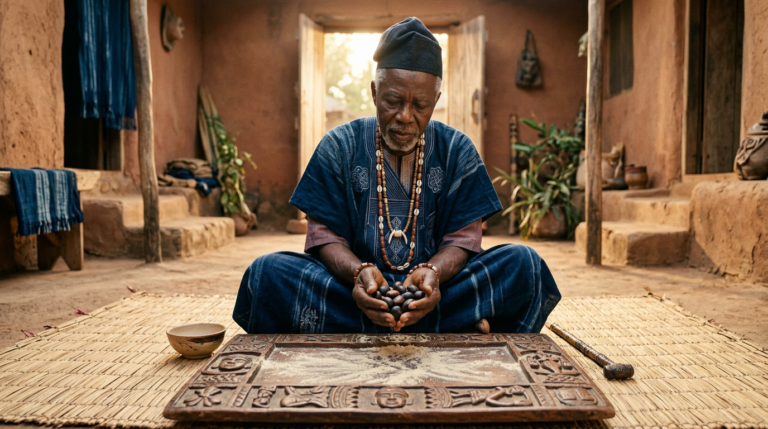
The Ifá divination process and how it works is described in detail elsewhere on this site, but its relationship to Ẹbọ is essential to name clearly. The Ifá literary corpus comprises 256 Odù, each containing hundreds of verses (Ẹsẹ̀ Ifá) with narratives, proverbs, and specific prescriptions. When the Babaláwo or Iyanifá casts the Opele (divining chain) or Ikin (sacred palm nuts) and an Odù is revealed, that Odù’s texts determine what Ẹbọ is needed: which materials, which Òrìṣà or ancestral force is addressed, the timing, the location, and the prayers to accompany it.
Understanding Odù and their meanings is a lifetime’s study. The key point for practitioners encountering Ẹbọ for the first time is this: no legitimate Ẹbọ is improvised from personal preference. Every element traces back to an Odù. That rootedness in text and tradition is precisely what distinguishes authentic Ẹbọ from spiritual tourism or magical thinking.
Reading the Signs: When Ẹbọ Is Accepted or Must Be Repeated
The divination process does not simply end when the Ẹbọ is performed. Experienced practitioners read a range of signs to determine whether an offering has been received: the behavior of the materials during preparation, the outcome of subsequent divination, changes in the client’s circumstances, or specific signs that an Odù identifies as confirmation. When an Ẹbọ has not been accepted — whether because of incomplete preparation, improper materials, or a misidentified Odù — the appropriate response is to return to divination and address the gap, not to escalate the offering arbitrarily.
This feedback loop is significant. It means Ẹbọ is embedded in a system of discernment, not blind ritual performance. The tradition has mechanisms for error correction built in.
Materials, Preparation, and the Ritual Process
The physical dimension of Ẹbọ is real and specific. Certain materials carry particular symbolic and àṣẹ-bearing properties; the manner of preparation and placement is as deliberate as the offering itself.
Common Items Used in Ẹbọ and Their Symbolic Significance
Ẹbọ materials span a wide range: foods, herbs, animals, metals, natural elements, and crafted objects. Each item is selected for its àṣẹ — the specific energetic quality it carries in relation to the Odù and the Òrìṣà or forces being addressed. Honey carries sweetness and is associated with Ọṣun. Palm oil channels the warmth and protective power connected to Ògún. Kola nut (obi) is used across traditions as an offering of respect and a medium for reading ancestral affirmation.
Animals, where prescribed, are not chosen randomly. Each species is associated with specific Odù and Òrìṣà, and the animal’s life-force is understood to serve as a concentrated àṣẹ transfer. The solemnity with which this is approached in tradition stands in direct contrast to how sensationalist media coverage typically presents it.
The Importance of Intention, Prayer, and Orin (Song)
The physical materials are the visible layer of Ẹbọ. The invisible layer — which practitioner sources consistently describe as equally essential — is composed of intention, àdúrà (prayer), and orin (ritual song). Without these, the most carefully assembled physical offering carries no àṣẹ forward.
Prayer activates the personal relationship between the practitioner and the force being addressed. Song encodes the tradition’s accumulated wisdom in a form that resonates beyond verbal communication. Intention aligns the practitioner’s Orí with the purpose of the offering. Together, these three elements transform physical materials into a genuine act of communication.
Where Ẹbọ Is Placed and Why Location Matters
Location in Ẹbọ is not incidental. Offerings are placed at crossroads (associated with Èṣù), in rivers (associated with Ọṣun), at thresholds, in forests, at ancestral shrines, or on specific altars depending entirely on what the Odù prescribes. The crossroads, in particular, is a threshold between Aiyé and Òrun — a point of maximum spiritual permeability where an offering can pass most readily into the invisible world.
The material world, in Yoruba cosmology, is organized in ways that map onto spiritual geography. Knowing where to place an Ẹbọ is not superstition; it is applied cosmological knowledge.
Ẹbọ and the Òrìṣà: Strengthening Sacred Relationships
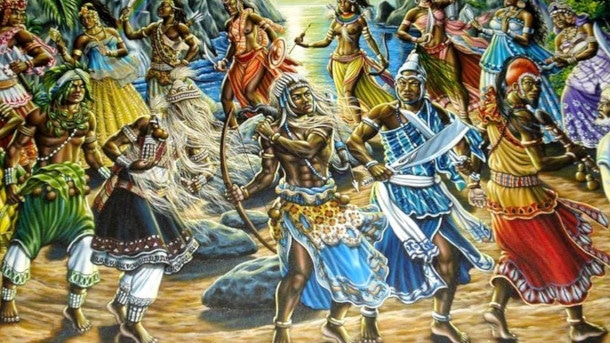
Every Òrìṣà in Yoruba tradition maintains particular relationships with specific materials, foods, colors, rhythms, and expressions of Ẹbọ. These associations are not arbitrary — they encode each Òrìṣà’s nature, history, and domain within the cosmos.
Offerings Specific to Individual Òrìṣà
An introduction to the Òrìṣà belongs elsewhere, but the connection to Ẹbọ must be stated here: the identity of the Òrìṣà determines the form of the offering. Ọṣun receives honey, yellow cloth, and river offerings. Ògún receives palm oil, iron implements, and foods associated with strength. Ṣango receives red cloth, rams, and objects connected to lightning and power. Obàtálá receives white foods, snails, and offerings marked by clarity and cool energy.
When an Odù reveals that a specific Òrìṣà requires attention — whether for alignment, gratitude, or propitiation — the Ẹbọ prescribed will be calibrated to that Òrìṣà’s nature. This is why the generalized notion that “any offering will do” misses the point entirely. Ẹbọ is precise because relationships are precise.
How Ẹbọ Deepens Devotion and Spiritual Connection
Performing Ẹbọ consistently and correctly deepens a practitioner’s relationship with their Òrìṣà over time. This is not metaphorical. The cumulative effect of years of intentional offering, prayer, and attentiveness creates a channel — a relationship with texture, history, and momentum. Practitioners describe this not as dependency but as mutual recognition: the Òrìṣà responds more readily to someone who has shown up consistently, and the practitioner becomes more capable of perceiving and receiving that response.
Ẹbọ, in this light, is devotional practice. It is the equivalent of maintaining any meaningful relationship through consistent, intentional presence.