
Ọṣun Òrìṣà: Rivers, Love, Fertility, and Feminine Power
She is called Yèyé — great mother — and her presence is felt wherever sweet water moves. This article covers Ọṣun's cosmological identity, her sacred river, her governance of love and abundance, her authority over feminine spiritual power, her living festival in Òṣogbo, her survival in the diaspora, and how a devotee approaches her today. Whether you are arriving at Ọṣun's name for the first time or deepening a devotional relationship, what follows is grounded in Yorùbá tradition and the Ifá literary corpus.
Who Is Ọṣun? Understanding the Òrìṣà of Sweet Waters
Ọṣun is the Yorùbá Òrìṣà of love, sexuality, fertility, fresh water, purity, wealth, prosperity, and beauty — and by most accounts, one of the most widely venerated of all the Òrìṣà. A quick note on that word: Òrìṣà does not translate neatly as "goddess" in the Greek-pantheon sense. Òrìṣà are divine emanations of Olódùmarè (the supreme being in Yorùbá cosmology) who govern specific forces within creation, relate to human beings through devotion and initiation, and carry Àṣẹ — the dynamic spiritual authority that animates all things.
Ọṣun's Place Among the Òrìṣà
Ọṣun's position within the Yorùbá cosmos is not supplementary. Widely cited accounts describe how Olódùmarè sent either sixteen or seventeen Irúnmọlẹ̀ (primordial divine beings) to make the earth habitable. Ọṣun was the only woman among them. The male divinities excluded her from their deliberations. Every effort they made failed — crops would not grow, children would not come, rain would not fall. Only when they returned to seek her cooperation did creation proceed. The count of sixteen versus seventeen Irúnmọlẹ̀ varies across lineage traditions and should be understood as one of those places where oral tradition holds multiple valid versions; what is consistent across accounts is Ọṣun's indispensability to the entire enterprise.
Names, Praise Names, and Epithets of Ọṣun
Among Ọṣun's most recognized praise names (oríkì) is Òre Yèyé Ọṣun — "the good mother Ọṣun." Yèyé functions as an honorific title meaning "great mother," affirming her role as a divine maternal force rather than merely a maternal metaphor. Each oríkì is a theological claim made active through vocalization — an invocation calling a specific dimension of her Àṣẹ into the present moment. Other common epithets address her as the one who carries a fan of brass, the owner of rivers, and the one whose medicine is honey. These titles are not decorative; they encode doctrine. Yorùbá praise poetry and oríkì as a genre deserves its own study, and Ọṣun's oríkì are among the tradition's most richly layered.
Ọṣun in Odù Ifá
Ọṣun appears across multiple Odù in the Ifá literary corpus, particularly in Ọṣẹ Méjì and Ìrosùn Méjì — understanding Odù Ifá and their teachings is essential background here. In these bodies of verse, Ọṣun is invoked as healer, as the force that restores fertility and flow when conditions have stagnated, and as the one who mediates between human suffering and divine remedy. Some lineage traditions describe a warrior dimension to Ọṣun as well, the Ọṣun who carries a sword alongside her mirror — though this facet is preserved more explicitly in certain lineage teachings than in others and should be approached with guidance from an initiated elder.
Ọṣun and the Sacred River: Water as Àṣẹ

Ọṣun and the Osun River are not merely associated — she is the river, in the sense that the water carries her Àṣẹ directly. Understanding why fresh water holds this place in Yorùbá spiritual thought unlocks something fundamental about how Ọṣun works in the lives of her devotees.
The Ọṣun River and Its Spiritual Geography
The Osun River originates in Ekiti State in southwestern Nigeria, extends approximately 267 kilometers southward through Yorùbá territory, and its banks near Osogbo constitute the earthly domain and principal sanctuary of Ọṣun. According to tradition, Ọṣun granted the founders of Osogbo permission to build their city beside her river on one condition: faithful and continuous worship. That covenant is not merely history. It frames the relationship between the people of Osogbo and the river as a living spiritual contract. Tradition holds that this covenant also motivates the community to protect the river from pollution — an indigenous ecological ethic encoded in devotional practice long before the language of environmental stewardship existed.
Water as Life Force in Yorùbá Thought
Fresh water in Yorùbá cosmology is not a neutral resource. It lives. It purifies, transmits, and sustains Àṣẹ. It carries prayers downstream and returns blessings to those who honor its source. Still, moving, shallow, deep — each quality of water corresponds to a spiritual state. Ọṣun's domain is specifically sweet water — rivers, streams, the drinkable and life-giving, not the salt ocean, which belongs to Olókun. That distinction matters. Ọṣun governs what nourishes: what enters the body, what feeds the crop, what fills the womb.
Ọṣun as the Mother of Fertility, Love, and Abundance
Ọṣun's domains are sometimes flattened into a single category — "love goddess" — and that reduction misses almost everything interesting. Her authority over fertility, love, and abundance is layered, specific, and theologically coherent.
Fertility Beyond the Physical: Children, Creativity, and Prosperity
Fertility, in Ọṣun's care, means more than childbearing. It names any condition of generativity: the creative work that brings something new into the world, the prosperity that makes a household flourish, the healing that restores a depleted body or spirit. Ọṣun is called upon by those seeking children, yes. She is also called upon by artists, merchants, healers, and anyone whose capacity to produce has run dry. The root is the same — the Àṣẹ of generation.
Children are considered her most sacred gift.
And yet the tradition is clear that she does not give them cheaply. The covenant with Ọṣun — in childbearing, in creative life, in prosperity — requires reciprocal faithfulness. Devotees who receive abundance from her are expected to honor the relationship through continued offerings and gratitude, not merely petition in a moment of need.
Ọṣun and Romantic Love in Yorùbá Culture
Ọṣun governs the full complexity of love: attraction and longing, the tenderness between partners, the heartbreak that follows betrayal, and the sweetness of reconciliation. Her Odù verses narrate love not as a sentimental abstraction but as a relational force with real consequences — for individuals, families, and communities. Certain Ifá verses describe Ọṣun herself as navigating love's difficulties with dignity, which is why she is so often called upon in matters of the heart. Her capacity for love is inseparable from her capacity for power.
She does not simply bless romance. She governs its terms.
Ọṣun's Connection to Wealth and Honey
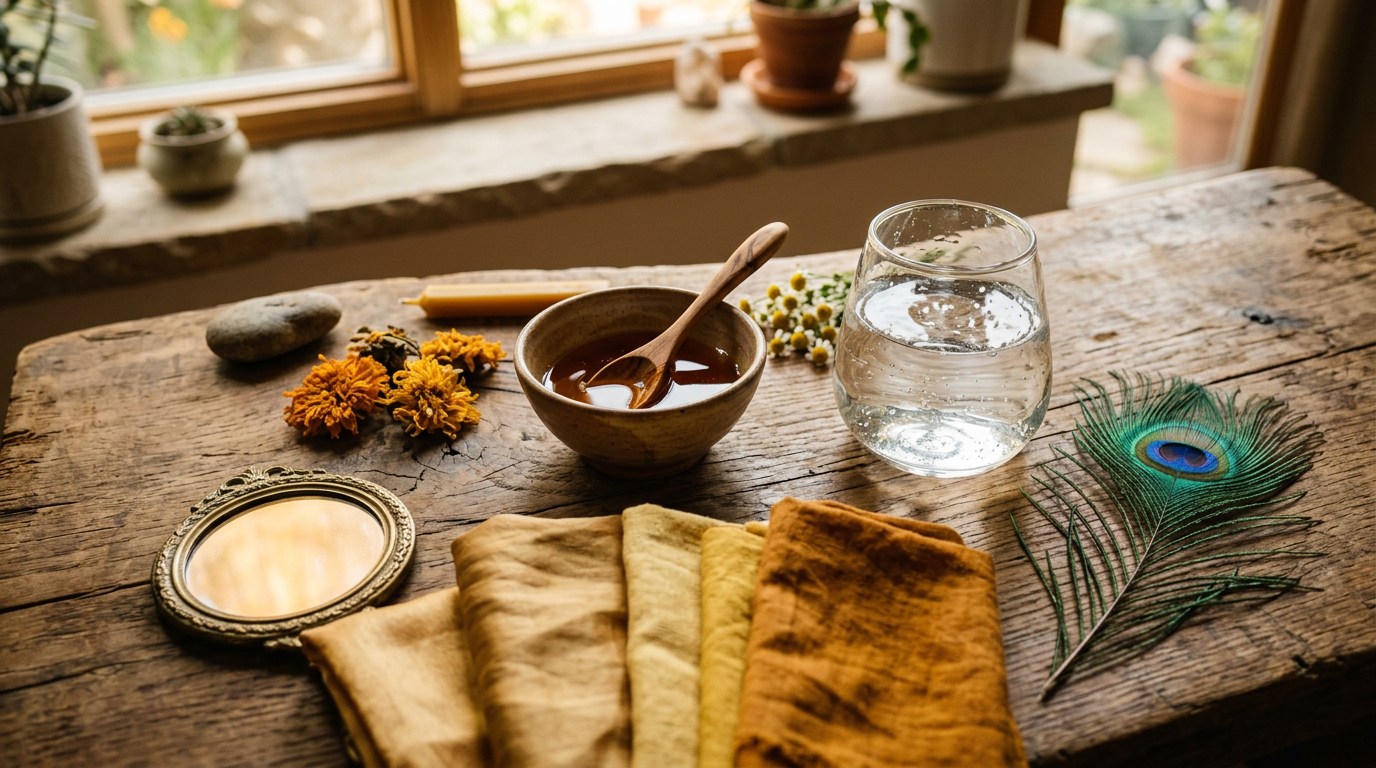
Brass, gold, and amber are Ọṣun's metals and colors. Mirrors reflect her clarity. Honey is her quintessential offering across every tradition that honors her — Yorùbá homeland practice, Cuban Lucumí, Brazilian Candomblé. The ritual of tasting honey before presenting it to Ọṣun (to confirm it has not soured) encodes a precise ethical principle: nothing deceptive, nothing bitter, nothing false belongs in her presence. Sweetness here is not mere pleasantness. It is sincerity made tangible. Peacock feathers appear among her symbols in certain diaspora traditions particularly, and their presence should be understood in that context. Wealth in Ọṣun's domain is not separated from beauty or purity — they arrive together, or not at all.
Ọṣun and Feminine Power: Àjẹ́, Ìyámi, and the Authority of Women
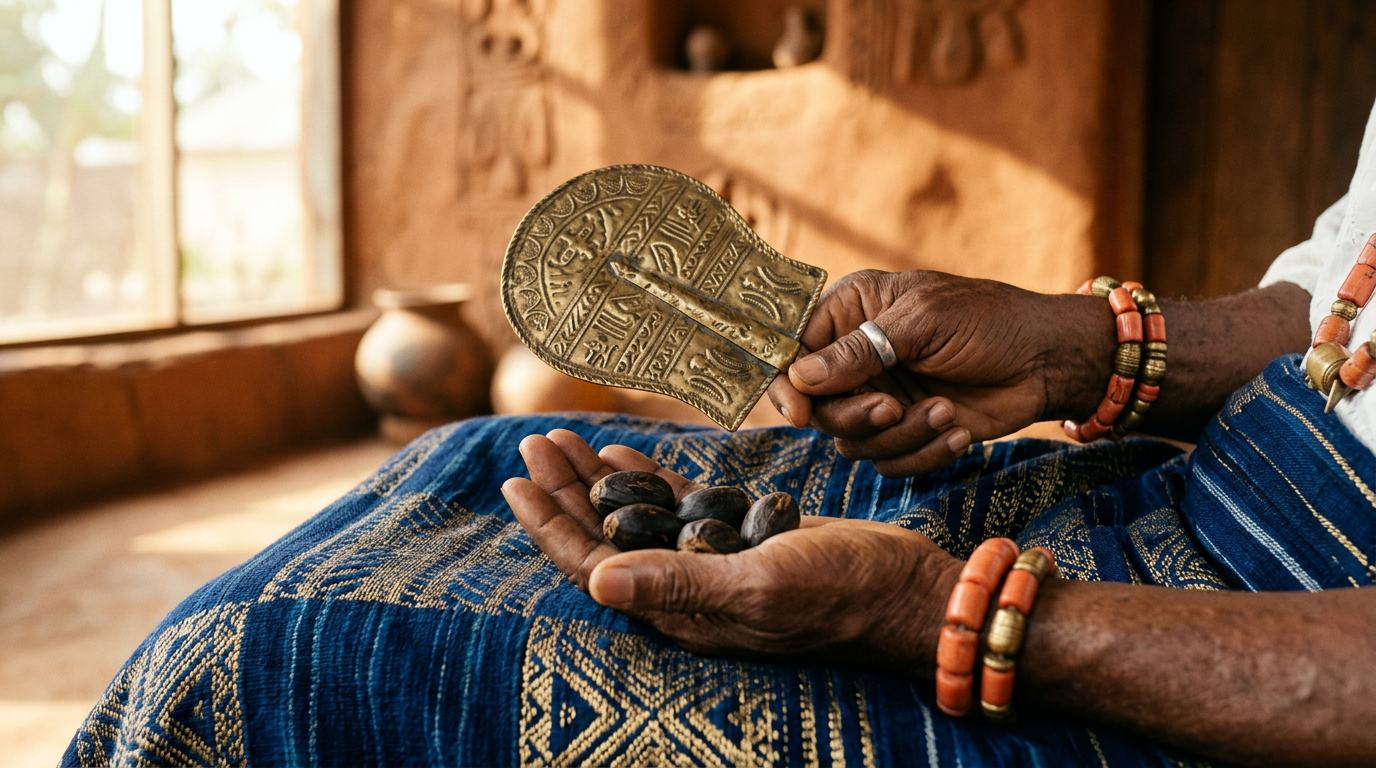
Ọṣun holds authority over feminine spiritual power in Yorùbá cosmology because she is the only woman among the original Irúnmọlẹ̀ and the recognized head of the Ìyámi Àjẹ́, the primordial collective of feminine forces. These two facts are not separate — together they form the tradition's foundational argument that feminine Àṣẹ is not supplementary to cosmic order but constitutive of it.
Ọṣun as the Only Woman Among the Original Irúnmọlẹ̀
The myth is worth sitting with carefully. When the male Irúnmọlẹ̀ (sixteen or seventeen in number, depending on lineage tradition) excluded Ọṣun from the work of creation, they were not just being rude. They were attempting a cosmological experiment: could the universe function without feminine Àṣẹ? The answer the tradition gives is unambiguous — it could not. Nothing grew. Nothing lived. Nothing held its form. This narrative is a tradition-internal theological argument: feminine spiritual authority is not a courtesy extended by male power, but a structural requirement of creation itself. That is a strong claim. The Ifá corpus makes it plainly.
The Relationship Between Ọṣun and the Àjẹ́
Tradition-grounded accounts identify Ọṣun as the head and leader of the Ìyámi Àjẹ́ — the primordial feminine powers in Yorùbá cosmology. The Ìyámi Àjẹ́ (sometimes rendered as Ìyámi Òṣòròngà) are described across practitioner-facing sources as forces who carry deep Àṣẹ and govern spiritual and societal equilibrium on behalf of Olódùmarè. They are not marginal figures — they govern life's most fundamental processes. It was Ọṣun's organized refusal to cooperate with the male Irúnmọlẹ̀, representing the Ìyámi, that forced cosmic acknowledgment of feminine authority. The Àjẹ́ in contemporary discourse is sometimes mischaracterized as purely fearsome or dangerous; within Ifá tradition, they are better understood as powerful forces whose alignment is essential and whose displeasure is consequential.
Feminine Àṣẹ in Yorùbá Cosmology
Àṣẹ — divine power or authority — is not gendered in the sense of being male or female as a default. But within Yorùbá cosmological thought, certain dimensions of Àṣẹ are identified as particularly feminine in character: the power of the womb, the authority of the mother, the capacity to withhold or bestow life. Ọṣun is the embodiment and custodian of this feminine Àṣẹ. To honor her is, among other things, to honor the legitimacy of women's spiritual authority in tradition — not as a modern political project but as a cosmological fact the Ifá corpus has always carried.
The Ọṣun-Òṣogbo Festival: Living Tradition and UNESCO Heritage

The Ọṣun-Òṣogbo Festival is one of the clearest demonstrations that Ọṣun's veneration is not an antiquarian subject. It is a living, collective, annually renewed covenant between a community and its Òrìṣà.
History and Significance of the Annual Festival
The festival is a two-week event held each August, culminating in a grand procession through the streets of Osogbo to the Sacred Grove on the banks of the Osun River. The procession is led by the Ataoja of Osogbo — the traditional ruler of the city — and the Arugba, a young virgin maiden selected to carry the sacred calabash of offerings to Ọṣun's shrine within the grove. The Arugba's role is both ritual and symbolic: she embodies the community's collective petition, carrying its prayers and gratitude on her head to the river's edge. Tens of thousands of devotees attend annually, drawn from Nigeria and from diaspora communities across the Americas, Europe, and beyond.
The Sacred Grove of Ọṣun-Òṣogbo
The Ọṣun-Ọṣogbo Sacred Grove — a dense forest of approximately 75 hectares on the outskirts of Osogbo, dotted with shrines, sculptures, and artworks honoring Ọṣun and other Òrìṣà — was inscribed as a UNESCO World Heritage Site in 2005, recognized as one of the last remnants of primary high forest in southern Nigeria. Sacred groves once adjoined nearly every Yorùbá settlement, but urbanization eliminated most of them. The Ọṣun-Ọṣogbo grove is now the last surviving example of this tradition in Yorùbá culture, which accounts for the particular intensity of feeling it carries for the global Yorùbá diaspora. The grove's path to UNESCO recognition included a period of serious neglect in the mid-twentieth century — shrines abandoned, priests dispersed under colonial pressure — followed by a community-led revival that restored and expanded the artworks and ritual spaces. The survival of the grove is a story about Yorùbá custodianship and resilience; the community's agency in that revival is the heart of the story.
Ọṣun in the Diaspora: Continuity and Transformation
When Yorùbá people were enslaved and transported across the Atlantic, they carried their spiritual world with them. Ọṣun survived.
Ọṣun in Cuban Lucumí and Brazilian Candomblé Traditions
In Cuban Lucumí (also called Santería or La Regla de Ocha), Ọṣun is venerated as Ochún. In Brazilian Candomblé, she is Oxum. Both traditions preserve her core domains — love, rivers, fertility, beauty, sweetness — and both maintain honey as her primary offering. What changed, as Yorùbá spiritual practice adapted to the conditions of the Caribbean and South America, were the specific ritual forms, the calendar contexts, and in some cases the syncretic layering with Catholic saints that enslaved practitioners used as protective camouflage. Those syncretic associations (Ochún with Our Lady of Charity in Cuba, for instance) are meaningful within those traditions and should be respected on their own terms. They are not, however, features of Yorùbá homeland practice or Ifá-centered tradition, and the two contexts should not be conflated. The diaspora forms demonstrate Ọṣun's Àṣẹ is portable. They are distinct living traditions, not inferior copies.
Reclaiming Ọṣun in African-Centered Spiritual Practice
Across the diaspora — and increasingly within Nigeria itself — practitioners are actively returning to Ifá-rooted, homeland-grounded understandings of Ọṣun, moving away from heavily syncretic framings toward the Yorùbá-language oríkì, the Odù verses, and the protocol of initiated lineages. This reclamation is both spiritual and political: it asserts that indigenous African religious knowledge is complete, sophisticated, and does not require translation into European religious categories to be valid. Ọṣun's Àṣẹ, in this context, becomes a lens through which practitioners of African descent reconnect with a heritage that was deliberately severed.
How to Honor Ọṣun: Offerings, Prayers, and Devotional Practice
Approaching Ọṣun requires preparation, sincerity, and ideally the guidance of someone who has walked this path before you. What follows is general orientation — not a complete ritual manual, and not a substitute for working with an initiated elder.
Traditional Offerings and Their Meanings
Honey is the offering most universally associated with Ọṣun. As noted above, the practice of tasting it before presenting it ensures that nothing sour reaches her — a ritual enactment of sincerity. Alongside honey, traditional offerings commonly include fresh river water, pumpkin, yellow and gold items, brass objects, mirrors, fans, and sweet foods such as àkàrà (bean cakes) prepared with care. Offerings are typically brought to the river's edge or to a consecrated altar. Each item is not arbitrary — it corresponds to a specific dimension of her Àṣẹ, and the tradition carries reasons for each. Those reasons are best learned in relationship with a lineage holder.
Oríkì and Prayers to Ọṣun
Oríkì (praise poetry and epithets) are the primary liturgical language of Ọṣun's worship. Reciting her oríkì is not performance — it is invocation. Each line names a quality, recalls a mythic event, or addresses her directly. Òre Yèyé Ọṣun — good mother Ọṣun — is perhaps the phrase most devotees know first. Academic work on Ọṣun's oríkì, including peer-reviewed research published through the Dergipark journal portal, confirms the phonetic and semantic precision of these epithets, each one preserving a distinct theological claim within the tradition. In devotional practice, oríkì may be recited aloud at the river, at an altar, or during festival observance. The voice itself is the instrument.
Approaching Ọṣun with Reverence and Proper Protocol
Ọṣun is, by tradition, a demanding presence in the most loving sense — she receives sincerity and she notices its absence. Approaching her requires cleanliness, a clear intention, and humility. Several practical orientations apply broadly: arrive at the river or altar with offerings prepared, not empty-handed; do not approach in a state of unresolved conflict or deception; and listen as much as you petition. That said, specific protocols — initiation requirements, taboos, the handling of particular ritual objects, the timing of specific ceremonies — vary by lineage and are not appropriately detailed in a general article.