Ṣàngó in the Diaspora: From Ọ̀yọ́ to Cuba, Brazil, and Trinidad
Few Òrìṣà have traveled as far, or survived as much, as Ṣàngó. From the royal courts of the Ọ̀yọ́ Empire to the terreiros of Salvador, the cabildos of Havana, and the feast grounds of Trinidad, Ṣàngó's veneration crossed the Atlantic under conditions of extraordinary violence — and arrived, recognizably intact, on three continents. This article traces that journey, section by section, comparing how each diaspora community received, adapted, and ultimately transformed a tradition that began with a king.
Ṣàngó in Ọ̀yọ́: The Historical and Spiritual Foundation
Ṣàngó as Alááfin and Òrìṣà
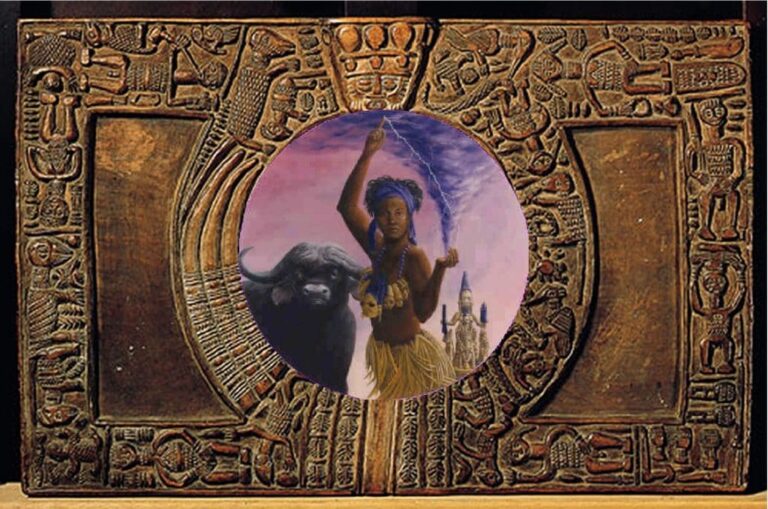
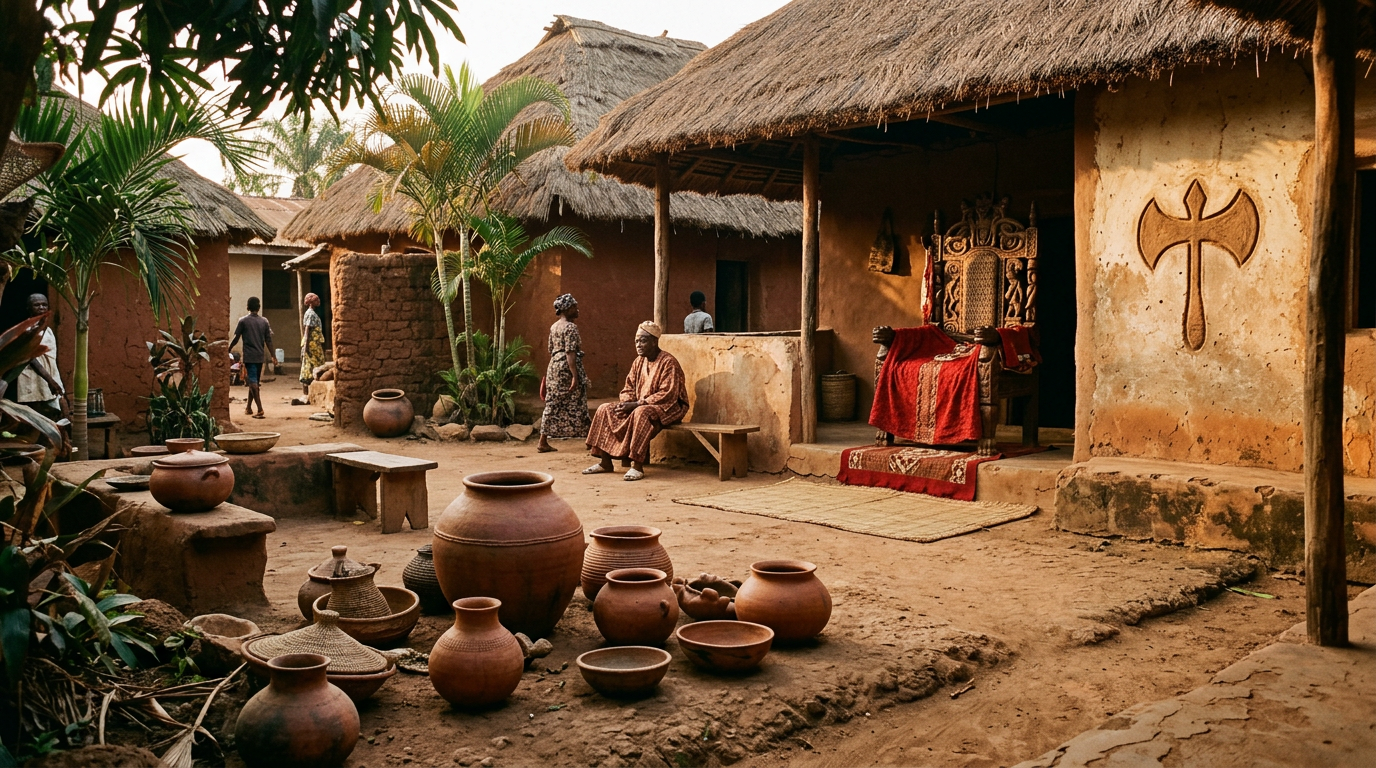
Ṣàngó was a historical king of the Ọ̀yọ́ Empire, deified after death as the Yorùbá òrìṣà of thunder, lightning, fire, and retributive justice. Oral tradition counts him as either the third or fourth Aláàfin of Ọ̀yọ́ — a discrepancy that is genuine within the tradition itself, not a scholar's error — and both counts circulate among informed practitioners and historians today. What neither version disputes is the trajectory: a powerful ruler, a dramatic death, and a transformation into one of the most widely venerated figures in the entire Yorùbá cosmos.
This pattern of deification is worth understanding on its own terms. Unlike cosmic òrìṣà who preceded creation, Ṣàngó belongs to a class of deified humans whose elevation reflects specifically Yorùbá mechanisms of ancestor veneration and political legitimation. In Yorùbá cosmology, becoming an òrìṣà is not a contradiction of one's humanity; it is its culmination.
The Role of Ṣàngó in Ọ̀yọ́ Statecraft and Cosmology
Ṣàngó embodied the fusion of sacred kingship and cosmic order within Ọ̀yọ́. Scholars working in the lineage of Wándé Abímbọ́lá's scholarship on Yorùbá religion commonly note that Ṣàngó functioned simultaneously as a political symbol of divine royal authority and as an object of communal veneration across the empire — meaning that loyalty to Ṣàngó and loyalty to the Ọ̀yọ́ state were, for much of the empire's history, inseparable categories.
This dual function had practical consequences. According to accounts documented in Nigerian cultural journalism and tradition-facing sources, devotees historically invoked Ṣàngó as a witness when swearing oaths of innocence, a practice that reflects his domain over retributive justice. Control over the Ṣàngó cult, including its priesthood and ritual calendar, was thus also a form of political control. When Ọ̀yọ́ began to collapse in the early nineteenth century, the cult's dispersal would carry some of that political weight across the Atlantic.
How Did Ṣàngó Devotion Survive the Middle Passage?
How Enslaved Yorùbá Carried Spiritual Knowledge
The Voyages: The Trans-Atlantic Slave Trade Database, as analyzed in a peer-reviewed study in the Journal of the Royal Statistical Society, records that during the collapse of the Ọ̀yọ́ Empire between roughly 1817 and 1836, an estimated 121,000 individuals from the Yorùbá-speaking region were transported as enslaved people — approximately 42% to Brazil and 40% to Cuba. Those numbers represent not only bodies forcibly removed from West Africa but entire liturgical systems, oral archives, and cosmological frameworks carried in human memory across the ocean.
Memory, in this case, was communal. No single person carried Ṣàngó's tradition; networks of kin, co-practitioners, and community elders transmitted prayers, drum patterns, initiation protocols, and sacred narratives collectively, often under conditions designed to destroy exactly that kind of cultural continuity.
The Conditions That Shaped Religious Continuity
What made survival possible — partially, imperfectly, but genuinely — was a combination of institutional structure, strategic adaptation, and sheer determination to keep practices alive. The form that survival took differed sharply between Cuba and Brazil, shaped by the legal, demographic, and religious conditions each community faced. Trinidad's trajectory was distinct again, for reasons addressed below.
The enslaved Yorùbá were not a homogeneous group. Captives arrived from Kêtu, Abeokuta, Ọ̀yọ́ itself, and dozens of other Yorùbá-speaking towns, each carrying regional inflections of shared religious practices. In diaspora communities, the work of consolidation — merging multiple lineages into coherent ritual systems — was itself an act of creative preservation, not mere replication.
Shangó in Lucumí: Cuba's Living Yorùbá Heritage
Liturgical Continuities With Yorùbá Practice
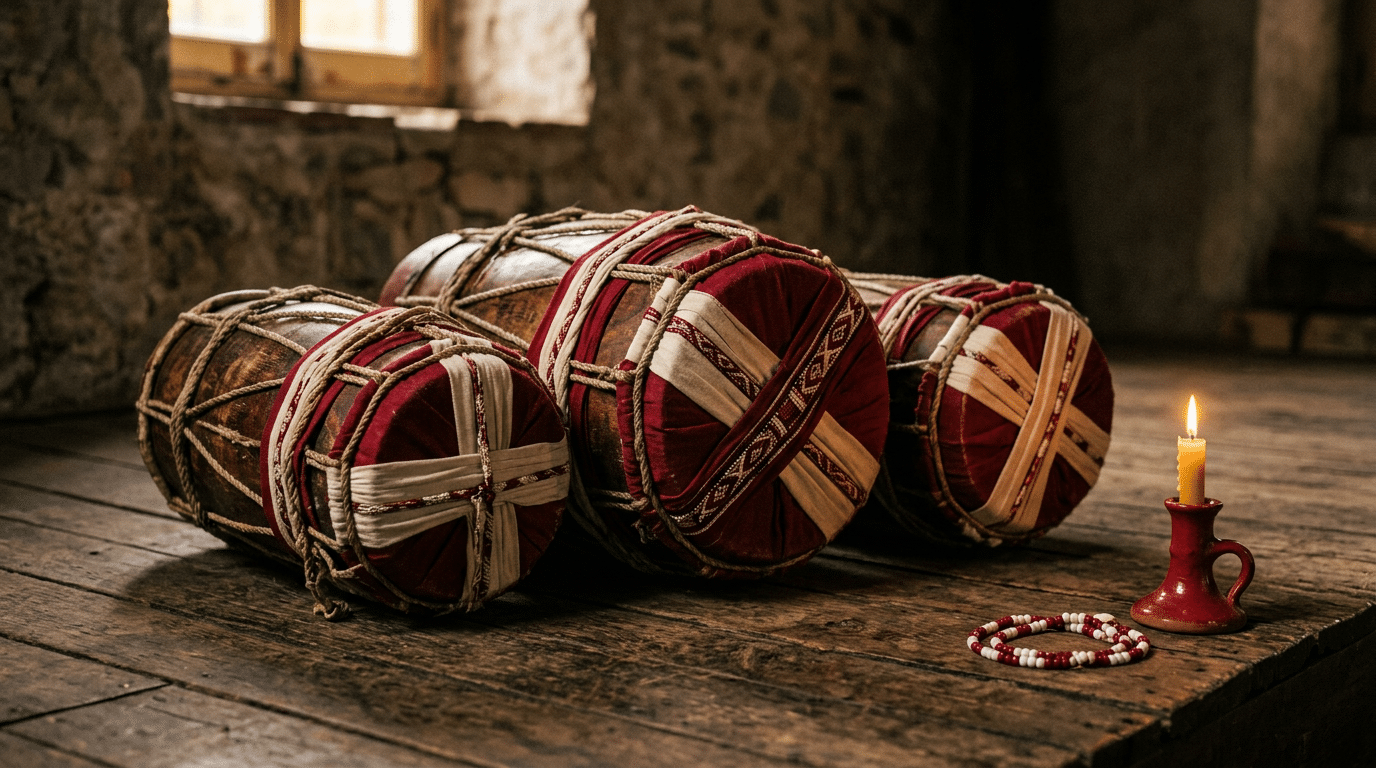
In Cuba, Yorùbá captives and their descendants formed ethnic mutual-aid societies called cabildos — organizations that provided the institutional framework for preserving Òrìṣà rituals, sacred drumming, oral literature, and liturgical Yorùbá language under conditions of enslavement. The religion that emerged from these structures, known as Lucumí or Regla de Ocha (and sometimes called Santería, though many practitioners reject that term as a colonial diminutive), retained key structural elements of Yorùbá practice: Òrìṣà worship, Ifá divination, initiation rituals, and the sacred batá drums. These were not surface survivals. They were load-bearing continuities.
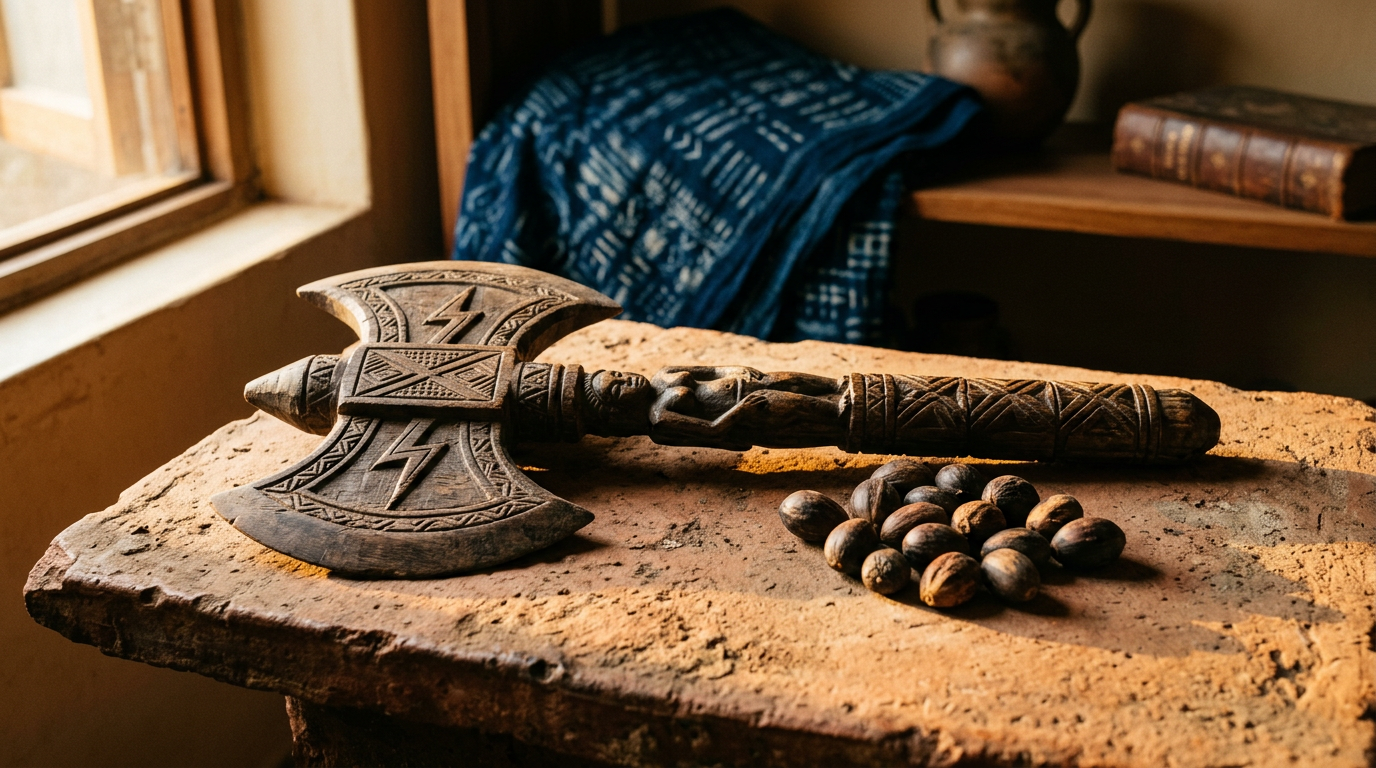
Ṣàngó arrived in Cuba as Changó and kept his core identity largely intact: lord of thunder and lightning, wielder of the double axe, avatar of justice. Liturgical chants in praise of Changó in Cuba still draw on Yorùbá-language formulas; the drum rhythms associated with his veneration trace directly to Ọ̀yọ́-rooted traditions.
Syncretism, Santa Bárbara, and Resistance
The identification of Changó with the Catholic martyr Santa Bárbara — whose feast day on December 4 became the primary occasion for his communal veneration across Cuba — is the most visible sign of Lucumí syncretism. The theological logic is tradition-internal: a patakí (sacred narrative) describes Ṣàngó disguising himself in Ọya's clothes, an image that resonated with Santa Bárbara's own iconography and her story of cross-dressed concealment.
The blended forms are better understood as a protective strategy under conditions of forced conversion than as a dilution of Yorùbá tradition. Practitioners used Catholic iconography as a public screen while maintaining internal Yorùbá liturgy. This was survival strategy and organic evolution operating simultaneously — a point scholars of syncretism in diasporic traditions have made with increasing precision over the past two decades. Some practitioners and scholars go further, arguing that the blended forms represent genuine theological development in their own right, not merely tactical concealment.
Xangô in Candomblé: Brazilian Expressions of the Fourth Alááfin
Nação Ketu and the Preservation of Ṣàngó's Rites
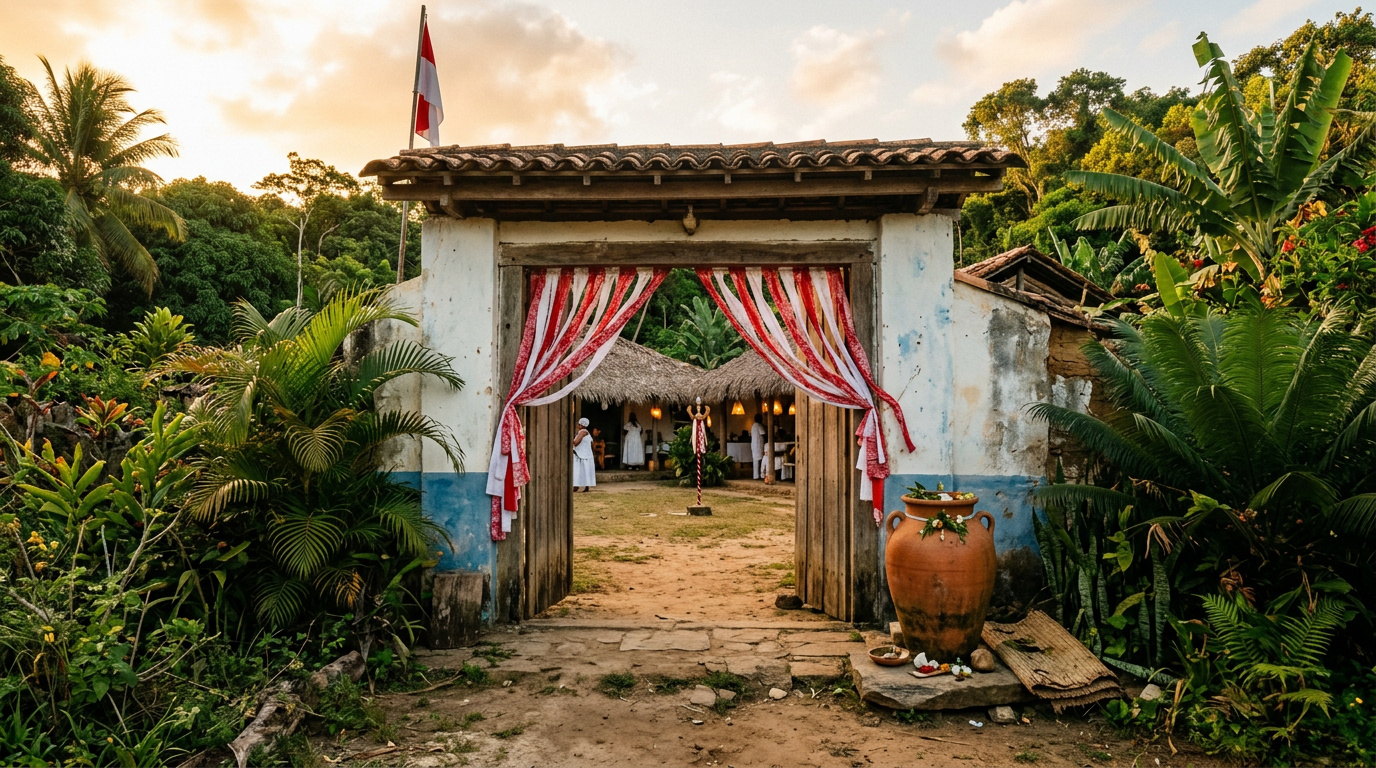
In Brazilian Candomblé, Xangô is the royal òrìṣà of the Ọ̀yọ́ kings — venerated as the lord of fire, justice, storm, and friendship, his cult having spread from Ọ̀yọ́ throughout the empire before the Middle Passage carried it to Brazil. The Ketu nation (nação Ketu) of Candomblé, which traces its liturgical lineage to the Yorùbá-speaking region centered on Kêtu, became the primary institutional home for Xangô's rites in Brazil.
The Ilê Axé Opô Afonjá terreiro in Salvador, Bahia — popularly known as Casa de Xangô, consecrated in 1910 and designated a National Historic Heritage site of Brazil in 1998 — is among the most historically significant Candomblé houses of the Ketu nation. The informal name Casa de Xangô is not incidental: Xangô's centrality in the Ketu nation's identity is inscribed in the very way practitioners refer to their most prestigious house.
Regional Variations Across Brazilian Terreiros
Brazil's scale produced regional divergence that Cuba's more contained geography did not. In the northeast — in and around Recife and Pernambuco — the Afro-Brazilian Candomblé tradition became known regionally as Xangô, taking its name directly from the òrìṣà. The tradition did not split off as a separate religion; the regional name simply reflects how thoroughly Xangô's identity saturated that community's religious imagination.
The arrival of Yorùbá captives from multiple towns meant that cults initially tied to specific lineages were reorganized into the nação system of Candomblé. Short answer: this was reconsolidation, not invention. Xangô's rites were not created in Brazil from scratch — they were gathered, sorted, and rehoused within a new communal architecture built from the fragments of several Yorùbá lineages at once.
Shango in Trinidad: An Afro-Caribbean Tradition in Its Own Right
The Shango Baptist Movement
Trinidad's path to Shango devotion is structurally different from Cuba's and Brazil's, and that difference matters. The Orisha religion in Trinidad originated in the mid-to-late nineteenth century with several thousand Yorùbá-speaking indentured laborers from present-day Nigeria — not enslaved people, a historical distinction that shaped everything that followed. Arriving as free persons under contract, Trinidad's Yorùbá community built religious structures in different legal and social conditions than those faced by enslaved Africans in Havana or Salvador.
The tradition that developed blended Yorùbá òrìṣà veneration with elements of French Catholic syncretism and, later, Spiritual Baptist practice. It became known colloquially as "Shango" — but many practitioners today prefer "Trinidad Orisha" or simply "Orisha tradition," and the label "Shango Baptist" is widely considered derogatory within the community. The naming question is not merely semantic: it reflects a long history of the tradition being defined from outside rather than within.
Orisha Tradition and National Identity in Trinidad
Over the twentieth century, the Orisha tradition in Trinidad moved from a stigmatized, semi-clandestine practice toward formal recognition as part of Trinidad and Tobago's national cultural heritage. Legal protections and the broader post-independence reclamation of African-descended cultural identity gave the tradition space to consolidate and self-define. Shango — Ṣàngó — remained at the center of that identity, both as a specific òrìṣà and as the figure whose name had come to stand for the entire tradition. That kind of metonymic power says something about the gravitational pull Ṣàngó exerts wherever his veneration takes root.
What Unites and Divides Ṣàngó Traditions Across the Diaspora?

Shared Symbols: Thunder, the Double Axe, and Red
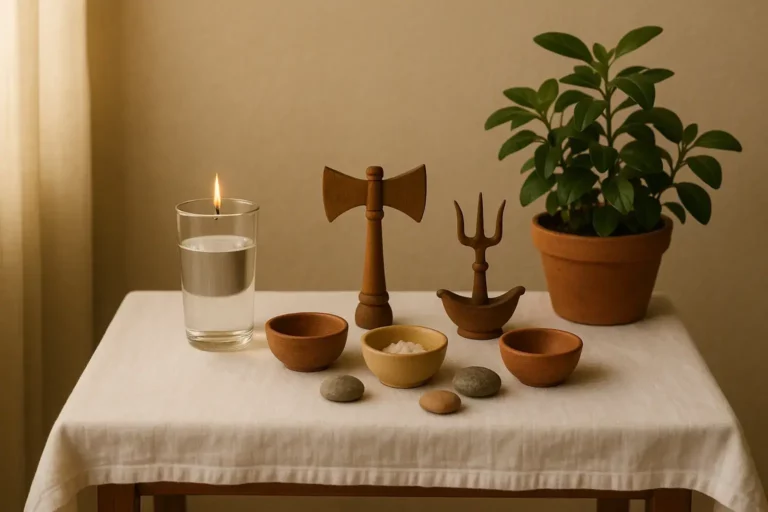
Across Lucumí, Candomblé, and Trinidadian Orisha practice, Ṣàngó retains a remarkably consistent symbolic core. The double-headed axe known as the oshé, the color red, thunderstones, and dominion over thunder, lightning, and justice appear in all three traditions — surviving centuries of geographic separation, linguistic shift, and religious adaptation without significant alteration. These shared symbols function as a kind of transatlantic fingerprint, evidence that the original Ọ̀yọ́ cult's central iconography was too deeply embedded to be easily displaced.
This persistence is not accidental. The oshé and the color red were not decorative choices; they were cosmologically load-bearing. Communities that abandoned them would have been, in a real sense, abandoning Ṣàngó.
Divergences in Ritual, Language, and Community Structure
The differences are just as instructive. Cuba's Lucumí tradition organized itself through cabildos and later through ile (houses) structured around initiated lineages; Brazil's Candomblé used the terreiro and the nação system; Trinidad's Orisha tradition built around outdoor feast grounds and community worship less tightly organized around priestly lineage. Liturgical language diverged too — Lucumí preserved more recognizable Yorùbá-language formulas; Brazilian Candomblé maintained Yorùbá liturgical vocabulary within a Portuguese-speaking context; Trinidad's tradition incorporated English and creole into its devotional life much earlier.
Framing these divergences as deviations from an "authentic" Ọ̀yọ́ original misses the point entirely. Each community adapted to survive. The Ifá and Òrìṣà practice in the Americas that exists today is the product of that adaptation — creative, contested, and alive.
Why Understanding Ṣàngó's Journey Matters Today
The World Sàngó Cultural Festival, held annually in Ọyọ̀, Nigeria, now draws diaspora practitioners from Cuba, Brazil, Trinidad, and beyond — a reversal of the one-directional dispersal of the Middle Passage, with the Americas sending knowledge and devotion back to the Yorùbá heartland. Ṣàngó's transatlantic journey has created feedback loops that neither colonial slavers nor nineteenth-century plantation managers could have anticipated.
For practitioners, tracing this history clarifies which elements of local tradition are continuous with Ọ̀yọ́ origins and which represent local creativity — a distinction that matters for theological self-understanding, if not always for practice.
For scholars, the comparative study of Ṣàngó across three diaspora contexts offers one of the clearest available case studies in how religious traditions transmit, adapt, and reconstitute themselves under extreme conditions.
For those engaged in cultural preservation, what the history of Ṣàngó's dispersal demonstrates — from the history of the Ọ̀yọ́ Empire and Yorùbá religion to the contemporary terreiro — is that religious knowledge is extraordinarily durable when communities choose to treat it as worth carrying, whatever the cost.
The thunder has a very long echo.