
Your First Ifá Consultation: The Session, Questions, and Outcome
Most people walking into their first Ifá consultation have the same quiet worry: am I going to understand what's happening? This guide answers that directly — what the session looks like from start to finish, how to prepare, what kinds of questions the tradition supports, and what the outcome actually means for your life.
A first consultation makes more sense once you’ve seen the wider tradition it sits within. For a full picture of Ifá — the 256 Odù, the Babaláwo’s role, the philosophy behind Ẹbọ — see our complete guide to Ifá divination.
Why People Seek an Ifá Consultation
First-time seekers arrive for all kinds of reasons, and the tradition makes room for all of them.
Spiritual Crossroads and Life Transitions
People most commonly seek an Ifá consultation when something in their life has shifted — a career decision that won't resolve itself, a relationship at a turning point, a health concern that conventional advice hasn't clarified, or a persistent sense that something is misaligned. The Ifá divination tradition addresses questions spanning health, relationships, finances, career, ancestral obligations, and overall life direction, framing each situation not as an isolated problem but as something with spiritual, energetic, and ancestral dimensions. The emphasis is on uncovering root causes rather than surface symptoms — that's the tradition's own teaching, not a clinical promise.
Transitions carry particular weight. Moving to a new city. Having a child. Losing someone close. Beginning a spiritual practice. These are the moments when many people, across cultures, want guidance that goes deeper than what a practical checklist can offer.
Curiosity vs. Urgency — Both Are Valid
Not every first consultation happens in crisis. Some people arrive simply curious — drawn to Ifá through Yorùbá cultural study, through diaspora community connections, or through the accounts of people they trust. Many first-time seekers in the African diaspora come to Ifá through cultural or community pathways, not through a lifetime of practice, and that is a fully legitimate entry point. The tradition doesn't require a burning question. Arriving open-ended, asking how to understand your path more clearly, is its own kind of inquiry.
The important thing is that your reason is yours. Urgency and curiosity both produce real consultations.
How to Prepare Before Your Session

Preparation isn't about performing the right ritual before you arrive. It's about showing up with clarity instead of clutter.
Setting Your Intention
In the days before your consultation, spend time with the question or questions you're bringing. Practitioner guidance consistently stresses that vague questions yield diffuse answers. Asking Ifá for "general luck" or framing a question around how to change someone else's behavior tends to produce guidance that doesn't land with much precision. What the tradition supports — and what tends to produce the most useful sessions — is focused, first-person, open-ended questions about your own life.
Think: What is keeping me from moving forward in this area? rather than Will this work out? The first question invites interpretation; the second asks for a forecast.
Also arrive ready to hear something unexpected. Guidance that confirms a decision you've already made is nice, but the tradition's value lies in what it surfaces that you hadn't considered. Go in willing to be redirected.
Practical and Spiritual Etiquette
Dress respectfully. Arrive on time, or early. Bring any materials your Babaláwo (the Ifá divination priest — more on this role below) has asked for in advance. Some practitioners request a small item personal to you; others work without one. Ask beforehand if you're unsure.
Silence your phone. Listen more than you speak during the session itself. The consultation is not a back-and-forth debate; you'll have opportunity to ask questions, but the divination process has its own structure and pace that deserves your full attention.
What Happens During the Divination Session
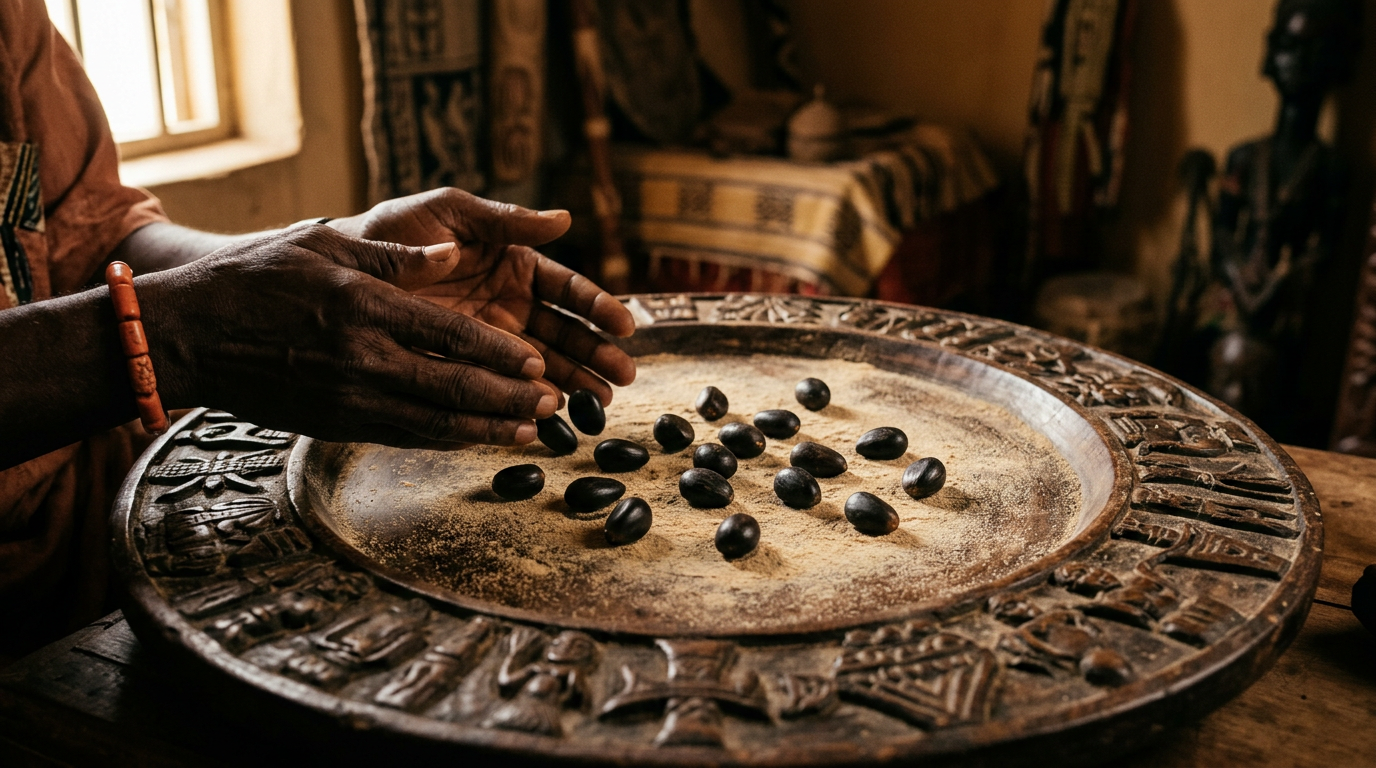
The session is more grounded than most first-timers expect. There is no trance, no dramatic spirit possession. UNESCO's documentation of the Ifá divination system explicitly marks this distinction: Ifá practitioners interpret sacred signs and encoded wisdom rather than channeling spirits — a clarification worth holding onto if you've encountered other divination traditions that work differently.
The Role of the Babalawo
The Babaláwo — the title translates roughly as "father of mysteries" — is the trained priest who conducts the session. Widely cited accounts of training requirements describe a minimum apprenticeship of five years under an experienced elder Awo, with many extending considerably longer before full recognition. The Babaláwo functions simultaneously as interpreter, counselor, and ritual specialist: casting the divination instruments, identifying the Odù that emerges, reciting the relevant verses from memory, and working with you to understand what the message means for your specific situation.
A note on terminology: the role of the Babalawo is specifically a male priestly title. The Ìyánífá is the female Ifá priest, and some consultations are conducted by Ìyánífá practitioners. The scope of each role — including which instruments each may use — varies across lineages, so if this matters to you, ask your practitioner directly.
The Divination Instruments — Ikin and Ọ̀pẹ̀lẹ̀
The Babaláwo uses one of two sacred instruments. The ikin are sixteen sacred palm nuts, manipulated by hand in a sequence that generates a binary figure — a signature cast one mark at a time. The ọ̀pẹ̀lẹ̀ is a divining chain with eight seed-pods strung along it; when cast, each pod lands face-up or face-down, producing a signature in a single throw.
Both instruments work toward the same purpose: generating one of 256 possible binary signatures called Odù. The ikin method is slower and considered the more traditional form; the ọ̀pẹ̀lẹ̀ is faster and widely used in practice consultations. Your Babaláwo will use whichever their training and lineage specifies.
How the Odù Is Revealed
Once the binary signature is established, the Odù — one of 256 chapters within the Ifá literary corpus — is identified. Each Odù contains approximately 800 verses called Ẹsẹ̀ (an approximate count, as the corpus is considered ongoing and ever-growing), each a narrative teaching drawn from the tradition's oral literature. The Babaláwo selects and recites the verses most relevant to your situation, interpreting them in relationship to what you've brought to the session.
What is Odù Ifá is a bigger question than can be answered in one session — each Odù is a world of its own. What you'll receive is a reading of the verses that speak most directly to your current circumstances.
The Odù also arrives with a polarity: Ìrẹ or Ìbì. Ìrẹ indicates a state of alignment — the Odù arrives with potential for good fortune and forward movement. Ìbì indicates resistance or misaligned energy that needs addressing. These are not simply "good" or "bad" outcomes; the Ifa Foundation cautions specifically against that reduction. They are diagnostic orientations that shape what action the tradition recommends.
The Kinds of Questions Ifá Addresses
Questions You Bring vs. Questions Ifá Raises
You'll bring your own questions to the session. But Ifá may also surface questions you didn't know you had. The divination process reads your situation as a whole, not just the specific concern you verbalized — which means the Odù may point to something adjacent to your stated question, or something underneath it.
This is one of the tradition's most useful qualities and also one of the most disorienting for first-timers. You came about your career. The reading keeps returning to an ancestral pattern. Stay open to that. The root the tradition identifies is the one Ifá addresses, not necessarily the one you came in planning to discuss.
What Ifá Does Not Do
Ifá is not a system for controlling other people's choices. It won't tell you how to make someone love you, how to guarantee a business deal, or how to force an outcome. Questions framed around external control tend to produce diffuse guidance precisely because the tradition doesn't operate in that register.
Ifá also doesn't predict a sealed fate. The entire point of the consultation is that knowing the Odù gives you a map — and maps imply that you'll be doing the walking. The session produces orientation, not destiny.
Understanding Your Odù and the Outcome
How the Babalawo Interprets the Odù
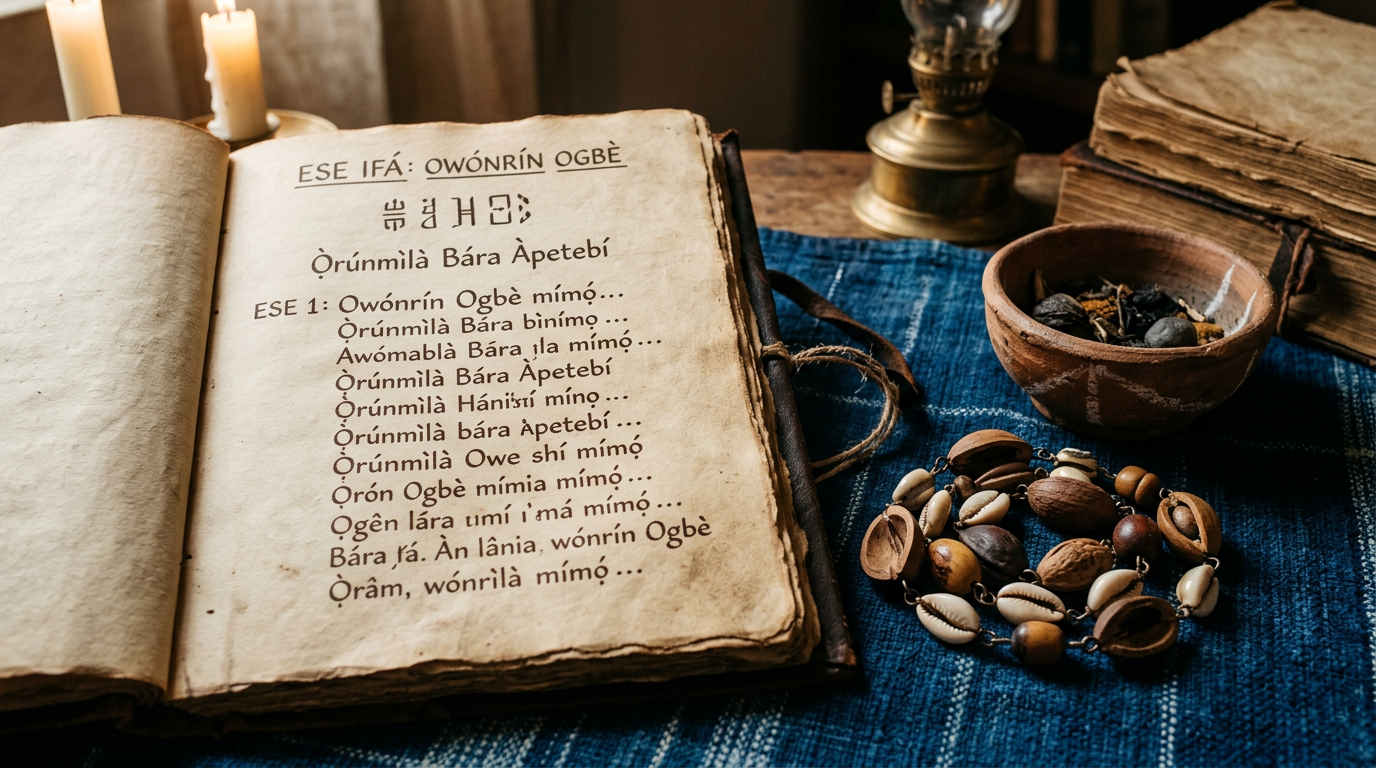
After the Odù is cast and its polarity established, the Babaláwo draws on verses — recited from memory, sometimes at length — that speak to the pattern in front of you. Interpretation is not improvised guesswork; it's the application of a vast oral literature to a specific human situation. The tradition describes Orunmila, the Òrìṣà of wisdom and intellectual development, as the divine patron of this system — the one who witnesses human destiny and makes it legible.
The Babaláwo will speak, and you should listen. You'll have opportunity to respond, to ask for clarification, to confirm which aspects of the reading connect with your actual circumstances. That dialogue shapes the final interpretation. A skilled practitioner isn't delivering a monologue — they're working with you.
Ẹbọ and Prescribed Action
Every Ifá consultation closes with a prescription of Ẹbọ — an offering or ritual action aligned with what the Odù revealed. Ẹbọ is not something you choose or self-prescribe; it emerges from the divination itself. And it is not appeasement. Practitioner and tradition sources consistently describe the meaning and purpose of Ẹbọ in Ifá as an act of alignment — bringing your action into harmony with the path the Odù identified, demonstrating commitment to the change you're seeking.
The form of Ẹbọ varies. Sometimes it's an offering of food or natural materials. Sometimes it's a behavioral commitment — something to do, or something to stop doing. What it always is, in the tradition's framing, is the practical bridge between the consultation and actual transformation. The reading without the Ẹbọ is a map you didn't use.
After the Consultation — What Comes Next
Following Through on Guidance
The consultation is a beginning. A clear and serious one, but a beginning.
Ẹbọ that goes unperformed leaves the prescribed benefit unactivated. The tradition holds that the seeker's willingness to act — to actually move on the guidance received — is inseparable from the outcome. You can't receive transformation passively. The session identified the path; following it is your part.
Take notes after the consultation if you can. Record what the Odù was, what the Babaláwo said about it, and what Ẹbọ was prescribed. Some guidance lands immediately; other parts of a reading become clear weeks later when circumstances align with what was said.
Building a Relationship with Your Babalawo
One consultation gives you a single Odù, read in the context of a specific moment. The tradition is larger than that. Many practitioners return to their Babaláwo regularly — seasonally, at major life transitions, or whenever a significant decision requires deeper orientation.
Building that relationship over time changes the quality of the guidance. A Babaláwo who knows your lineage, your patterns, and your Odù history can read with more depth than one meeting allows. That continuity is how finding a trustworthy Babalawo becomes less a one-time search and more an ongoing relationship with the tradition itself.
Where to Go From Here
Walking into your first Ifá consultation prepared means arriving with a focused question, a willingness to hear something unexpected, and a basic understanding of what the session will produce. The mechanics — the ikin or ọ̀pẹ̀lẹ̀, the 256 Odù, the polarity of Ìrẹ and Ìbì, the closing prescription of Ẹbọ — are the structure within which a very human conversation takes place. UNESCO recognized the Ifá divination system as an Intangible Cultural Heritage of Humanity in 2005, not as mysticism but as an extraordinary living body of ethical and philosophical wisdom. Your first consultation is the point where that corpus meets your specific life. Come ready to listen, and then do something with what you hear.