Ṣàngó: Òrìṣà of Thunder, Justice, and Royal Authority
Few figures in Yorùbá spiritual life carry as much weight — historical, cosmological, and viscerally present — as Ṣàngó. He was a king before he was a god, a man whose power was so immense that death could not contain it. This article draws on oral tradition, Ifá cosmology, and the living practices of Ṣàngó's devotees from Ọ̀yọ́ to Havana to Salvador da Bahia to give you the fullest possible picture of who Ṣàngó is, what he demands, and how his veneration has endured across centuries and continents.
Who Is Ṣàngó? The Àlàáfin Who Became an Òrìṣà
Ṣàngó occupies a singular position in Yorùbá spiritual life: he is both a figure of recorded human history and one of the most powerful Òrìṣà in the Ifá cosmological framework. Understanding him requires holding both registers at once.
Ṣàngó as the Fourth Àlàáfin of Ọ̀yọ́
According to Britannica, Ṣàngó was the fourth Àlàáfin (king) of the Ọ̀yọ́ Empire, though some oral lineages count him as the third — a discrepancy that reflects the nature of living oral tradition rather than error on anyone's part. What different lineages agree on is this: he was a ruler of extraordinary and terrifying force. Tradition describes his voice as thunder itself, his spoken words capable of producing fire. His reign was defined by power exercised at the edge of its own limits, and that excess became the hinge on which his story turns.
The Transition from Historical King to Deified Òrìṣà
When Ṣàngó departed Ọ̀yọ́ — the circumstances vary by lineage, but disgrace and conflict feature in most accounts — his loyal followers refused to accept that he had simply died. They declared instead that he had ascended to the heavens on a chain, passing beyond death into divine existence. That proclamation became the founding act of his cult. From that moment, Ṣàngó was no longer merely a king to be mourned; he was an Òrìṣà to be invoked. The political and the sacred fused completely.
Ṣàngó's Place in the Ifá Cosmological Framework
Ṣàngó's cosmological identity carries an additional layer of theological complexity. Over time, his cult absorbed the attributes of Jakuta, an older Yorùbá deity who embodied the punishing wrath of Olódùmarè, the Supreme Being. The name Jakuta — still used for Ṣàngó in parts of Yorùbáland and in Cuban Lucumí practice — signals this synthesis. The result is a deity who operates on two registers simultaneously: the ancestral (a deified human king, close to his descendants and responsive to their affairs) and the cosmological (a primordial force of divine judgment inherent in the structure of the universe). Understanding Ṣàngó in the Ifá tradition means understanding that he is both.
Àṣà and Ìtàn: The Sacred Stories of Ṣàngó
The mythological cycle surrounding Ṣàngó is one of the most emotionally vivid in the entire Ifá corpus — passion, rivalry, war, betrayal, and transcendence all in one figure.
The Reign of Fire and the Departure from Ọ̀yọ́
Oral traditions across lineages describe Ṣàngó's reign as one of brilliance shadowed by dangerous excess. His power drew followers and enemies in equal measure. When political conflict erupted — accounts cite disputes with his chiefs and the consequences of his own volatile temperament — Ṣàngó withdrew from Ọ̀yọ́. His departure, followed by the founding declaration of his ascension, is not presented in tradition as a tragedy. It is presented as transformation: the moment when a great but flawed king shed his human limitations and became something more.
The Ṣàngó cult subsequently became inseparable from the institution of the Ọ̀yọ́ monarchy itself. The ruling Àlàáfin was understood to be Ṣàngó's earthly representative, which meant that devotion to Ṣàngó and loyalty to the Ọ̀yọ́ state were not two separate commitments — they were one.
Ṣàngó's Relationship with Ọya, Ọ̀ṣun, and Other Òrìṣà
Widely cited accounts describe Ṣàngó as having three principal wives: Ọba (his first wife), Ọ̀ṣun (widely said to be his favorite), and Ọya (his third wife and closest companion in storms and battle). The precise order and dynamics of these relationships vary across lineages and should be understood as reflecting the richness of oral tradition rather than settled biography. Each relationship generates its own cycle of stories — rivalry between Ọba and Ọ̀ṣun, the deep alliance between Ṣàngó and Ọya, the fierce love and conflict that move through all three.
Ọya, Òrìṣà of wind and transformation, appears almost inseparably connected to Ṣàngó: where his thunder announces divine presence, her wind clears the path. Ọ̀ṣun, Òrìṣà of rivers and fertility, brings sweetness and beauty into contrast with Ṣàngó's fire and force. These relationships are not decorative mythology — they model the way elemental and spiritual forces interact within Yorùbá cosmological thinking.
Odù Ifá That Speak of Ṣàngó
In some lineages, Ṣàngó's energy is particularly associated with the Odù Ọbàrà Méjì. Ọbàrà Méjì is one of the 256 Odù of the Ifá corpus — the body of sacred oral literature at the heart of Ifá divination — and in one widely known narrative within that Odù, Ṣàngó conquers the Arara Kingdom not through brute strength alone, but through sacrifice, discipline, and consultation of Òrúnmìlà. The teaching is clear: genuine power requires spiritual alignment, not just force. Other lineages associate Ṣàngó with different Odù, and no single attribution should be treated as universal. The variation is itself instructive. Ifá divination and the role of Odù provide the broader framework within which these narratives operate.
Thunder, Lightning, and Fire: The Elemental Powers of Ṣàngó
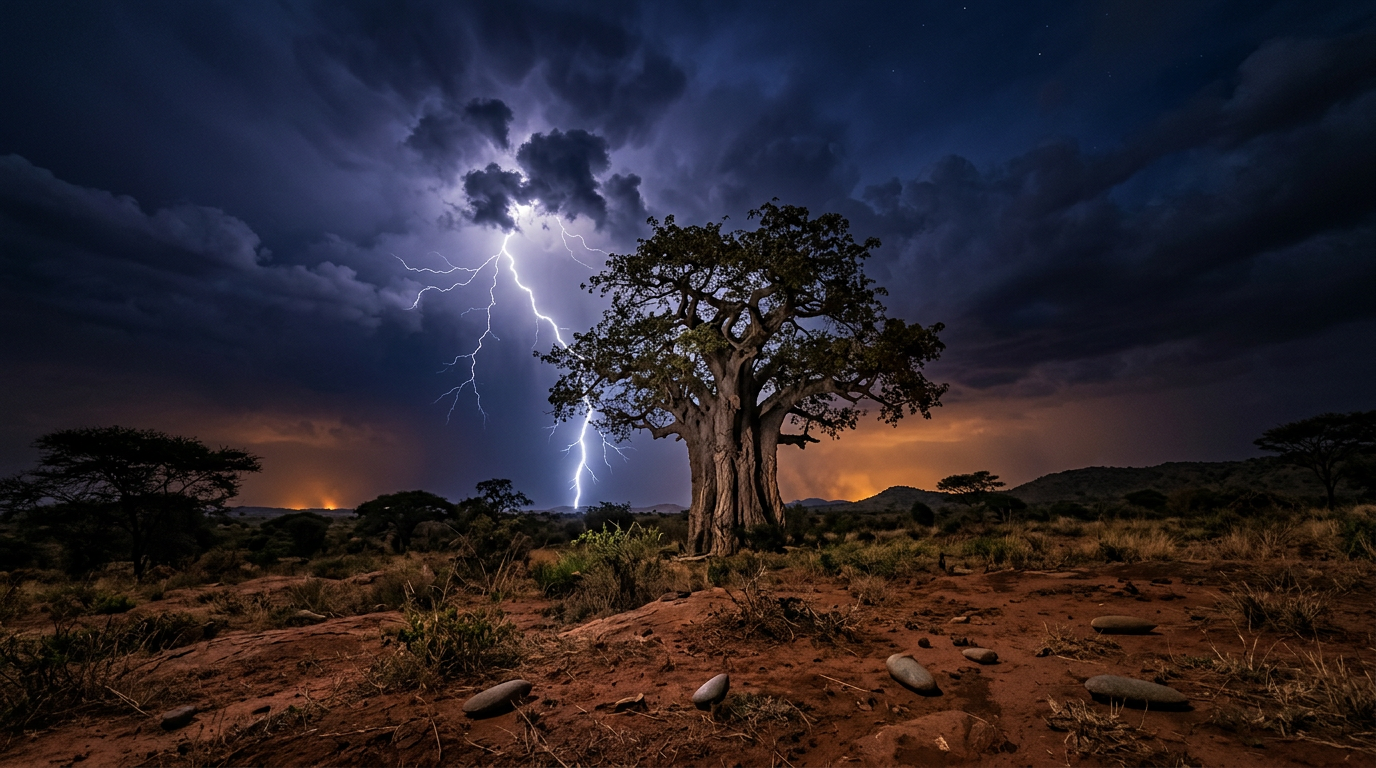
Ṣàngó commands thunder, lightning, and fire — but in Yorùbá thought, these are not simply meteorological phenomena. They are instruments of divine communication and moral action.
Àrá and Mànàmàná: Thunder and Lightning as Divine Instruments
Thunder (àrá) and lightning (mànàmàná) function in Ṣàngó's theology as announcements and verdicts. Thunder is the sound of his presence arriving. Lightning is his direct act. Within the tradition, a building or tree struck by lightning is understood as having received his attention — specifically, as scholars commonly note, his judgment directed at those inside who have committed falsehood or theft. This is a theological teaching, not a meteorological claim: it frames natural events as expressions of divine moral order, locating justice in the physical world rather than deferring it entirely to an afterlife.
Iná Ṣàngó: The Transformative Force of Fire
Fire in Ṣàngó's spiritual vocabulary carries a double valence. It destroys and purifies simultaneously. The same fire that consumes what is corrupt also transforms raw material into something refined. This double nature maps directly onto Ṣàngó's role as both punisher and protector: his energy does not discriminate between destruction and renewal because, in Yorùbá cosmological thought, they are not opposites. They are the same force at different stages of its work.
This is also why fire features so prominently in Ṣàngó's ceremonies. The Èlégún Ṣàngó — those permanently mounted by Ṣàngó's spirit, his living vessels in ceremony — are widely reported to perform feats during possession that include handling live coals and eating fire. These acts are not performances. They demonstrate that Ṣàngó's energy, when fully present, changes the nature of the body it inhabits.
How Ṣàngó's Elements Manifest in Nature and Spirit
The three elements Ṣàngó commands — thunder, lightning, and fire — form a unified teaching rather than a collection of separate attributes. Thunder announces. Lightning executes. Fire transforms what has been struck. Sequence matters. This progression is visible in how Ṣàngó's energy moves in human experience: the warning comes first (the thunder of conscience, of consequence approaching), the judgment follows, and what remains is changed. Practitioners working with Ṣàngó's energy are asked to understand this sequence, not to fear the fire but to respect what it is for.
What Are Ṣàngó's Sacred Symbols and Their Meanings?
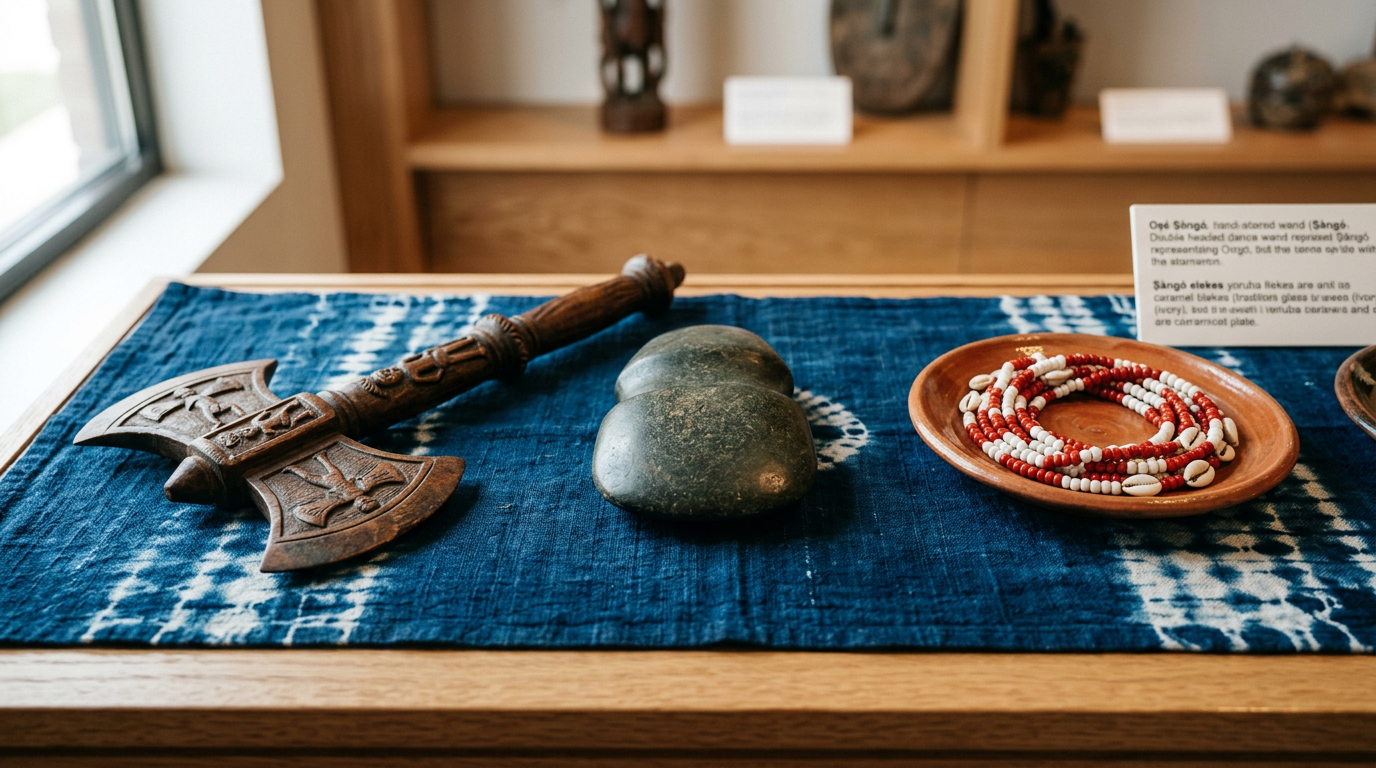
Ṣàngó's material culture is among the most visually distinctive of any Òrìṣà. His sacred objects are not decorative — each carries specific theological meaning and ritual function.
The Oṣé Ṣàngó: Double-Headed Axe of Authority
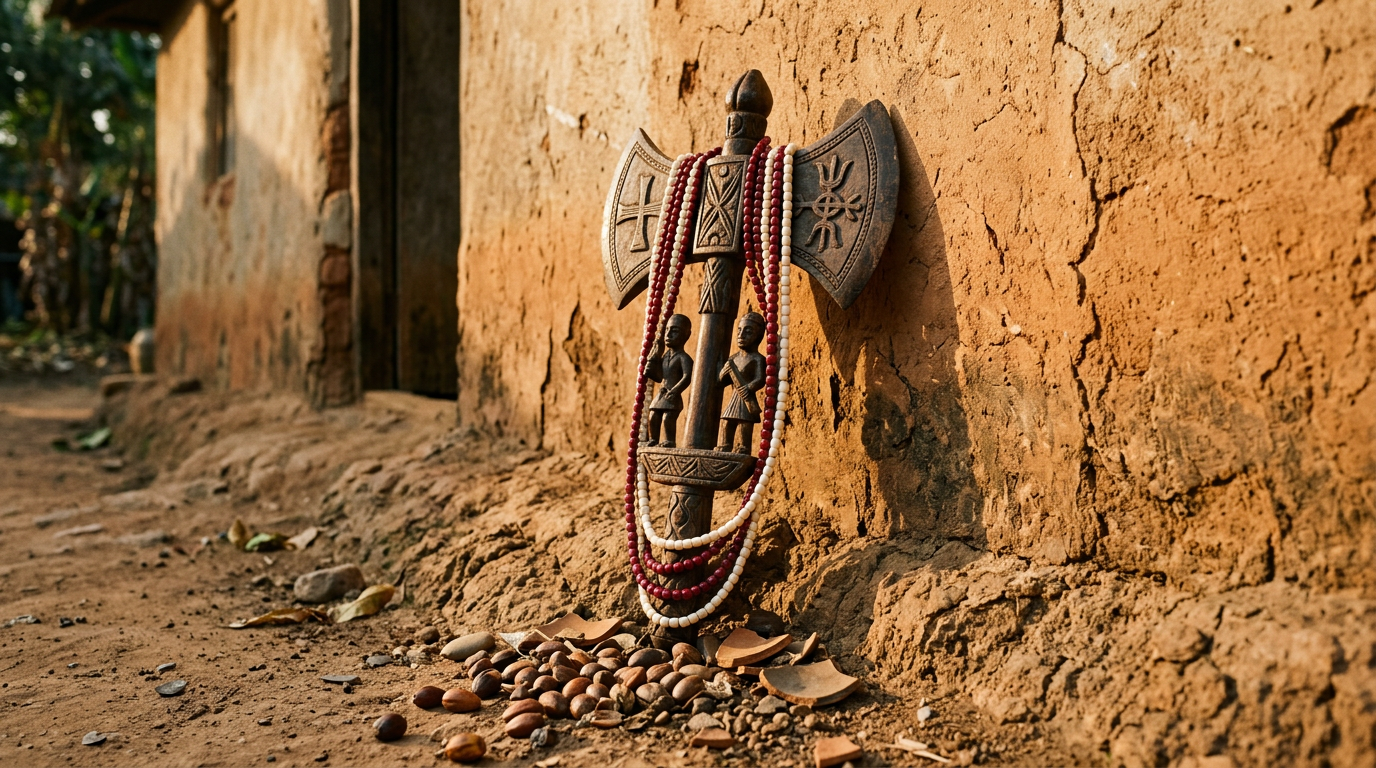
The oṣé Ṣàngó is Ṣàngó's primary ritual symbol: a double-headed axe that represents the balance between justice and mercy, the dual nature of power that must be exercised with discipline or it destroys its wielder. The two blades face outward in opposite directions, which practitioners understand as depicting the capacity to deliver judgment in both directions — against wrongdoing from any quarter. Priests, ceremonial dancers, and the Èlégún Ṣàngó carry the oṣé during worship and possession ceremonies. Handle carvings often depict supplicants, devotees, or the interlocking of spiritual forces, with each carving tradition carrying lineage-specific meaning.
The oṣé is not simply a weapon symbol. It is a statement of governance — specifically, of authority that answers to a moral standard higher than political power alone.
Èdùn Àrá: Thunder Stones and Their Ritual Significance
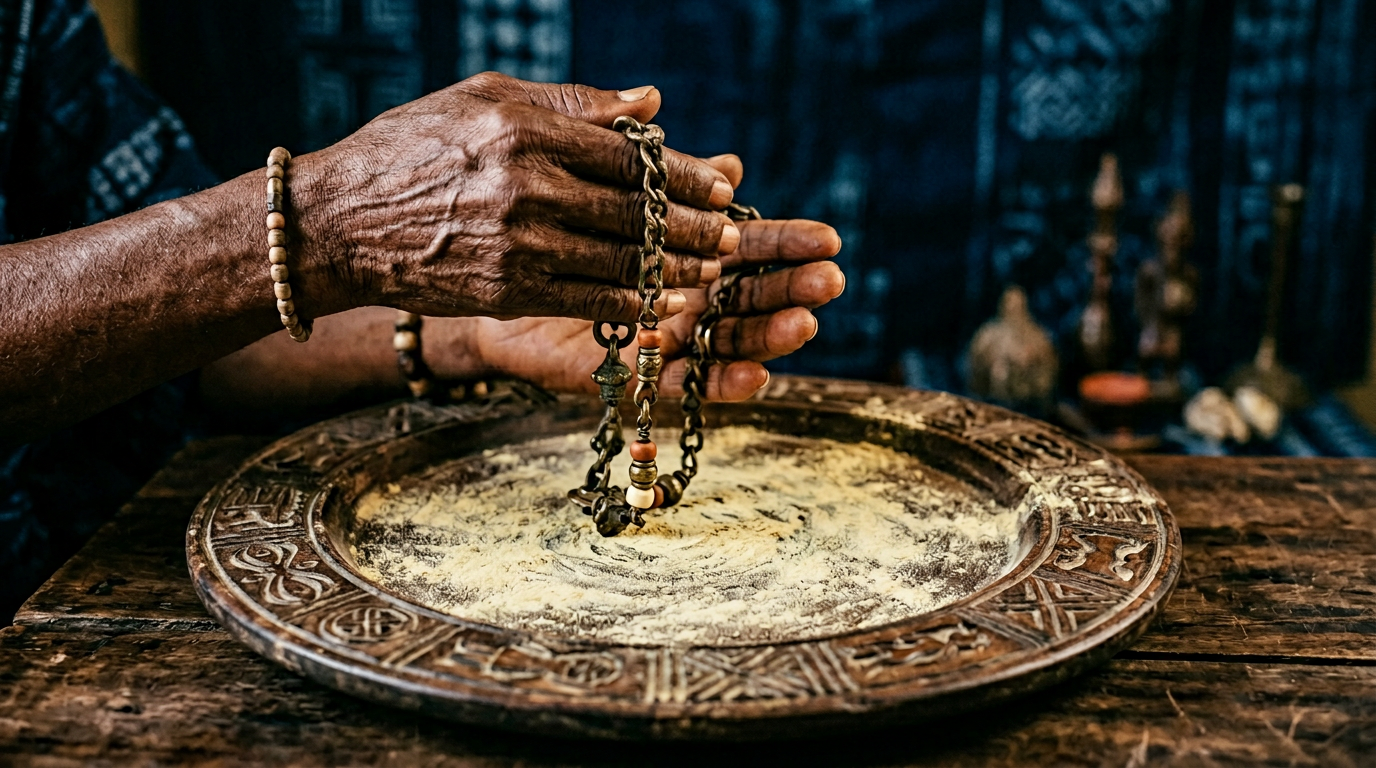
Èdùn àrá are prehistoric stone celts — ancient polished axe-heads that pre-date Yorùbá settlements in the region — found at the sites of lightning strikes. Yorùbá tradition holds that they are Ṣàngó's actual thunderbolts, cast from the heavens and embedded in the earth at the moment of impact. William Bascom's documentation of Ṣàngó shrines describes how these stones are kept at the shrine in a plate supported by an inverted mortar, a specific arrangement with its own ritual logic.
The convergence of prehistoric material and living theology is remarkable here. Objects that predate living memory by thousands of years are understood not as curiosities but as active sacred instruments, continuously charged by their origin.
Sacred Colors, Beads, and Regalia
Red and white are Ṣàngó's sacred colors, and their pairing is deliberate. According to UNESCO's documentation of the Sàngó Festival, devotees wear red-and-white beads (elekes) and dress in these colors during the annual festival and in personal devotional practice. Red carries the force of lightning, fire, and the urgency of divine action. White carries purity, truth, and the clarity that precedes judgment. Together, they express Ṣàngó's central duality: power and principle, action and accountability.
How Is Ṣàngó Venerated? Festivals, Priests, and Daily Devotion
Ṣàngó's worship spans the grandest communal ceremony in the Yorùbá calendar to the quiet personal discipline of daily devotion. Both registers matter.
Ọ̀ṣun Ṣàngó: The Annual Festival at Ọ̀yọ́
A clarifying note on naming: Ọ̀ṣun Ṣàngó here refers to the name of the festival tradition itself, not to Ọ̀ṣun the river goddess, who is a distinct Òrìṣà. The two names share a word but refer to different realities — the festival designation Ọ̀ṣun Ṣàngó should not be confused with Ọ̀ṣun, Ṣàngó's wife and the Òrìṣà of rivers and sweetwater.
The Sàngó Festival at Ọ̀yọ́ is a ten-day ancestral worship event held annually in August near the Koso Temple — the site traditionally associated with Ṣàngó's ascension. UNESCO has recognized the festival as Intangible Cultural Heritage, and its documentation describes the festival as marking the beginning of the Yorùbá Traditional New Year, deeply woven into the social, religious, cultural, and political institutions of Oyo State. During the festival, the Àlàáfin of Ọ̀yọ́ performs specific rites that reinforce the ancient connection between royal authority and Ṣàngó's divine mandate. The Koso Temple itself remains a living sacred site, not a historical monument.
Initiation and Priesthood in the Ṣàngó Tradition
Ṣàngó priesthood in Yorùbáland is not entered by choice alone. Those who become Ṣàngó priests are understood to have been chosen by Ṣàngó — identified through divination, through illness, through the persistent experience of his energy in their lives. Initiation is a formal process of recognition and preparation, not simply instruction.
Among the initiated, the Èlégún Ṣàngó hold a particular position. These are individuals permanently and spiritually mounted by Ṣàngó's presence, not merely occasional vessels but those who carry his energy as a defining aspect of their spiritual identity. During ceremonies, the Èlégún demonstrate Ṣàngó's power directly — handling live coals, eating fire — acts that practitioners understand as evidence of possession rather than skill. Their role is to make Ṣàngó present in the community, available for consultation, blessing, and correction.
Priests serve the broader function of maintaining Ṣàngó's shrine, preparing offerings, conducting divination when appropriate, and guiding devotees. The priesthood is not a role of status alone. It carries ongoing responsibility and ongoing accountability to Ṣàngó's standards.
Offerings, Prayers, and Daily Devotional Practice
Daily devotion to Ṣàngó does not require festival scale. Offerings of red palm wine, akara (bean cakes), bitter kola, and ram are among the traditional forms of honor. Prayers address Ṣàngó directly, acknowledging his power, his justice, and his protection. Devotees wear red-and-white elekes as a constant mark of alignment and protection. Many keep a small shrine where the oṣé Ṣàngó or èdùn àrá are kept, cared for, and addressed.
Consistency matters more than ceremony here. Ṣàngó's energy, tradition teaches, responds to sincerity and directness. Those who approach him with integrity receive his protection; those who approach him while maintaining the very falsehoods he punishes will find the encounter costly.
Ṣàngó as the Embodiment of Justice and Truth
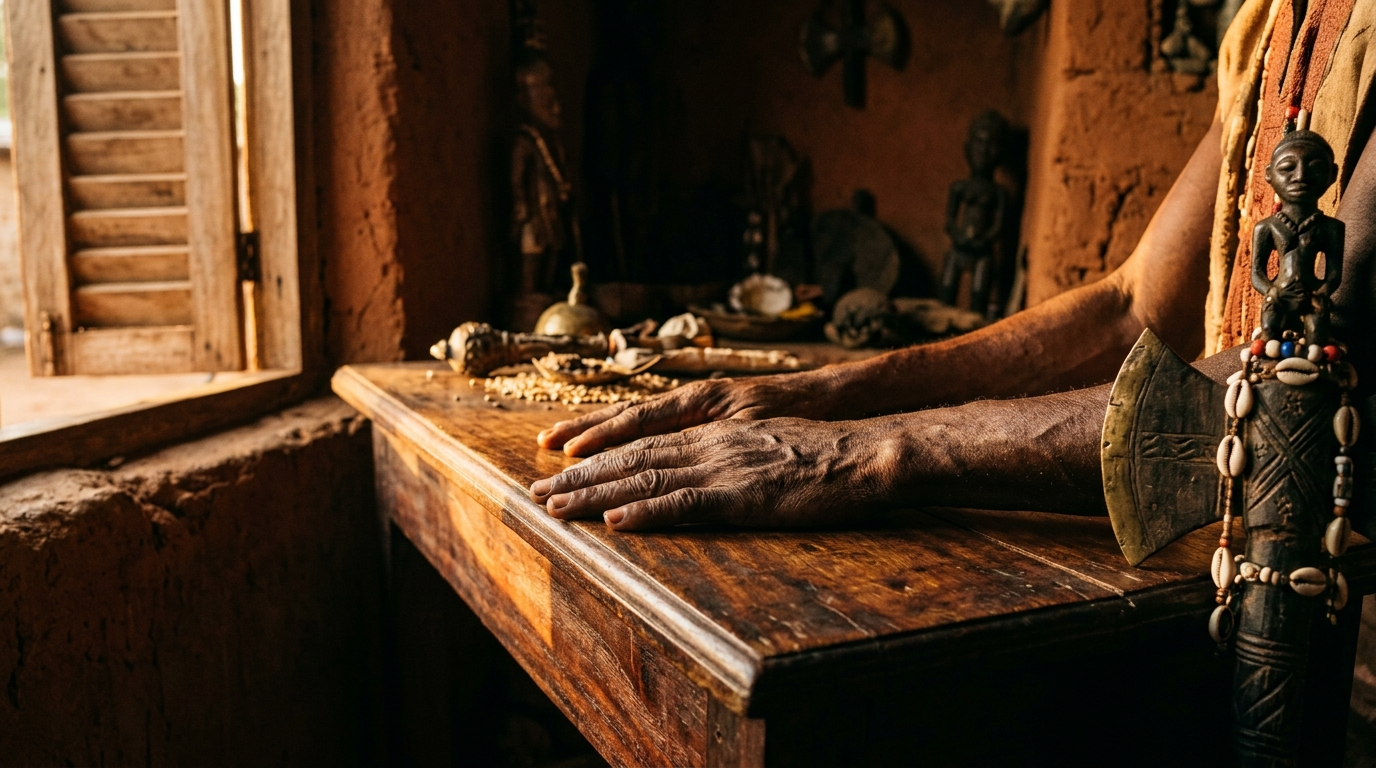
Ṣàngó is not merely associated with justice as an abstract virtue. He is justice as an active force — a corrective presence that operates in human affairs regardless of whether it has been invited.
Divine Justice: Ṣàngó's Intolerance of Falsehood and Theft
Scholars commonly note that within Yorùbá theological tradition, Ṣàngó's most specific moral targets are liars and thieves. A house struck by lightning is not understood as an accident of weather but, within this theological tradition, as evidence of Ṣàngó's judgment — a sign that falsehood or theft was present. This framing locates moral accountability in the physical world. Justice is not deferred; it arrives with the storm.
Ṣàngó's intolerance of falsehood is directly tied to his royal identity. A king who cannot be deceived, who sees through pretense, who punishes betrayal without delay — this is the ideal of Yorùbá kingship made divine. In Ṣàngó, the aspiration and the execution are the same thing.
Moral Authority and the Ethics of Power
Power without accountability is exactly what Ṣàngó's own story warns against. His reign ended, in many accounts, because his power exceeded his discipline. His deification then became the correction of that imbalance: as an Òrìṣà, Ṣàngó embodies not unchecked force but force accountable to divine principle.
This is why Ṣàngó's worship does not celebrate domination. It celebrates righteous authority — power that earns its standing through truthfulness, courage, and the willingness to hold others and oneself to account. The oṣé's double blade cuts in both directions.
Ṣàngó's Role in Oath-Taking and Conflict Resolution
Oaths taken in Ṣàngó's name carry an unusual weight. In traditional Yorùbá practice, swearing by Ṣàngó while lying is understood, within this theological framework, to invite his retribution. Community disputes involving accusations of theft, fraud, or betrayal have historically been brought before his shrine precisely because his presence renders deception dangerous in a way that human courts cannot replicate.
Ṣàngó's role in conflict resolution is therefore not that of a neutral mediator. He does not weigh arguments and deliberate. He responds to truth and falsehood directly. To bring a dispute before Ṣàngó is to submit to a verdict that does not negotiate.