Yoruba Herbal Medicine: Plants, Rituals, and Ifá Healing
There's a phrase at the heart of Yoruba spiritual practice that cuts through any temptation to separate botany from religion: Kòsí ewé, kòsí Òrìṣà — "Without leaves, the deities could not exist." That single line tells you everything about how Yoruba healing works. Plants are not ingredients. They are living participants in a cosmological system where divination, incantation, ancestral wisdom, and botanical knowledge all move together. This article unpacks that system: what ewé are, how healers use them, who administers them, and why the entire framework depends on something the lab cannot measure — àṣẹ.
This spoke is part of our broader guide to Yoruba spiritual healing traditions — which sets the wider context for how Ifá, ewé, and community care intertwine.
The Inseparable Bond Between Ifá and Herbal Medicine
Ifá healing and herbal medicine are not parallel tracks that occasionally intersect. They are one system. Yoruba medicine understands illness as a disruption of balance across four dimensions simultaneously — body, spirit, ancestry, and community. A fever is not merely a fever; it may be an ancestral signal, a relational rupture, or a spiritual imbalance expressing itself through the body. That ontology is why no herbal prescription happens before divination.
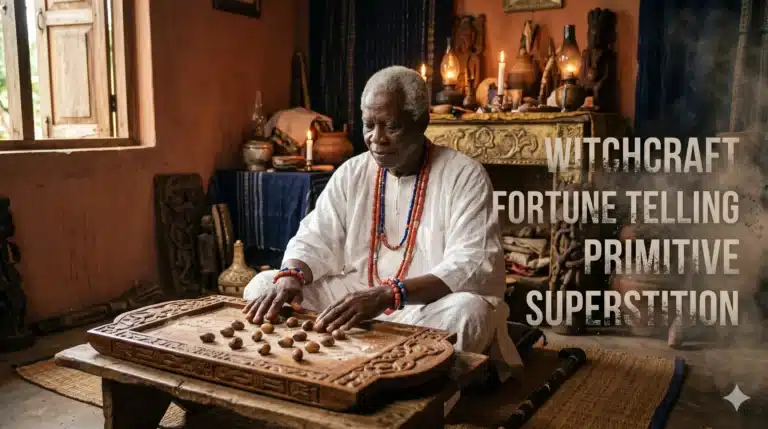
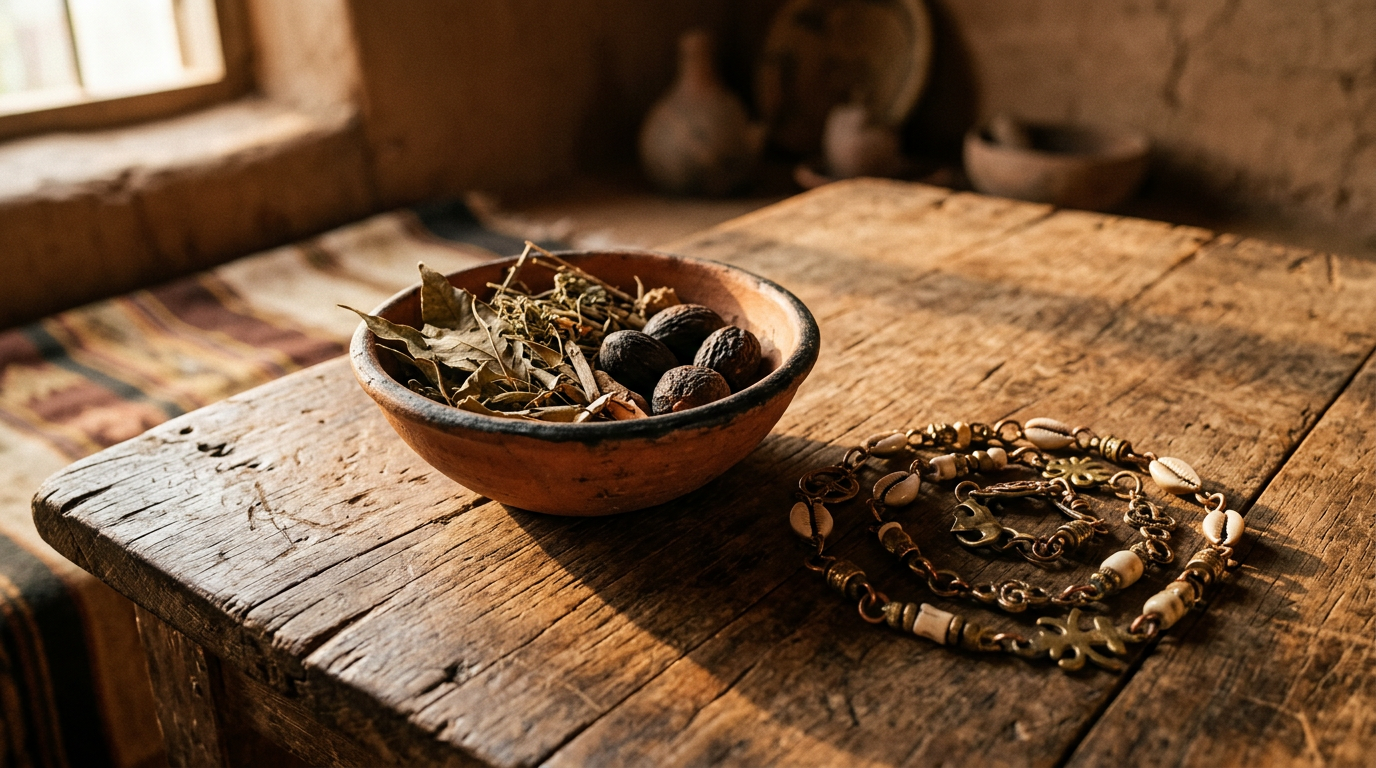
A Babaláwo consults Odù Ifá before recommending any plant remedy, using either the ikin (sacred palm nuts) or the ọpẹlẹ (divination chain) to identify the source of disruption — whether it lies in the spiritual, ancestral, or social domain. The plant comes after that diagnosis, not instead of it. This structure is not incidental. It reflects a coherent epistemology: you cannot treat what you have not correctly identified, and correct identification requires access to knowledge that the physical senses alone cannot provide.
The Ifá divination system was inscribed on UNESCO's Representative List of the Intangible Cultural Heritage of Humanity in 2008, recognizing precisely this integration — a living knowledge tradition in which healing, philosophy, and cosmology are inseparable.
Ewé: the Sacred Role of Leaves in Yoruba Healing
Why Leaves Are Considered Living Spiritual Forces
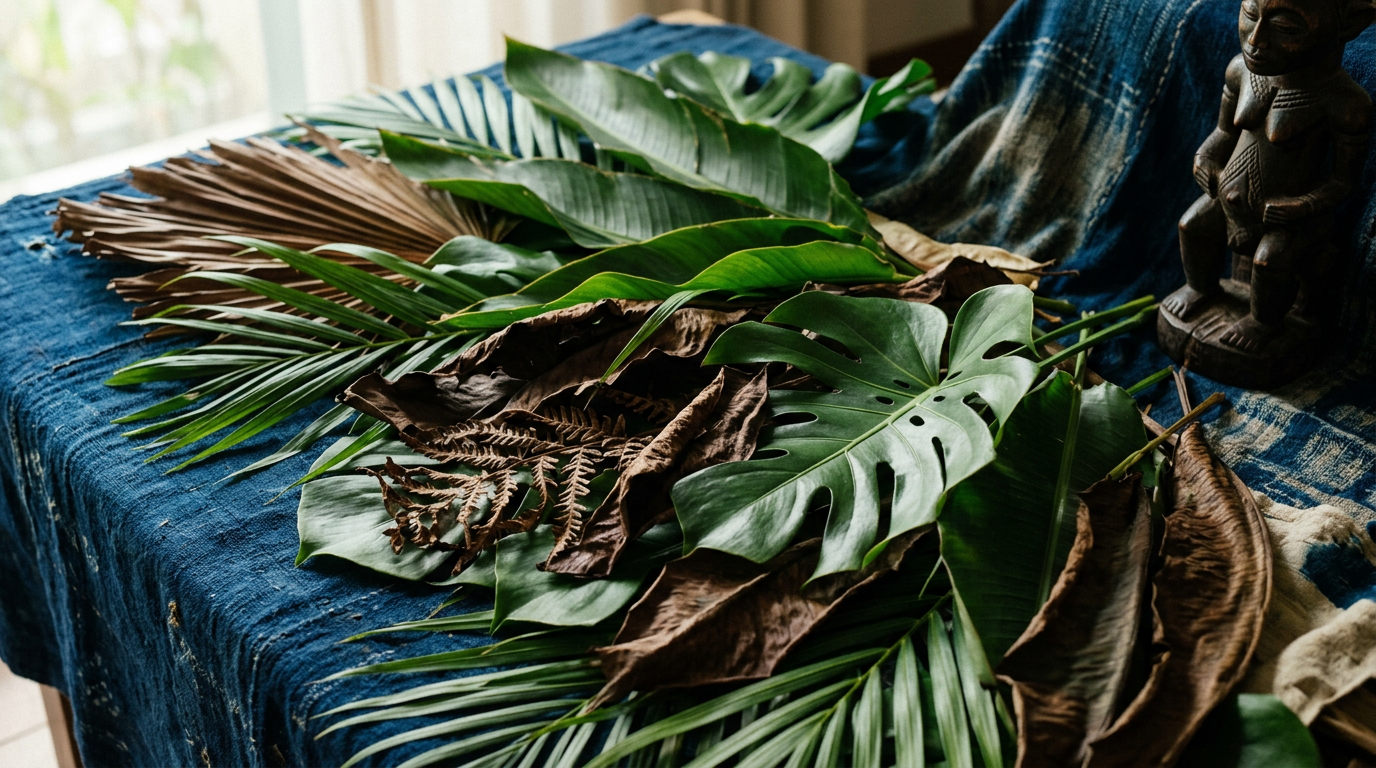
Leaves, in Yoruba tradition, are not raw material. Each ewé carries àṣẹ — a quality of divine energy, a capacity to act on the world — that is specific to that plant's nature, its associated Òrìṣà, and the conditions under which it was harvested. The principle Kòsí ewé, kòsí Òrìṣà does not merely assert that plants are useful to the deities; it asserts that the deities' activity in the world is mediated through plants. Remove the leaves, and the divine power has no channel through which to move.
This means the healer's relationship with a plant begins before it is ever picked. Approaching a plant requires ritual acknowledgment, an understanding of its spiritual character, and often an invocation. The Òrìṣà Ọṣanyìn — the tutelary deity of herbal medicine in Yoruba tradition — is credited with the capacity to communicate directly with plants, to understand their vibrational and energetic properties in ways that transcend simple botanical observation. Ọṣanyìn's mythology encodes something important about the tradition's epistemology: plant knowledge is gained through spiritual attunement. Initiation, therefore, is not a bureaucratic prerequisite. It is what qualifies someone to hear what the plant is actually saying.
How Ewé Are Selected Through Divination
Leaf selection is not left to personal preference or generic tradition. When a patient presents to a Babaláwo, the divination process identifies which Odù governs the situation, and the relevant verses within that Odù specify the appropriate ewé and the protocol for their use. The plant and the ritual frame arrive together as a prescription.
This means that two patients with symptoms that Western medicine might classify identically could receive entirely different herbal treatments, because their conditions arise from different spiritual configurations. The specificity is a feature, not an inconsistency. It reflects the system's insistence that the individual — their lineage, their relationships, their spiritual debts — is always the actual patient, not the symptom in isolation.
Key Medicinal Plants in Yoruba Tradition
Plants Associated with Specific Òrìṣà
Every major Òrìṣà in the Yoruba pantheon has a set of associated ewé, plants whose properties align with that deity's domain and àṣẹ. Ọ̀ṣun, the Òrìṣà of rivers and feminine creative power, is associated with cooling, sweet-natured herbs and aquatic plants. Ògún, the deity of iron and labor, claims plants with sharp, penetrating qualities — often thorny or intensely aromatic. Ṣàngó, who governs thunder, has affiliations with plants that carry heat and intensity.
Ọṣanyìn stands apart from this categorization as the deity to whom all medicinal plants ultimately belong. Where other Òrìṣà have favorite ewé, Ọṣanyìn holds mastery over the entire botanical world. Tradition distinguishes Ọṣanyìn from Ọrúnmìlà (the Òrìṣà of wisdom and the patron of Ifá divination): Ọrúnmìlà occupies a cosmological position as the founding father of Yoruba medicine, while Ọṣanyìn holds the practical honorary title of father of herbalism itself. That distinction maps cleanly onto the difference between diagnostic wisdom and applied botanical knowledge.
Common Ewé Used in Healing Preparations
Specific plants appear repeatedly across healing traditions within the Yoruba system. Ewe tete (African spinach, Amaranthus hybridus) is used for a range of physical complaints and ritual baths. Ewe efirin (African basil, Ocimum gratissimum) is widely employed in cleansing preparations and fever treatments. Ewe igi nla (moringa) has deep roots in nutritional and medicinal practice. Bitter leaf (Vernonia amygdalina) is one of the most commonly used plants in herbal decoctions.
What these plants share is not just pharmacological activity — though ethno-pharmacological research has confirmed bioactive compounds in many of them — but recognized àṣẹ within the tradition. Understanding the Òrìṣà and their domains helps practitioners appreciate why a given plant belongs to a particular ritual context, because Òrìṣà association shapes not just which plant is used but how it is prepared and under what conditions it is gathered.
Ritual Protocols That Activate Herbal Remedies
The Role of Incantations (Ofo Àṣẹ) and Prayer
A plant remedy without its ritual activation is, within the Yoruba framework, an incomplete medicine. Incantations — called ọfọ̀ — are not decorative additions to the pharmaceutical act. They are what transforms a botanical preparation into a spiritually potent remedy. The ọfọ̀ invokes àṣẹ, aligns the healer's intention with the plant's energetic nature, and connects the entire act of healing to the Odù from which the prescription emerged.
This is not the same as a placebo mechanism, though some academic literature has reached for that analogy. The Yoruba framework does not concede that the plant does the "real" work and the incantation does the psychological work. Both are real, and neither is complete without the other. Sacrificial offerings (ẹbọ) often accompany herbal treatments as well, addressing the relational or ancestral dimension of the illness while the plant addresses the physical.
Preparation Methods: Infusions, Baths, and Offerings
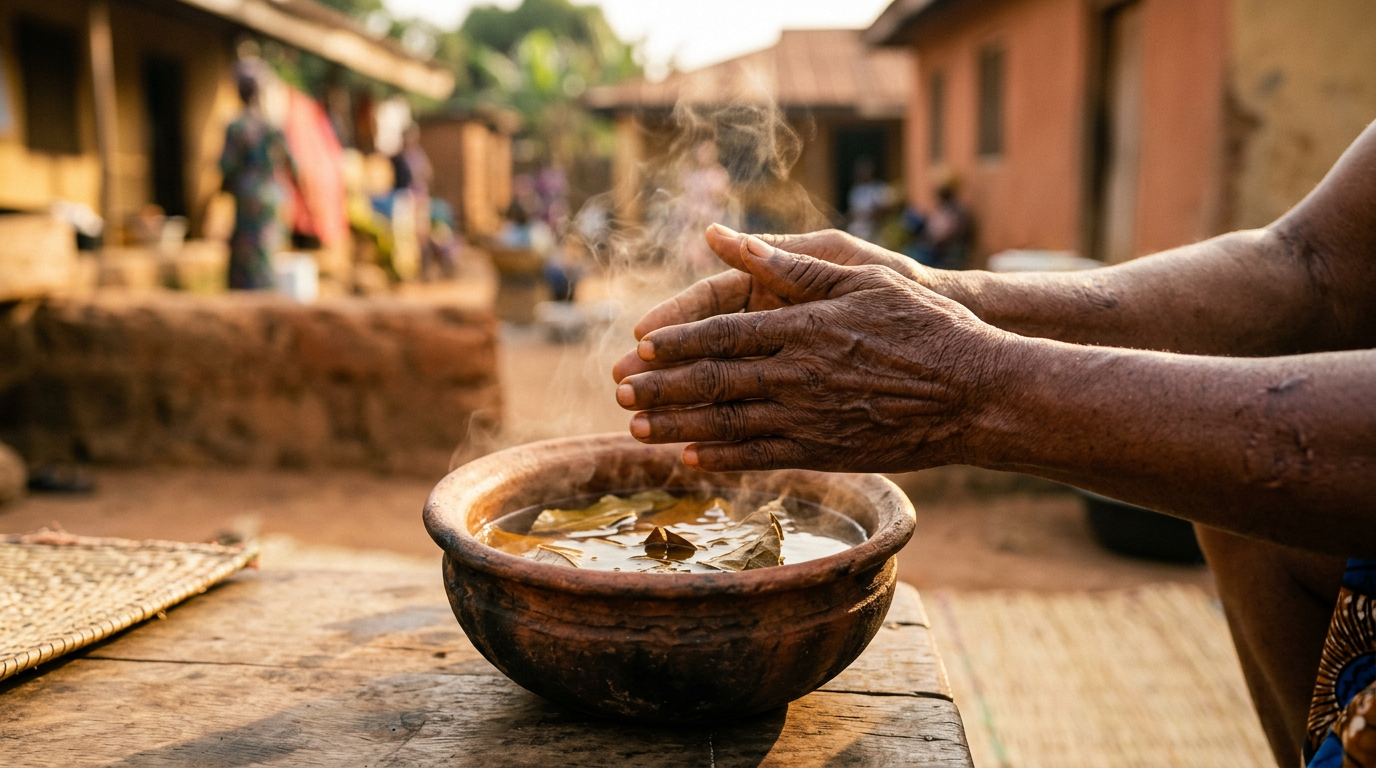
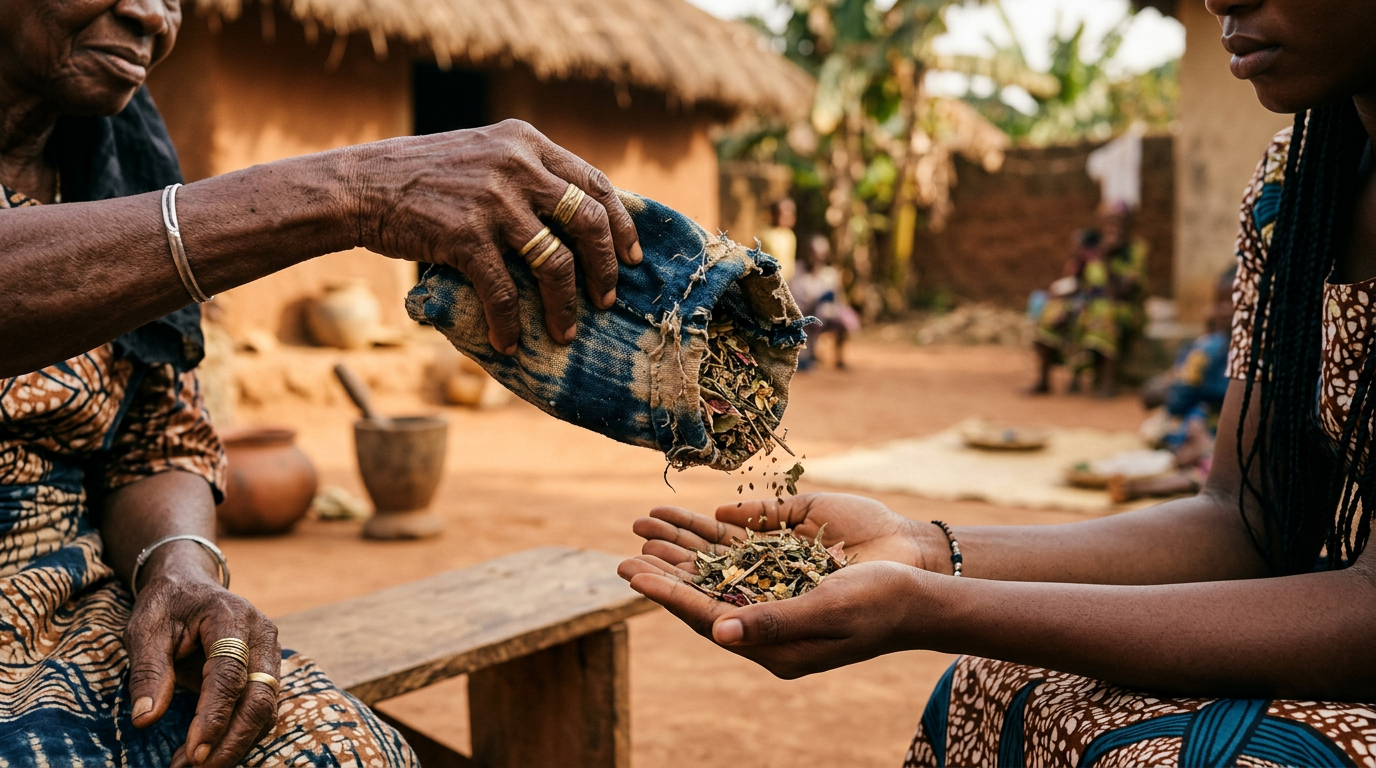
Traditional Yoruba herbal preparations take several forms, each suited to a different dimension of treatment. Omi-èwe — leaves soaked in water — produces infusions used either for drinking or for ritual bathing. Agbo refers to decoctions, plants boiled to release deeper properties, often used for more acute physical conditions. Poultices are applied topically for localized complaints. Some preparations are burned to produce ritual ash or incense with both physical and spiritual applications.
The spiritual baths and cleansing rituals in Yoruba tradition that practitioners perform are not separable from the herbal element; the ewé in the bath water is precisely what carries the àṣẹ into the body. Form follows function, and function is always dual — physical and spiritual simultaneously. Choosing the wrong preparation method for a given Odù-prescribed remedy is understood as a meaningful error, not just an aesthetic one.
The Babaláwo and oníṣègùn: Healers Within the Ifá System
Distinct Roles and Areas of Expertise
The Ifá healing system involves at least two distinct specialist roles, though the line between them is not always absolute across all lineages. The Babaláwo (literally, "father of secrets") is an initiated Ifá priest whose primary function is divination — consulting the Odù to diagnose the roots of illness and prescribe the appropriate response, which may include herbal remedies, ritual acts, or both. The oníṣègùn is the herbalist specialist, whose knowledge centers on the plant pharmacopoeia: which ewé carry which properties, how to prepare them, when to harvest.
These roles are complementary by design. The Babaláwo provides the diagnostic framework and the spiritual prescription; the oníṣègùn provides deep botanical expertise and preparation skill. In practice, some practitioners carry both capacities, and in some lineage traditions there is significant overlap. The distinction is best understood as a structural one — a division of knowledge that the tradition recognizes — rather than an absolute separation that holds universally.
Training and Knowledge Transmission
The scope of a Babaláwo's required knowledge is genuinely staggering. Training encompasses mastery of hundreds of Odù Ifá verses, herbal medicine, ritual performance, divination technique, and Yoruba spiritual philosophy. This knowledge is passed down through multi-year apprenticeship under a recognized elder rather than through formal institutional coursework. The transmission is relational, embodied, and incremental.
The role of the Babaláwo in Ifá practice reflects a model of education where the teacher's spiritual authorization — their lineage provenance — is as essential as the content they transmit. You cannot simply learn the correct verses from a text. The verses must be received from someone whose own reception was valid, creating an unbroken chain of transmission that reaches back to the tradition's origins.
UNESCO's documentation explicitly notes that aging priests, facing limited resources and the aftereffects of colonial suppression, now struggle to transmit the tradition to younger generations. That pressure is not abstract — it is a measurable gap in initiated knowledge carriers that grows each year an elder passes without fully trained successors.
Odù Ifá as the Source of Healing Wisdom
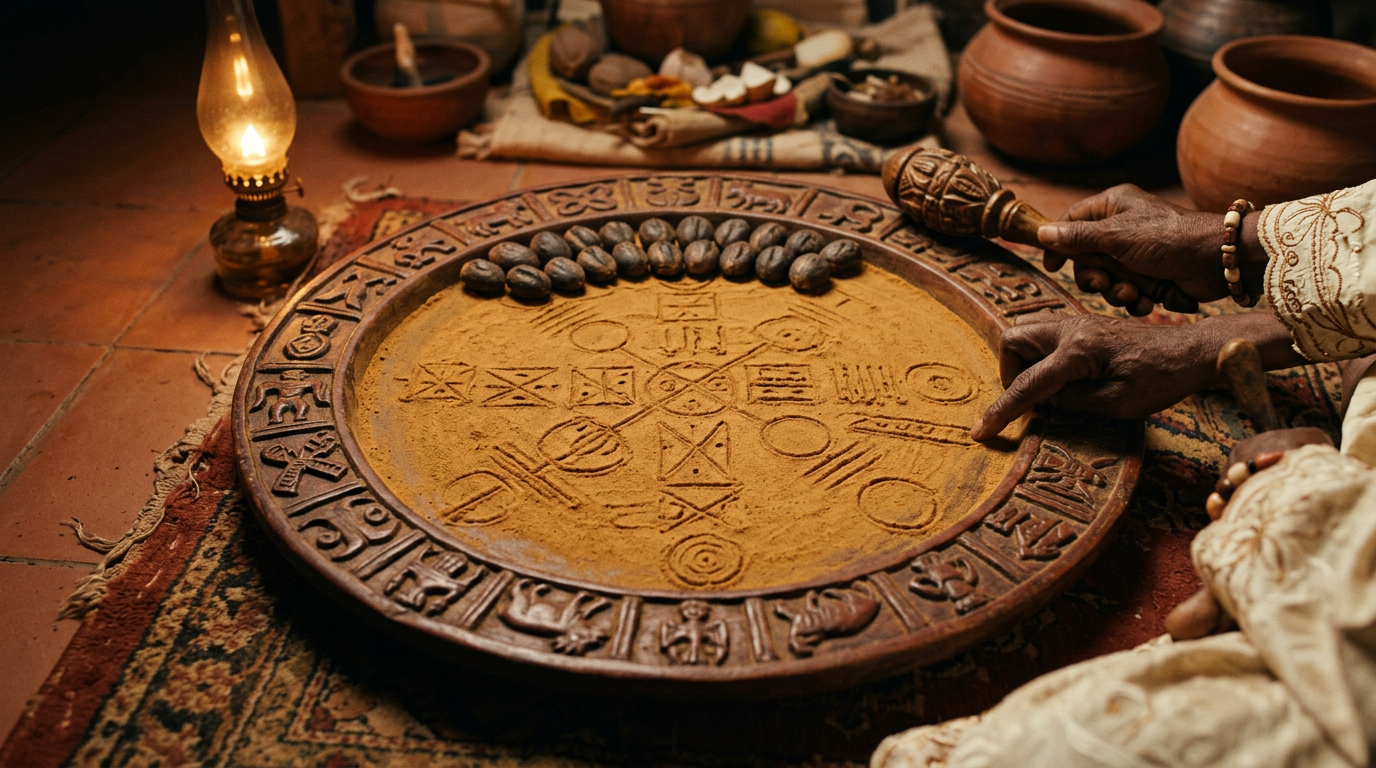
The Ifá literary corpus is vast by any measure. It consists of 256 Odù, each subdivided into ese (verses), with the total number of ese described as fluid and continuously growing rather than fixed. The UNESCO record acknowledges that the corpus encodes healing knowledge, moral philosophy, and cosmological wisdom across this enormous body of oral text.
Healing instructions within the Odù are not filed under a separate medical category. They appear embedded within narrative, myth, and ethical teaching — often as the resolution of a dilemma an ancient figure faced and how the correct ritual response saved them. This narrative structure means that a Babaláwo reading a Odù to address a patient's illness is simultaneously consulting a story, a moral precedent, and a practical prescription. The three are inseparable. Odù Ifá and their teachings represent one of the world's most comprehensive indigenous knowledge archives, one in which healing and wisdom literature have never been split into different genres.
Because of this structure, claims that a specific plant remedy comes from a specific Odù require care. Such connections are real and documented within the tradition, but they should be transmitted through initiated practitioners and verified primary texts rather than generalized summaries. The specificity is the point — and generalizing it removes the very precision that makes the system work.
Preserving Yoruba Herbal Wisdom in the Modern World
Challenges Facing Traditional Knowledge
The threats to Yoruba herbal knowledge are multiple, and they compound each other. Colonial rule and missionary pressure actively stigmatized Ifá and Yoruba healing for generations, framing these practices as primitive or dangerous. UNESCO confirms this suppression as a primary cause of transmission disruption — knowledge was driven underground, practitioners were discouraged or punished, and the prestige that would have attracted young apprentices was systematically undermined.
Alongside cultural suppression, Yoruba plant knowledge faces the threat of biopiracy — the commercialization of traditional botanical knowledge by pharmaceutical and cosmetic industries without attribution, consent, or compensation to the communities that developed and maintained it over centuries. Research from the International Institute for Environment and Development documents how traditional knowledge systems broadly face this extraction dynamic, and Yoruba herbal practice is not exempt. When a compound isolated from a traditionally used plant becomes a patented pharmaceutical ingredient, the community that knew about it for generations often receives nothing.
Urbanization adds another layer. As younger Yoruba generations move into cities and global labor markets, the apprenticeship model — which requires sustained physical proximity to an elder over years — becomes logistically difficult to maintain.
How Practitioners and Communities Are Keeping the Tradition Alive
Preservation efforts are real and varied. Diaspora communities in Brazil, Cuba, and the Caribbean have maintained Yoruba plant-healing practice continuously since the transatlantic slave trade, adapting ewé traditions to new botanical environments while preserving core ritual logic. Widely cited scholarship documents that in Candomblé, for instance, the ritualistic use of sacred leaves remains the primary community health modality — a testament to the tradition's resilience across radical geographical displacement.
Within Nigeria and the broader global Ifá community, practitioners and tradition-affiliated institutions are working to document Odù verses, record elder knowledge, and create apprenticeship structures that can survive modernization. Digital archives, introduction to Ifá divination materials, and community education programs have all entered the picture. The urgency is genuine: every elder who passes without a fully trained successor carries knowledge that cannot be reconstructed from texts alone.
The tradition is not frozen. It is living, adaptive, and worth the effort of its own community to protect on its own terms — not as a museum artifact, but as a functioning healing system with something real to offer anyone willing to approach it with appropriate respect.
Where the Tradition Stands — and Where You Can Begin
Yoruba herbal medicine is neither a relic nor a curiosity. It is a complete healing framework with its own epistemology, its own specialist practitioners, and a literary corpus — the Odù Ifá — that encodes millennia of diagnostic and botanical wisdom in hundreds of thousands of verses. The plants are real. The ritual protocols are specific. The healers are trained. And the tradition, despite centuries of suppression and extraction, is still being transmitted.
If you are a practitioner or student, the most important step is the same one the tradition has always required: find a legitimate lineage, work with an initiated teacher, and approach the ewé with the respect that Kòsí ewé, kòsí Òrìṣà demands. Books and articles — including this one — can orient you, but they cannot initiate you. The knowledge lives in people, passed from person to person across generations, exactly as it always has.