Òrúnmìlà: Òrìṣà of Wisdom, Witness to Destiny, Patron of Ifá
You may already know that Ifá divination accesses destiny — but the reason why it can do that traces to a single figure who was present when destiny was first assigned. This article covers Òrúnmìlà's identity, his cosmological position, his living presence in Odù Ifá narratives, the praise poetry dedicated to him, and what his teachings demand of practitioners today. It is written for those who already know the landscape of Yorùbá spiritual tradition and want a reference that holds the cosmological, liturgical, and ethical dimensions together.
Who Is Òrúnmìlà? An Introduction to the Òrìṣà of Wisdom
Òrúnmìlà is the Òrìṣà of wisdom, knowledge, fate, prophecy, enlightenment, and divination. He is not a deity who arrived alongside humanity — he is a primordial Irunmọlẹ (a divine being of the primordial order) who existed before the creation of humanity. That pre-human existence is not incidental biographical detail; it is the foundation of every authority he holds.
The Name Òrúnmìlà and Its Meaning
The name Òrúnmìlà carries more than one reading, and the variation is itself instructive. Scholars and practitioners most commonly interpret it as "Heaven knows the person that will succeed," while a related reading renders it as "only heaven knows the means of salvation." A third interpretation found in some lineages translates it closer to "God knows Ẹ̀là," connecting the name to another divine designation. No single reading has won universal acceptance, and practitioners familiar with different lineage traditions will defend their preferred etymology with care. What all three interpretations share is the same structural logic: the name locates Òrúnmìlà's authority in a knowledge that originates in the heavenly realm, not the earthly one.
Òrúnmìlà's Place Among the Òrìṣà
Within Yorùbá cosmology, Ifá tradition frames its spiritual universe as balanced on three legs: Òrúnmìlà, the Òrìṣà (the divinities), and the Ancestors — with Olódùmarè, the supreme being, as the transcendent source who does not intervene directly in daily human affairs. Òrúnmìlà occupies a position no other Òrìṣà shares. He is praised as Igbákejì Olódùmarè, "second in command to Olódùmarè," a title that signals not subordination so much as a closeness that no other divine being holds. He is, in effect, the active divine intelligence nearest to human life — the figure through whom Olódùmarè's knowledge reaches the world.
Elérìí Ìpín: The Witness to Destiny
The epithet that best captures Òrúnmìlà's unique cosmological function is Ẹlẹ́rìí Ìpín, "witness to destiny" or "witness to the portion." Yorùbá cosmology holds that before incarnation, each soul selects its Orí — its individual destiny, its inner head — from heads fashioned by the divine potter Ajala. Òrúnmìlà was present in that heavenly space when each soul made its choice. That witnessing is precisely why Ifá divination can access destiny: the knowledge was recorded at the moment of original choosing, and Òrúnmìlà carries it. When a Babáláwo casts the sacred palm nuts (Ikin) or the divining chain (Ọ̀pẹ̀lẹ̀), the encounter is not with speculation — it is with a witness who was there.
Òrúnmìlà in Yorùbá Cosmology and Creation
In Yorùbá cosmology, Òrúnmìlà was present at the ordering of the universe, witnessing the cosmic laws that govern destiny — which is why Ifá divination can address those laws with authority rather than speculation. His position is not that of a late arrival called in to assist; he belongs to the original order of things.
Òrúnmìlà's Presence at Creation
Tradition holds that Òrúnmìlà descended with the other primordial divinities when Olódùmarè sent beings to organize the earth. Unlike Òrìṣà whose domains are elemental — iron, water, thunder — Òrúnmìlà's domain is knowledge itself. He observed the laying down of cosmic law. The Odù Ifá narratives return to this moment repeatedly, not as nostalgia but as explanation: the reason divination works is that the diviner is consulting a being who saw the original blueprint.
The Relationship Between Òrúnmìlà and Olódùmarè
Olódùmarè does not speak directly to human beings. In Yorùbá religious understanding, the supreme being is transcendent — present everywhere but directly accessible nowhere. Òrúnmìlà bridges that gap. His epithet Igbákejì Olódùmarè marks him as the foremost divine intermediary, the one being whose knowledge of Olódùmarè's will is most complete. This is why Ifá divination carries the weight it does within the tradition: it is understood as consulting the one figure closest to the source of all knowledge.
Òrúnmìlà and Orí: Destiny and the Inner Head
Orí is the Yorùbá concept of the inner spiritual head — not a metaphor for personality in the Western psychological sense, but a distinct spiritual entity, chosen before birth and carried into life. Souls select their Orí before descending to earth; some choices are wise, some are poor, and the quality of the choice shapes the arc of a life. Òrúnmìlà's role as Ẹlẹ́rìí Ìpín means he holds knowledge of what each soul originally chose. Ifá divination, in this framework, is the technology by which a person can realign with the destiny their Orí carries — correcting course through sacrifice (Ẹbọ) and right action rather than remaining trapped by ignorance of what was originally intended.
Òrúnmìlà as the Patron and Foundation of Ifá
Ifá and Òrúnmìlà are inseparable, but they are not identical. Ifá is the divination system — the corpus of oral scripture, the ritual methodology, the ethical framework. Òrúnmìlà is its patron, its source, and its divine foundation. The system has a structure; he is the intelligence that generated it. One is the vessel; the other is what fills it.
How Òrúnmìlà Brought Ifá to Humanity
According to Ifá teaching, Òrúnmìlà received the knowledge of Ifá directly from Olódùmarè and transmitted it to humanity. This is not a story of human discovery or scholarly accumulation. It is a story of divine gift: a body of knowledge that originated in the heavenly realm, carried by a being who witnessed the cosmic order, delivered to human beings through a lineage of initiated priests. The Babáláwo — the priest of Ifá — is, by this account, the human custodian of Òrúnmìlà's wisdom, trained to access and interpret it on behalf of those who seek guidance.
The Sacred Relationship Between Òrúnmìlà and the Babáláwo
The Babáláwo (or Ìyánífá, the female Ifá priest recognized in certain lineages) does not simply perform a ritual technique. The practitioner enters into a relationship with Òrúnmìlà himself, studying for years — often decades — to internalize the Odù Ifá corpus deeply enough to recognize which of the 256 Odù a given divination reveals, and then to recall and recite the appropriate Ese (verses) for that Odù. The role of the Babáláwo in Ifá is therefore less analogous to a fortune-teller than to a scholar-priest whose library is oral, whose seminary is a lineage household, and whose final authority is the Òrìṣà who gave the knowledge in the first place.
Ifá Divination as the Voice of Òrúnmìlà
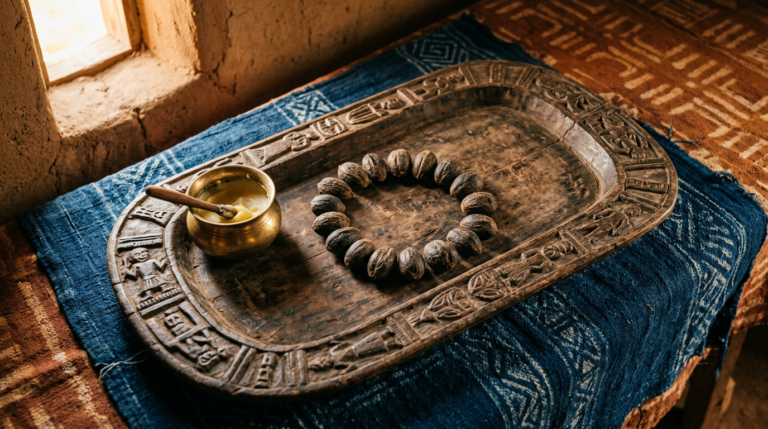
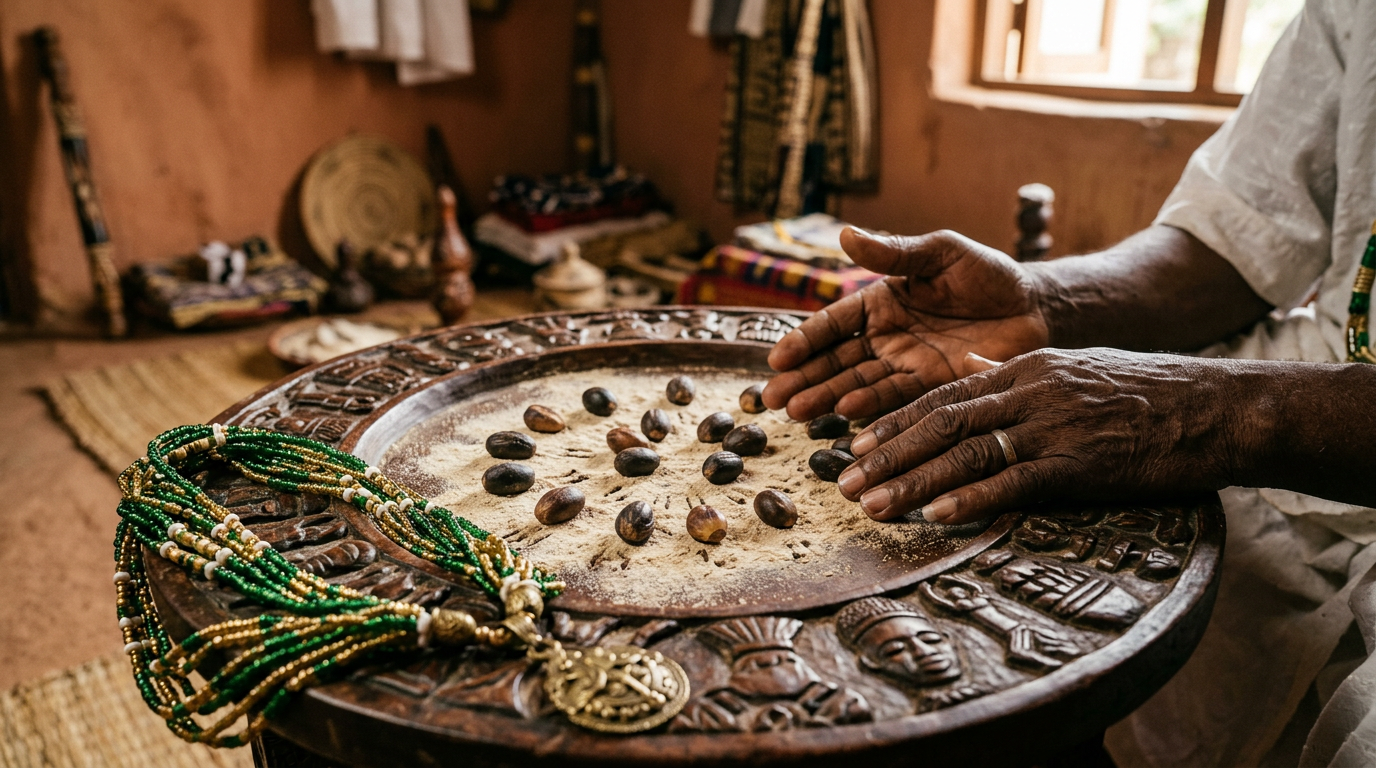
In practice, Ifá divination uses sacred palm nuts (Ikin) or the divining chain (Ọ̀pẹ̀lẹ̀) on a divination tray (Ọpọ́n Ifá) to produce a mathematically determined Odù — a binary geomantic calculation that identifies which of the 256 Odù governs the client's situation. UNESCO inscribed the Ifá divination system in 2008 on its Representative List of the Intangible Cultural Heritage of Humanity, recognizing a practice first proclaimed in 2005. The inscription describes a corpus of 256 Odù, each subdivided into verses (Ese), with approximately 800 Ese per Odù — a body of oral scripture that encodes Yorùbá history, cosmology, ethics, and social knowledge in a form that has been transmitted across generations without written text. When the Babáláwo speaks the Ese that corresponds to a client's Odù, the tradition holds that it is Òrúnmìlà's voice reaching across time.
Oríkì and Praise Names of Òrúnmìlà

Praise poetry in Yorùbá culture is not decoration. It is technology — a functional liturgical instrument through which Òrúnmìlà's presence is invoked, his attributes enumerated, his history rehearsed, and his power called into the ritual space. The Oríkì of Òrúnmìlà are used in Ifá ceremonies not as an optional flourish but as active invocation, and a study published in the Cambridge journal Africa established that Yorùbá Oríkì constitute a primary oral archive of historical, theological, and genealogical knowledge — meaning these verses carry evidentiary weight, not merely aesthetic value.
Key Praise Names and Their Significance
Two praise names stand above all others in terms of breadth of attestation across traditions. Ẹlẹ́rìí Ìpín ("witness to destiny") grounds his authority in cosmological event: he was present at the moment destiny was assigned. Igbákejì Olódùmarè ("second in command to Olódùmarè") grounds it in divine hierarchy. Together they frame who Òrúnmìlà is from two directions — what he witnessed, and where he stands.
Some lineages also use the name Àgbọnnìrègún, which certain practitioners recognize as an alternative name connecting Òrúnmìlà to the Ifá corpus itself. This name varies in usage across lineage traditions and is drawn from practitioner oral transmission rather than a single codified source; those trained in lineages that use it will recognize it immediately, while others may encounter it rarely. The principle holds across all of Òrúnmìlà's praise poetry: names encode theology. Each epithet is a compressed doctrine about his nature, and reciting it is an act of affirmation, not mere description.
Understanding Oríkì as Living Theology
Oríkì are not static texts. They grow. Babáláwo lineages add verses across generations, incorporating new events, new teachings, and new manifestations of Òrúnmìlà's attributes into the oral record. This makes Oríkì a living theological document — not frozen in a founding moment but continuously developed by those who carry the tradition forward. For the practitioner, chanting an Oríkì of Òrúnmìlà is a participatory act: the chanter joins a chain of voices stretching back to the point at which Òrúnmìlà first made himself known to humanity, and the verse carries that accumulated weight in every performance.
Òrúnmìlà in the Odù Ifá: Stories and Teachings
The Odù Ifá portray Òrúnmìlà as a being who walked the earth, consulted the oracle, made sacrifices, faced adversity, and emerged transformed — making the corpus less a mythology of distant events and more a set of lived accounts from a wisdom-being who intervened directly in human history. Across the 256 Odù and their thousands of Ese, Òrúnmìlà appears as protagonist, counselor, and model: a figure who demonstrates through action what the tradition teaches in principle.
Some scholars have framed this in striking terms. The philosopher Sophie Oluwole argued that the Ifá corpus, with its 256 Odù and binary combinatorial logic, constitutes a form of systematic philosophy and epistemology — not supernatural guesswork, but a structured knowledge system grounded in Òrúnmìlà's witnessing of universal order. To understand Odù Ifá through this lens is to see the narratives not as folklore but as a philosophical archive.
Òrúnmìlà's Journey to Earth in Odù Narratives
Tradition holds that Òrúnmìlà incarnated on earth multiple times, distinguishing him from most Òrìṣà who operate through human intermediaries without themselves taking human form. This is a theologically significant distinction. It means the Odù Ifá stories are not recollections of a god observed from a distance; they are accounts of a being who experienced limitation, hunger, misfortune, and triumph in embodied form. He was rejected by communities that later needed his knowledge. He suffered the consequences of his own lapses, then corrected them through the very process Ifá recommends: consultation, prescription, sacrifice.
Moral and Spiritual Lessons from Òrúnmìlà's Stories
The pattern is consistent enough across Odù to be read as doctrine. Òrúnmìlà consults Ifá. He receives instruction. He performs Ẹbọ. The outcome shifts in his favor. When he neglects consultation — and the narratives include stories of his neglect as well as his faithfulness — things go wrong in ways that are then corrected through return to the process. This makes the Odù Ifá stories something closer to case law than mythology: each verse is a precedent, a recorded instance of what happens when Ifá's guidance is followed or ignored.
Recurring Themes: Patience, Knowledge, and Sacrifice
Patience in Ifá's Odù narratives is not passive waiting. It is disciplined non-reaction — the refusal to act on incomplete information before consulting the oracle. Òrúnmìlà models this in story after story, often delaying decisive action long past the point where human impatience would have intervened, and being vindicated by that delay.
Knowledge, as Ifá frames it, is not accumulated data. It is recognized pattern — the ability to identify which Odù governs a situation, which Ese applies, and which sacrifice is prescribed. Òrúnmìlà's knowledge is exhaustive precisely because he was present when the patterns were laid down. The Babáláwo who has memorized thousands of Ese is approximating, through years of study, the completeness of that original witnessing.
The role of sacrifice — Ẹbọ — runs deeper than exchange or appeasement. Across the Odù corpus, Ẹbọ functions as alignment: an act that brings the petitioner's situation into harmony with the prescription Ifá identified. It is the practical hinge between consultation and transformation. Without it, the divination is diagnosis without treatment. In the stories, Òrúnmìlà's own willingness to offer sacrifice when instructed to do so models the posture the tradition asks of every practitioner.
Veneration and Worship of Òrúnmìlà
Venerating Òrúnmìlà is an ongoing practice structured around specific ceremonies, sacred objects, and initiatory commitments — not a diffuse spiritual sentiment but a set of concrete acts within a living tradition.
Ceremonies and Rituals Honoring Òrúnmìlà
The principal ceremony honoring Òrúnmìlà is the Ìtẹ̀fá initiation, but regular Ifá consultation itself constitutes an ongoing act of veneration. When a Babáláwo divines, the ritual space — the Ọpọ́n Ifá (divination tray), the Ikin (sacred palm nuts), the invocatory prayers — is prepared in a manner that formally invites Òrúnmìlà's presence. The chanting of appropriate Oríkì at the opening of a divination session is not preamble; it is the moment the Òrìṣà is called in.
Annual festivals and lineage-specific celebrations also mark Òrúnmìlà's presence in community life. In Yorùbá communities in Nigeria, and in diaspora communities from Cuba to Brazil to the United States, festivals dedicated to Òrúnmìlà involve communal Ẹbọ, recitation of Odù, and the gathering of practitioners to reinforce both their personal relationship with the Òrìṣà and their bonds with each other as custodians of the tradition.
Sacred Items and Symbols Associated with Òrúnmìlà
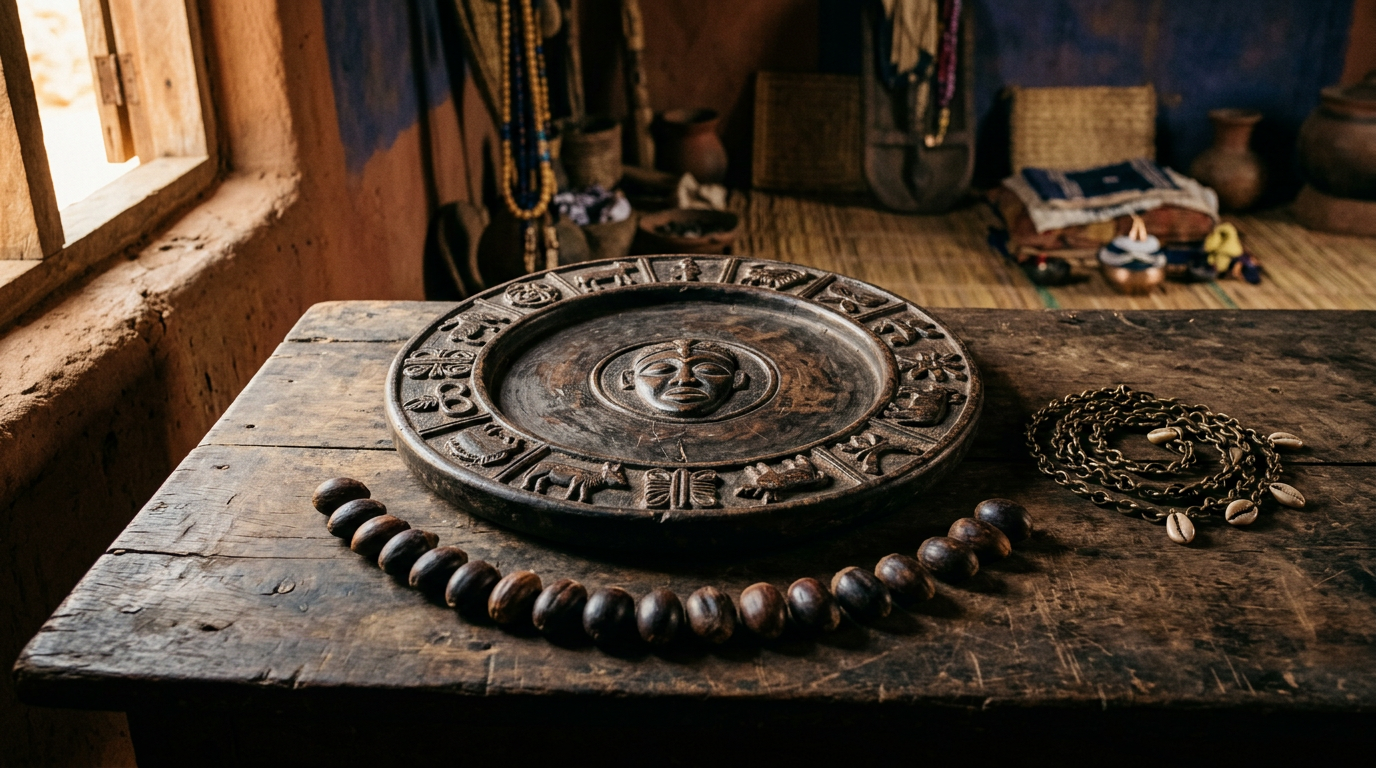
The primary sacred implements associated with Òrúnmìlà are those used in divination: the Ọpọ́n Ifá (carved wooden divination tray), the Ikin (sixteen sacred palm nuts), and the Ọ̀pẹ̀lẹ̀ (divining chain). These are not decorative artifacts. They are instruments through which Òrúnmìlà's voice is accessed, and they are treated with corresponding care — consecrated, stored properly, and handled within the bounds of ritual protocol.
The color green is associated with Òrúnmìlà in many lineage traditions, along with yellow and brown, reflecting the palm tree's hues. Beaded necklaces (Ileke Ifá) in these colors are worn by initiated practitioners as a visible sign of their relationship with the Òrìṣà.