
I was having a rivitting conversation with my Ori, and all of a sudden I hear the following words:
“Can you create a philosophical observation about the mind of the United States as it has evolved over the last 50 years and how it must evolve if maturity does not catch up to its current evolution?”
I was blown away…. what a challenge!
So I thought about it, and I decided “I can”.
So I researched, and wrote this post which I titled;
The American Mind at the Crossroads: An Ifá Perspective on Power Without Wisdom
How the acceleration of information broke America’s spiritual compass – and what ancient wisdom teaches about finding our way back
I watched it happen in real time.
Over the last fifty years, I’ve witnessed America download the entire internet into its consciousness while forgetting how to sit quietly with a single thought. We learned to process a thousand opinions before breakfast but lost the ability to hold one clear intention. We built towers that touch the sky while our roots withered in soil we no longer even see.
The American mind has become intoxicated with speed, information, and power – but somewhere along the way, we abandoned the spiritual center that gives these tools meaning.
This isn’t about politics. This isn’t about choosing sides in the latest cultural war. This is about something far more fundamental: the dangerous asymmetry between our technological capabilities and our spiritual maturity. And if you’re reading this, feeling the tension, sensing that something essential has been lost – you’re not wrong.
As a Babalawo who has watched this transformation unfold, I see it clearly through the lens of Ifá: America is suffering from acceleration without integration. And unless maturity catches up to our evolution, we’re headed for a reckoning that no amount of innovation can solve.

The Evolution: From Delay to Instant Gratification
In 1975, life moved at a different rhythm. News came once a day. Conversations required physical presence. Boredom forced you to sit with yourself, to think, to wonder. If you wanted to know something, you went to a library. If you wanted to connect with someone, you called them – and if they weren’t home, you waited.
That delay wasn’t a bug in the system. It was a feature that created space for contemplation.
Fast forward to 2026. The average American checks their phone 96 times a day. We consume more information in a single day than our grandparents consumed in a month. We can fact-check anything in seconds, but we’ve lost the patience to verify whether what we’re reading is actually true. We have more “friends” than ever before, yet loneliness has reached epidemic levels.
The American mind has evolved remarkable capabilities: rapid pattern recognition, multitasking, processing vast amounts of data simultaneously. But look at what we’ve atrophied: sustained attention, sitting with uncertainty, holding paradox, deep listening, the ability to be bored without reaching for a screen.
We’ve become magnificent sprinters who’ve forgotten how to walk.
I remember a client who came to me for divination, anxious and scattered. She couldn’t sit still for ten minutes without checking her phone. When I asked her when she last sat in silence, she looked at me like I’d asked her to climb Mount Kilimanjaro. “Silence?” she said. “That’s terrifying.”
That’s when I knew we were in trouble.

What Ifá Teaches About Balance and Center
In Yoruba spiritual philosophy, there’s a principle called Iwa-Pele – good character, balanced conduct, harmony. It’s the foundation of everything. You can have all the knowledge in the world, all the power, all the technology – but without Iwa-Pele, you’re just a hurricane with no direction.
Ifá teaches that true power comes from alignment between your Ori (inner consciousness, your divine self) and your actions in Ayé (the physical world). When these are in harmony, you move through life with purpose, clarity, and balance. When they’re disconnected, you become like a ship with broken navigation – lots of movement, no destination.
America has a broken navigation system.
We’ve accumulated unprecedented power – military, economic, technological – but we’ve lost touch with the wisdom traditions that once provided moral and spiritual ballast. We can split atoms but can’t have a civil conversation with our neighbors. We can sequence the human genome but can’t figure out how to live together without tearing each other apart.
This is what happens when power outpaces wisdom. It’s like giving a teenager the keys to a Ferrari and a bottle of whiskey. The capability is there, but the maturity to wield it responsibly? Not so much.
In my reflection on the 2024 election, I wrote about how real change starts with looking in the mirror. The same principle applies here. We can’t heal America’s fragmentation until we heal our own inner fragmentation. We can’t restore balance to the nation until we restore balance within ourselves.
The Mirror Principle: Your Inner Chaos is America’s Outer Chaos
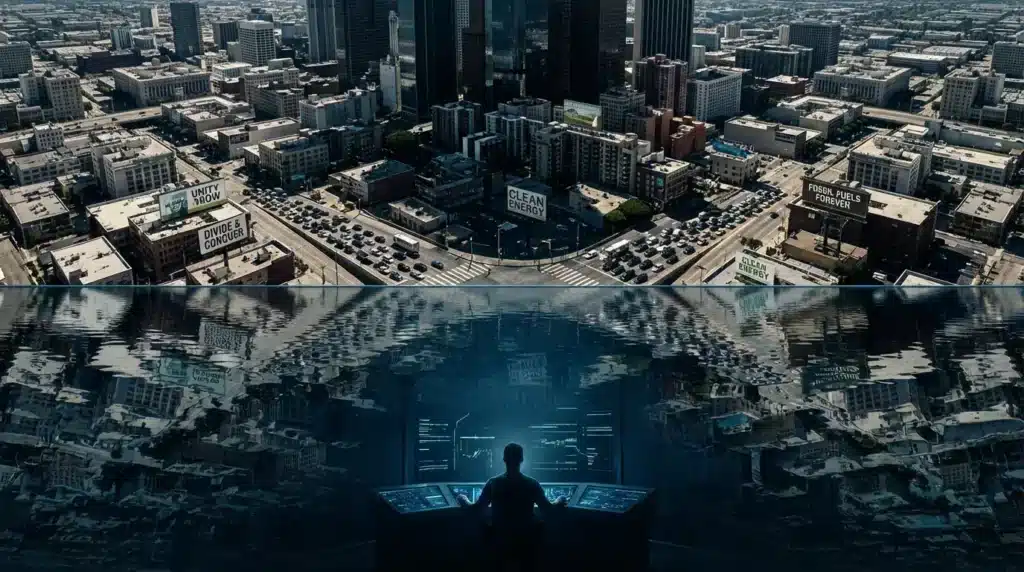
Here’s something most people don’t want to hear: The chaos you see in American discourse is a direct reflection of the chaos in individual minds.
When you scroll through social media at 2 AM, anxiety coursing through your veins, feeding on outrage and fear – you’re not just consuming the chaos, you’re creating it. Every angry comment, every share of sensationalized news, every moment you choose reaction over reflection – you’re adding fuel to the fire.
Ifá teaches that we’re all connected through Aṣe, the universal life force that flows through everything. Your thoughts, your words, your actions – they ripple out into the collective consciousness. There is no such thing as a private thought that doesn’t affect the whole.
I see this in my practice constantly. People come to me wanting to know why their relationships are chaotic, why their communities are divided, why everything feels so unstable. And when I cast Ifá, the answer is almost always the same: Look within first.
The division in America isn’t just “out there” in Washington or on cable news. It’s in the way you talk to yourself. It’s in the judgments you make about people who think differently. It’s in your unwillingness to sit with discomfort, to question your certainties, to admit when you don’t know.
You cannot give what you don’t have. If you don’t have inner peace, you cannot contribute to collective peace. If you don’t have clarity within, you cannot help create clarity without. If you’re fragmented, you will only create more fragmentation.
This is the mirror principle: fix yourself first, and the world around you begins to shift.

The Illusion of Connection
We tell ourselves we’re more connected than ever. Look at all these platforms! Look at all this communication! I can reach anyone, anywhere, anytime!
But connection isn’t the same as communion.
Real connection requires presence. It requires the willingness to be vulnerable, to listen deeply, to sit with another person’s truth even when it makes you uncomfortable. It requires time, patience, and the courage to show up as you actually are, not as your curated online persona.
The paradox of our age is this: we’re drowning in communication but starving for connection. We have a thousand followers but no one who really knows us. We can broadcast our thoughts to the world but can’t have an honest conversation with our own family members.
In Yoruba spiritual tradition, maintaining connection to Ori (your higher self), to the Orisas (divine forces), to ancestors, and to community isn’t optional – it’s the foundation of a meaningful life. These connections ground you. They remind you who you are when the world tells you to be someone else.
But these connections require something America has forgotten how to do: slow down and be present.
You can’t maintain spiritual connection while checking your phone every three minutes. You can’t hear the voice of your ancestors in a mind cluttered with notifications. You can’t know yourself when you’re constantly consuming other people’s opinions about who you should be.

What Happens When Maturity Doesn’t Catch Up
So what happens if we continue on this trajectory? What does America look like in 10, 20, 50 years if we don’t develop the wisdom to match our power?
The pattern is already emerging:
Further fragmentation into algorithmic tribes. We’re already seeing it – people living in completely separate realities, where “truth” is whatever confirms their existing beliefs. The algorithm feeds us more of what we already think, creating hermetically sealed bubbles where disagreement becomes not just uncomfortable but existential threat.
Reaction replacing response. Without the inner stability that comes from spiritual practice, we become purely reactive. Something happens, we react. Someone disagrees, we attack. Uncertainty arises, we panic. We lose the ability to pause, breathe, and choose our response consciously.
The confusion of data with wisdom. We’ll have more information than ever but less understanding. More opinions but less insight. More noise but less signal. We’ll mistake the map for the territory, the menu for the meal, the finger pointing at the moon for the moon itself.
The erosion of shared reality. When everyone lives in their own algorithmic bubble, when no one can agree on basic facts, when truth becomes purely subjective – society fractures. Democracy requires a shared sense of reality. Without it, we’re just shouting past each other into the void.
Collective adolescence. America will remain the adolescent giant – powerful, brilliant in flashes, but lacking the integration to use that brilliance constructively. All energy, no center. All capability, no wisdom. All speed, no direction.
This isn’t inevitable. But it is where we’re headed unless something changes.
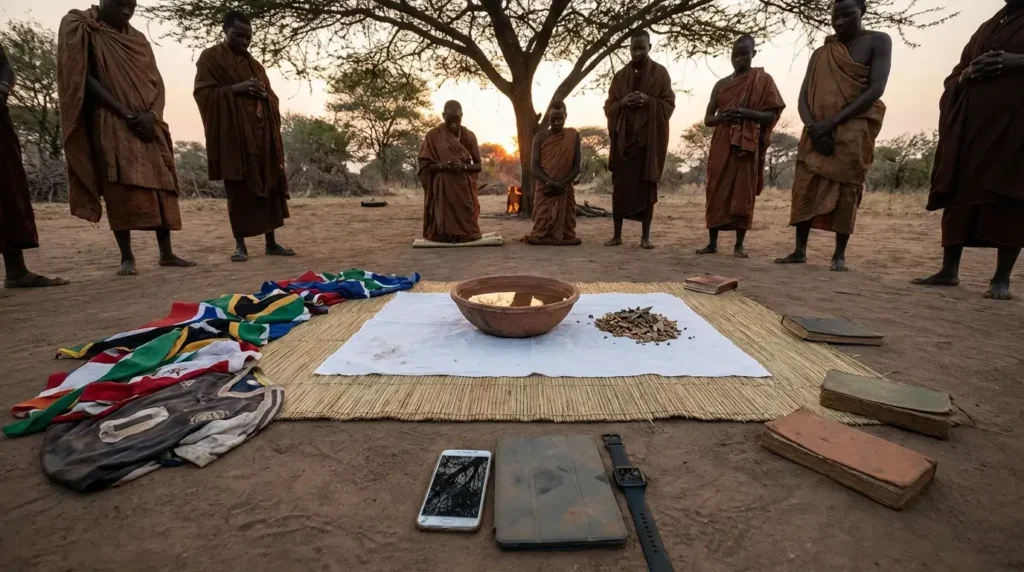
What Must Be Sacrificed: The Ebo America Needs
In Ifá, when we face challenges, we perform ebo – sacrifice or offering. It’s not about appeasing angry gods; it’s about demonstrating commitment to change. It’s about giving up what’s comfortable to receive what’s necessary.
So what must America sacrifice to mature?
First, the addiction to certainty. We need to let go of the illusion that we can know everything, control everything, predict everything. Wisdom begins with admitting “I don’t know.” Maturity starts when you can sit with uncertainty without needing to immediately fill the space with an opinion.
Second, the comfort of tribal thinking. Us versus them. Good guys versus bad guys. My team versus your team. This binary thinking is comfortable because it’s simple. But reality is complex, messy, contradictory. Growing up means being able to hold multiple truths at once, even when they contradict each other.
Third, the belief that technology can solve spiritual problems. No app is going to give you inner peace. No algorithm is going to teach you how to love. No virtual reality is going to connect you with your ancestors. Some problems require ancient solutions, not innovations.
Fourth, the luxury of passivity. You can’t just consume your way to wisdom. You can’t just watch others do the work and hope things get better. Transformation requires participation. It requires you to show up, do your inner work, and take responsibility for your small corner of the world.

The Path Forward: Individual Practices, Collective Ripples
Here’s the good news: you have more power than you think.
Every moment of genuine presence you create is an act of resistance against the forces pulling us toward fragmentation. Every time you choose reflection over reaction, you’re healing not just yourself but the collective consciousness.
Here are practices that create ripples:
1. Daily silence. Start with just five minutes. Turn everything off. Sit. Breathe. Listen to the voice beneath the noise. This is where you reconnect with your Ori, your inner wisdom. This is where clarity lives.
2. Question your certainties. Once a day, take something you’re absolutely certain about and ask: “What if I’m wrong?” Not to become wishy-washy, but to practice intellectual humility. Wisdom knows it doesn’t know everything.
3. Real conversation. Once a week, have a face-to-face conversation with someone – no phones, no distractions. Practice deep listening. Practice being fully present. This is how you remember what real connection feels like.
4. Nature immersion. Spend time in nature without your phone. Let the rhythms of the natural world remind you that there’s wisdom older and deeper than the latest trending topic. The trees don’t check Twitter. Learn from them.
5. Ancestral connection. Honor those who came before you. Not with perfection, but with remembrance. Light a candle. Pour water. Speak their names. You come from a long line of people who survived incredible challenges. Their wisdom lives in you.
6. Conscious consumption. Before you scroll, before you click, before you share – pause and ask: “Does this serve my highest good? Does this align with who I want to be?” You vote with your attention. Choose wisely.
7. Service without expectation. Find one way each week to serve your community without needing recognition or reward. This breaks the addiction to ego and reconnects you with purpose beyond yourself.
These aren’t grand gestures. They’re not revolutionary acts that will change the world overnight. But here’s what I know after forty years of spiritual practice: small, consistent actions in alignment with truth create ripples that eventually become waves.
Imagine millions of Americans each choosing to do this work. Each choosing consciousness over reactivity. Each choosing presence over distraction. Each choosing wisdom over information. That’s how transformation happens – not from the top down, but from the inside out.
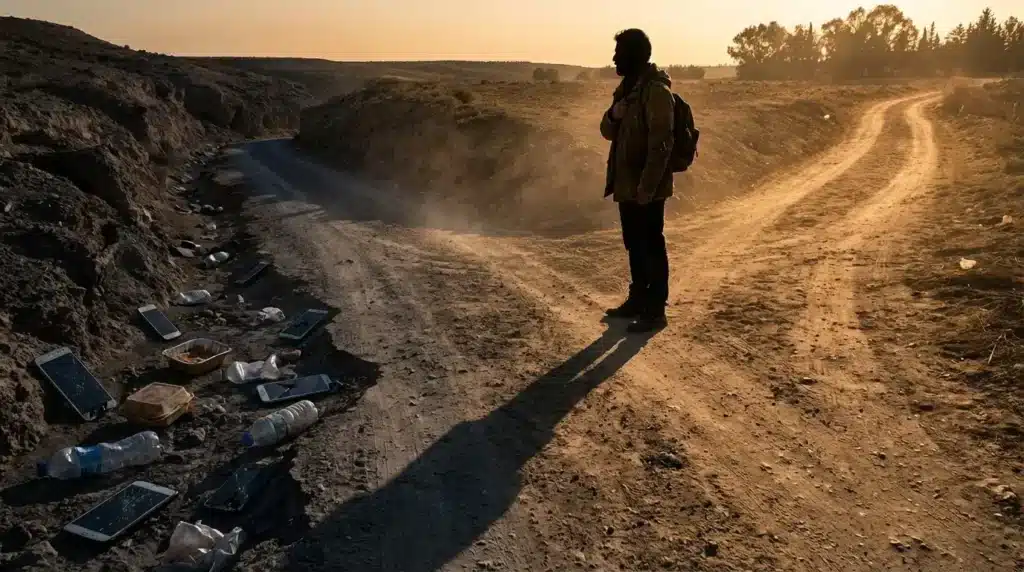
The Choice Before Us
We’re at a crossroads. One path leads deeper into fragmentation, reactivity, and chaos – the adolescent giant stumbling forward with no clear direction. The other path leads toward integration, wisdom, and collective maturity – but it requires each of us to do our inner work.
The question isn’t whether America will change. The question is whether you will.
Because here’s the truth that Ifá has taught me: you cannot control the nation, but you can control yourself. You cannot fix the collective until you heal the individual. You cannot demand that others grow up while refusing to do your own work.
The power has always been yours. Not the power to force others to change, but the power to embody the change you want to see. Not the power to control events, but the power to choose your response to them. Not the power to know everything, but the power to admit what you don’t know and keep seeking.
This is the maturity America needs. And it starts with the person reading these words right now.
So I’ll ask you the same question I ask my clients during divination: What are you willing to sacrifice to become who you’re meant to be? What comforts will you give up? What certainties will you release? What old patterns will you let die so something new can be born?
The American mind stands at the crossroads. One path leads to more of what we already have – speed without direction, power without wisdom, connection without presence. The other path requires us to slow down, look within, and do the hard work of integration.
The choice, as always, is yours.
*Aṣe?