Ifá Divination: The Complete Guide to the Yoruba Oracle System
Few systems of knowledge have been as persistently misunderstood as Ifá divination. Called an "oracle," lumped in with fortune-telling, reduced in popular imagination to a man shaking shells over a bowl — the reality is far richer and far more demanding. This guide walks you through what Ifá actually is, how it works, who practices it, and what it means philosophically, drawing on Yoruba tradition, UNESCO documentation, and practitioner sources to give you a framework you can trust.
Looking for the beginner-friendly primer instead? See our foundational guide to Ifá divination — what it is, how a session works, and why this Yoruba wisdom system endures.
What Is Ifá Divination?
Ifá divination is a structured system of knowledge in which a trained priest interprets a set of sacred signs to provide guidance on human affairs. That one sentence matters more than it might seem. Ifá is not mediumship. The diviner does not become possessed, does not channel a spirit, and does not rely on personal psychic gifts. Instead, as UNESCO's intangible heritage documentation makes explicit, Ifá rests on a systematic body of signs interpreted through disciplined training — a distinction that sets it apart from virtually every other divinatory tradition practiced in the West African region.
The person interpreting these divination signs is not casually trained. If you are curious about the years of apprenticeship and lineage preparation involved, see our companion guide on the path to becoming a Babaláwo.
Think of it less like a séance and more like consulting an extraordinarily sophisticated body of case law. Every situation a human being can encounter has, within the Ifá corpus, a precedent. The priest's job is to locate it.
Ifá as a Knowledge System
The knowledge encoded in Ifá spans ethics, medicine, cosmology, history, and philosophy. The system is oral: its content lives in the memory of trained diviners and in the verses they recite during consultation. There is no single book of Ifá, no canonical written text that one can simply purchase and read. The learning is relational, transmitted from master to student across years of intensive study.
This is precisely what makes Ifá's survival across centuries so remarkable. The tradition has endured colonial suppression, religious persecution, and the catastrophic rupture of the transatlantic slave trade — and it has endured not despite being oral but partly because of it. The corpus lives in people, and people move.
Ifá in the Context of Yoruba Cosmology
Within Yoruba cosmology, Ifá is inseparable from Ọ̀rúnmìlà, the deity of wisdom and divination who was present at the moment of creation and witnessed the destiny assigned to every human soul. The tradition understands the universe as ordered, purposeful, and knowable — and Ifá is the primary instrument through which human beings access that order.
The Yoruba cosmos includes Olódùmarè (the supreme deity), the Òrìṣà (divine forces or "divinities" who govern natural and human affairs), and the ancestors. Ifá sits at the intersection of all three, serving as both a communication channel and a philosophical framework. To understand the Òrìṣà and their roles is to understand why Ifá consults are not merely predictive but prescriptive: the system assumes that a human being's relationship to cosmic forces can be actively shaped, not just passively observed.
The Origin and History of the Ifá Tradition
The tradition begins, mythologically and historically, in a single place.
Ọ̀rúnmìlà — the Witness of Destiny
According to Yoruba tradition, Ọ̀rúnmìlà holds two key titles that define his cosmic role. The first is Elérì Ìpín — "the witness of destiny" — reflecting his presence at the moment each soul chose its path before entering the world. The second is Ibìkéjì Olódùmarè, meaning "second only to the Creator." As the Encyclopedia of African Religion notes, Ọ̀rúnmìlà is understood to be the deity of wisdom, omniscience, and divination — the figure through whom divine knowledge becomes accessible to human beings.
These titles are not ceremonial flourishes. They carry the tradition's epistemological claim: that Ifá's knowledge is not invented by practitioners but transmitted from a source that was present at the origin of things.
Historical Roots in Yorùbáland
According to Yoruba tradition, Ifá originated in Ilé-Ifẹ̀ — the sacred city widely regarded, within Yoruba cosmology, as the literal first place on earth and the cosmological center of Yoruba civilization. The Office of the Ooni of Ife, the most senior traditional seat of Yoruba authority, preserves this account as a foundational cultural fact. It is a mythological claim — but "mythological" in the Yoruba context does not mean fictional; it means foundational.
Historically, Yoruba-speaking peoples have occupied what is now southwestern Nigeria, Benin, and Togo for at least a millennium, and the Ifá tradition appears to have been a defining intellectual institution of that civilization from very early in its documented history. Colonial rule and Christian missionary activity from the nineteenth century onward subjected Ifá practitioners to serious discrimination, and UNESCO has noted that many senior priests reached advanced age without adequate means to transmit the corpus. That active cultural pressure makes the tradition's survival more striking, not less.
UNESCO Recognition and Global Relevance
In November 2005, UNESCO proclaimed the Ifá divination system a Masterpiece of the Oral and Intangible Heritage of Humanity — one of eighty-six traditions worldwide to receive that designation. The UNESCO intangible heritage record RL/00146 describes Ifá as "a system of divination and one of the links of communication between human beings and the spiritual world," formally recognizing it not as folklore but as a living, sophisticated intellectual tradition requiring active protection.
Professor Wándé Abímbọ́lá, the internationally recognized spokesperson for Ifá scholarship and practice, has been central to that preservation effort for decades. The UNESCO recognition did not create the tradition's legitimacy — it acknowledged what practitioners had long maintained.
The Odù Ifá Corpus — 256 Sacred Signs

If Ifá is a system of knowledge, the Odù corpus is its structure. And that structure is precise.
Structure of the 256 Odù
The Ifá corpus consists of 256 signs called Odù. The first 16 are primordial — called the Ojú Odù, or principal Odù — and each of the remaining 240 is generated by combining two of those 16 with each other. The mathematics here is exact: 16 multiplied by 16 gives 256 total signs, each unique, each carrying its own body of knowledge.
This architecture has a structural parallel to binary code. Each Odù is produced through a casting process that generates marks of two possible types — single or double — arranged in four positions on each of two columns. Two positions, two values, four slots per column, two columns: the combinatorics are formally equivalent to an eight-bit binary string. That analogy is genuinely interesting and widely noted in both academic and practitioner literature. It should not be overstated — Yoruba diviners were not doing computer science — but it does illustrate how a simple generative logic can produce a system of extraordinary complexity.
How Odù Carry Meaning Through Verse and Narrative
Each of the 256 Odù is not a bare sign but a library. According to UNESCO's documentation, each Odù contains approximately 800 poetic verses called Ese, though the exact count is unknown because the corpus continues to grow as practitioners compose new verses within traditional forms. A fully trained Babaláwo must memorize enough Ese across enough Odù to serve whatever sign the casting produces — a cognitive demand that helps explain why complete training routinely takes a decade or more.
The Ese are narrative. They tell stories: of Ọ̀rúnmìlà traveling to a distant place, consulting his own diviners, following or ignoring their prescription, and experiencing the consequences. Each story encodes a human situation, a recommended response, and a projected outcome.
Verse. Narrative. Consequence. Prescription.
The Relationship Between Odù and Human Experience
The Odù corpus works on the premise that every human situation is, at its structural core, an instance of a situation that has occurred before — and that Ifá has already addressed. This is why practitioners describe the system as comprehensive: not because it can mechanically predict the future, but because it encodes the full range of human experience in a way that allows analogical reasoning.
A skilled Babaláwo does not simply recite Ese at random. The practitioner identifies which verses are relevant to the querent's actual circumstances, interprets the correspondence between the narrative and the client's situation, and derives from that interpretation a specific course of action. The Odù provides the framework; the practitioner's judgment, memory, and relational intelligence do the rest.
Key Figures in Ifá Practice
Three categories of participant make an Ifá consultation work: the diviner who reads, the client who brings the question, and — depending on the lineage — the female priest who may perform either role.
The Babaláwo — Father of Secrets
Babaláwo means "father of secrets," and the title is earned through an apprenticeship that typically spans a decade or more. Across practitioner sources, most Ifá initiates train that long before being recognized as complete diviners — though the actual duration varies by lineage and individual circumstance, and there is no universal certification body that standardizes the process.
The training is not primarily about ritual mechanics; those can be taught relatively quickly. The real work is memorizing the Ese: thousands of verses across hundreds of Odù, each with its own narrative logic and prescribed outcomes. A Babaláwo who cannot recall the relevant verses when a particular Odù falls has simply not finished learning. The tradition has no shortcut for this. Years of recitation, repetition, and supervised practice are the only path.
The role of the Babalawo extends beyond the consultation room. Senior Babaláwo serve as community counselors, historians, and custodians of Yoruba oral literature. In many communities, a Babaláwo's authority encompasses medical advice, conflict resolution, and lifecycle rituals — because the Odù corpus speaks to all of these domains.
The Ìyánífá — Mothers of Ifá
Ìyánífá — "mothers of Ifá" — are female Ifá priests. Their recognition and scope of practice is one of the genuinely unresolved debates within the contemporary tradition. Some lineages fully recognize Ìyánífá as functional equivalents to Babaláwo, capable of performing complete consultations; others restrict their role significantly, arguing that certain aspects of Ifá initiation are not available to women.
This is a live internal conversation, not a settled matter. Readers coming to Ifá from diasporic traditions may encounter very different positions on this question depending on which lineage or community they are engaging. Presenting either position as universal would be inaccurate.
The Role of the Querent (Client)
The person who comes to Ifá for guidance — called the querent or client — is not a passive recipient. The querent brings a genuine question or situation; they hold the Ikin (sacred palm nuts) and pray while the Babaláwo casts; and they must engage honestly with both the Odù revealed and the prescription that follows. Ifá's logic is relational: the system cannot be useful to someone who approaches it as a test or a curiosity rather than as a sincere consultation.
The querent is also expected to act. Ifá does not deliver answers to be considered and set aside. The Ẹbọ (spiritual remedy or sacrifice) prescribed by the Odù is understood to be necessary for the guidance to take effect — and following through is ultimately the querent's responsibility.
How an Ifá Divination Session Works
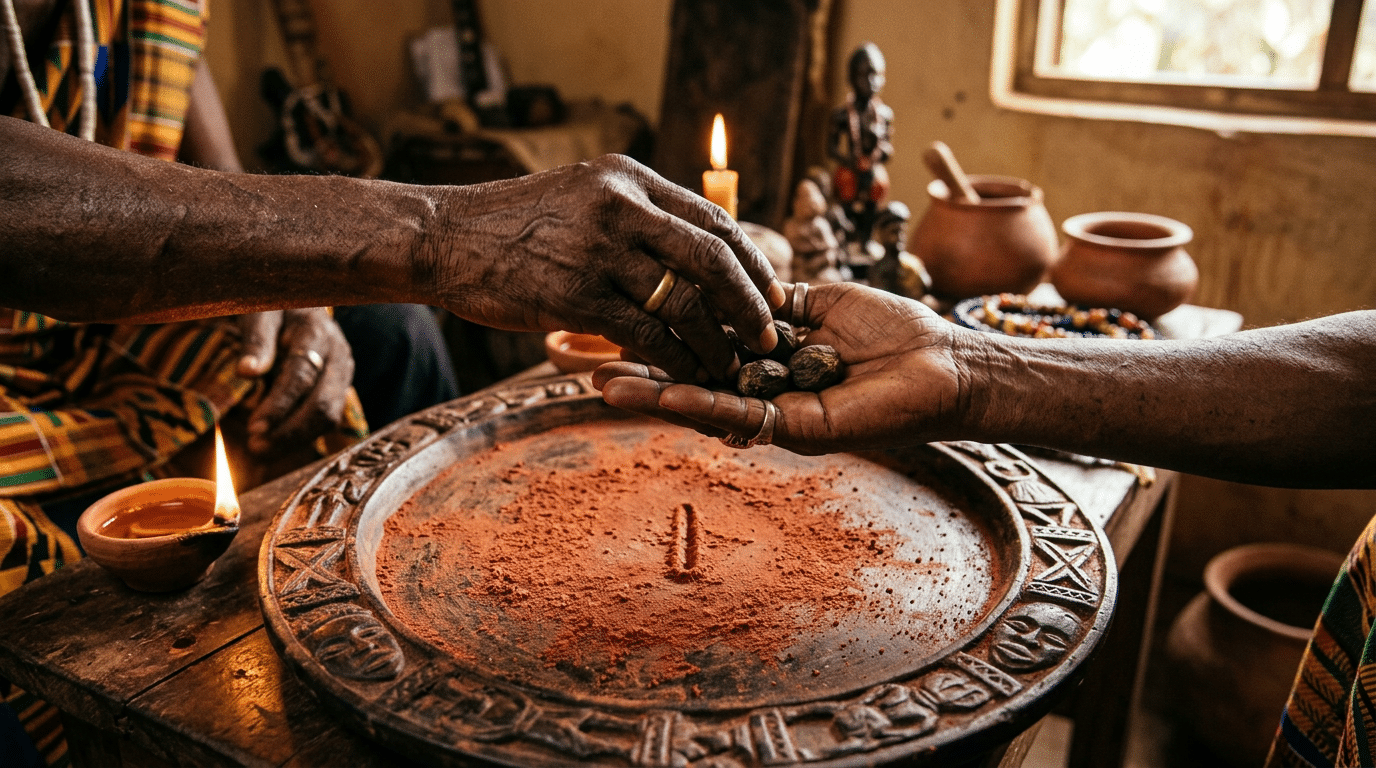
An Ifá consultation follows a sequence that is both ritualized and logical. Each step has a specific purpose, and none is arbitrary.
Sacred Instruments — Ikin, Ọ̀pẹ̀lẹ̀, and the Divination Tray
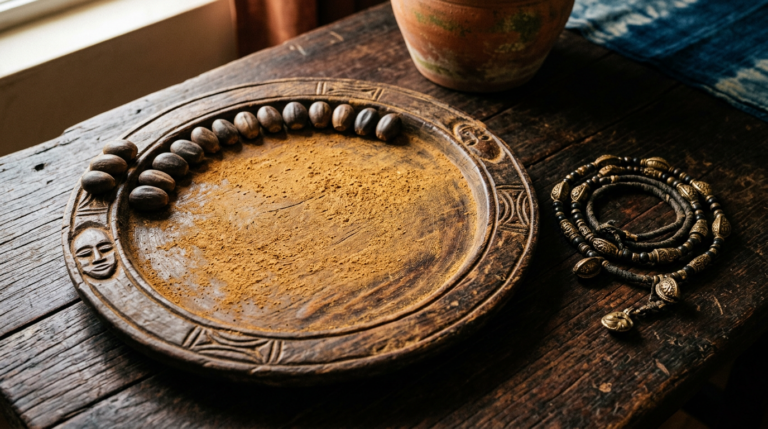
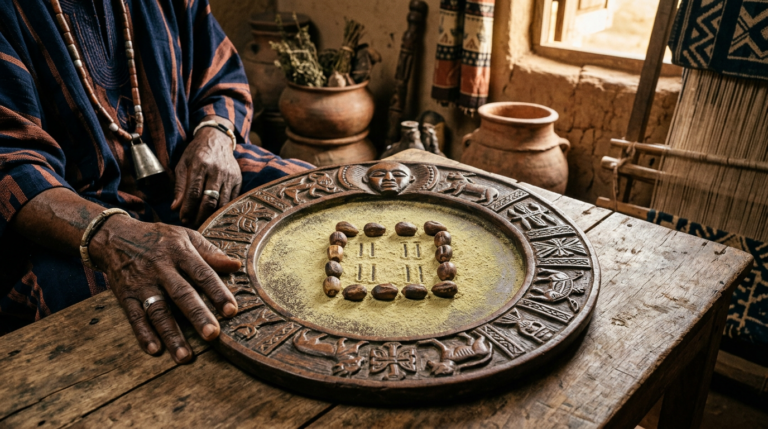
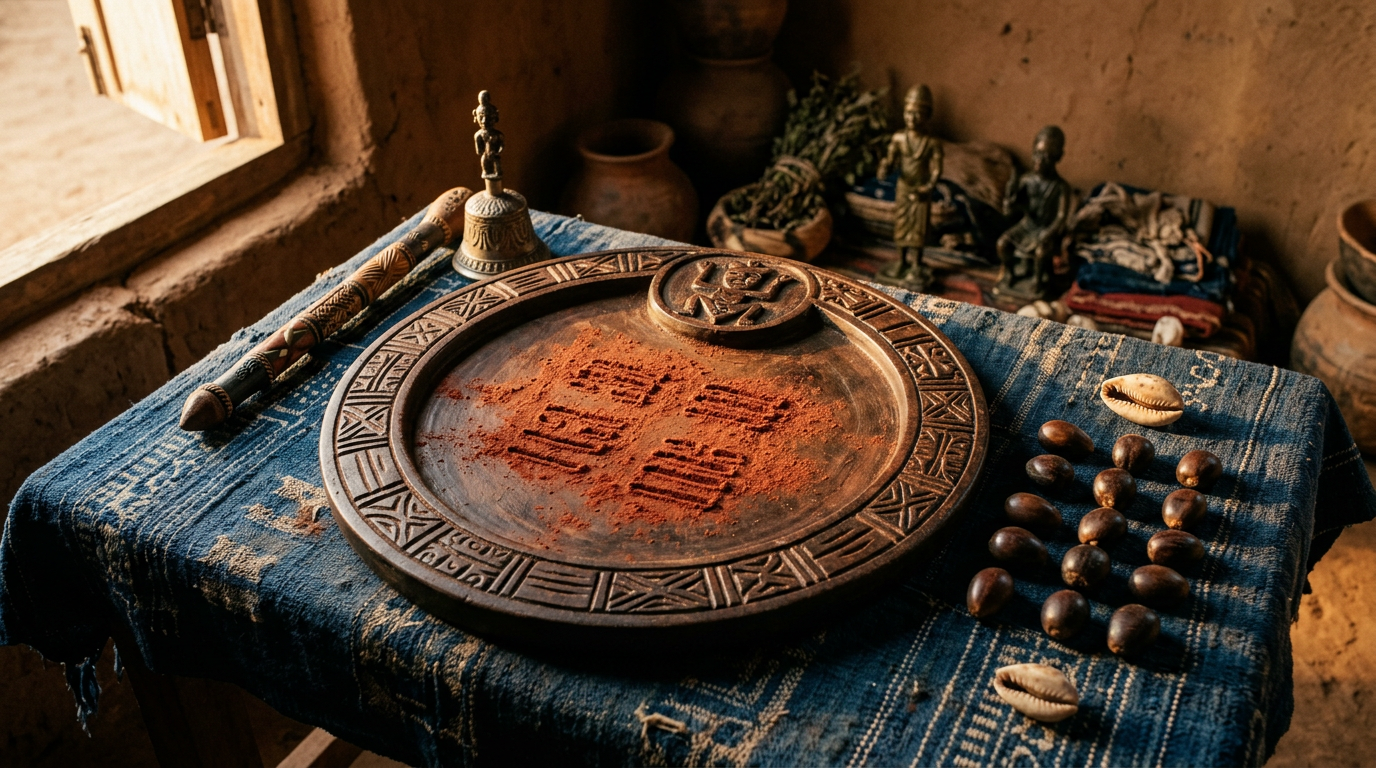
Two instruments generate the Odù signature, and they are not interchangeable. The primary method uses 16 sacred palm nuts — Ikin — which the Babaláwo passes rapidly between both hands. Whichever nuts remain in the right hand after each pass (one or two) determine a single mark on the divination tray. This process is repeated until all eight positions of the Odù signature are filled. The Ikin method, called Dafa, is considered the senior and more authoritative approach.
The Ọ̀pẹ̀lẹ̀ is a divination chain of eight seed pods, cast in a single throw to produce the same eight-position signature more quickly. The Ọ̀pẹ̀lẹ̀ is practical for everyday consultations; the Ikin is reserved for major questions and formal ritual occasions.
Both methods produce marks in Iyẹrọsun powder — a red camwood dust — spread across the Opọn Ifá, a carved wooden divination tray. The marks become the visible record of the Odù. The tray itself is a sacred object, typically carved with imagery of Ẹṣù-Elegba at the top, acknowledging the divine messenger who facilitates communication between realms.
The Process of Casting and Reading Odù
Once the Odù is marked on the tray, the Babaláwo has identified which of the 256 signs governs this consultation. The practitioner then draws on memory to recall the relevant Ese — verses that correspond to the querent's stated situation — and recites them. The verse tells a story. The Babaláwo then interprets the correspondence between that story and the querent's actual circumstances.
The reading also identifies the Odù's valence: whether the sign has fallen in an auspicious orientation (Iré) or a challenging one (Ibì). An Iré reading confirms that the path ahead is supported; an Ibì reading signals that something needs to change before the desired outcome can occur. Neither is a verdict. Both are navigational.
Ẹbọ — Sacrifice and Spiritual Remedy
Ẹbọ is the action that completes the consultation. It is never self-prescribed — the Ifa Foundation is clear that Ẹbọ derives specifically from the Odù revealed in consultation and cannot be invented or substituted by the querent's own judgment. The prescription may involve food offerings, prayers, acts of charity, changes in behavior, or — in some circumstances — animal sacrifice. All of these fall under the Ifá umbrella of "sacrifice" in the technical sense: something of value given in exchange for alignment with a better path.
For a non-practitioner audience, an introduction to Ẹbọ and spiritual offerings can help clarify the distinctions. The word "sacrifice" carries heavy baggage in Western contexts, but within Ifá's logic, Ẹbọ is less about appeasement and more about reciprocity — an acknowledgment that change requires investment, and that the cosmos responds to genuine engagement rather than passive wish.
When an Ibì Odù is cast, Ẹbọ may also require behavioral change. The tradition is explicit: offering without inner transformation is incomplete. Ifa's prescription can call for a change of heart, not only a change of altar.
Philosophical and Ethical Foundations of Ifá

Ifá is often called an oracle, but the deeper truth is that it is an ethical system that uses divination as its primary teaching tool. The philosophical architecture underneath the ritual is coherent, demanding, and sophisticated.
Orí and Personal Destiny
Every human being, according to Yoruba philosophy, carries an Orí — literally "head," but understood as the inner spiritual principle of personal identity and destiny. Orí is not merely a metaphor. It is the metaphysical structure through which a soul chose its life path before birth, and it remains the individual's primary spiritual guide throughout that life.
Academic philosophy of religion sources from the University of Alabama's Global Critical Philosophy of Religion project describe Orí as the seat of personal destiny, and note that Yoruba thinkers hold a live internal debate about how fixed that destiny actually is. Some hold that the Orí-choice is substantially determined; others emphasize that propitiation, right action, and Ifá guidance can meaningfully reshape one's path. Ifá does not resolve this tension so much as work within it: the system assumes that destiny is real AND that human beings have meaningful agency to align with or diverge from their best possible path.
Crucially, Orí must be propitiated before any other Òrìṣà. The tradition holds that without a supportive Orí, no external divine force can effectively help a person. The inner guide must be tended first. This is one of Ifá's more philosophically interesting claims: that the most important spiritual relationship a person has is with themselves — their own deepest character and potential — rather than with any external power. For more on the meaning and importance of Orí in Yoruba spirituality, the tradition's own literature goes considerably deeper than any summary can.
Ìwà Pẹ̀lẹ́ — the Ethic of Good Character
If Orí is the destination, Ìwà Pẹ̀lẹ́ is how you travel. The phrase translates as "gentle good character," and it functions as the central ethical concept of the entire Ifá system. The tradition holds that perfecting one's character is not merely a moral nicety but the ultimate purpose of a human life.
This is encoded in one of Ifá's most quoted proverbs: Aìkú parí ìwà — "immortality is perfect character." The claim is striking. Not wealth. Not offspring. Not mystical power. Perfect character is what outlasts a person's life and constitutes their truest legacy.
Within Ifá's framework, Ìwà Pẹ̀lẹ́ is not passive gentleness. It requires honesty, patience, generosity, and sustained self-examination. A Babaláwo who lacks good character is, by the tradition's own standards, unqualified to practice — because the corpus he recites will be undermined by the person reciting it. Character and competence are not separable in Ifá's ethical vision.
Balance, Reciprocity, and Cosmic Order
Ifá understands the universe as fundamentally ordered — and that order is maintained through reciprocity. Nothing is received without something given. No relationship, human or divine, functions without ongoing exchange. This is not a transactional view of the sacred; it is a relational one. The Yoruba concept of aṣẹ — the divine energy or power that flows through all things — circulates through acts of genuine reciprocity: offerings, prayer, right action, and honest engagement with the guidance the Odù provides.
Imbalance, in this framework, is not moral failure so much as a state that calls for correction. When a difficult Odù falls, it does not mean the querent is bad. It means the current configuration of forces is not aligned with the desired outcome, and that alignment is achievable through prescribed action. Ifá's cosmology is neither fatalistic nor naively optimistic. It is corrective.
Ifá in the Diaspora and the Modern World
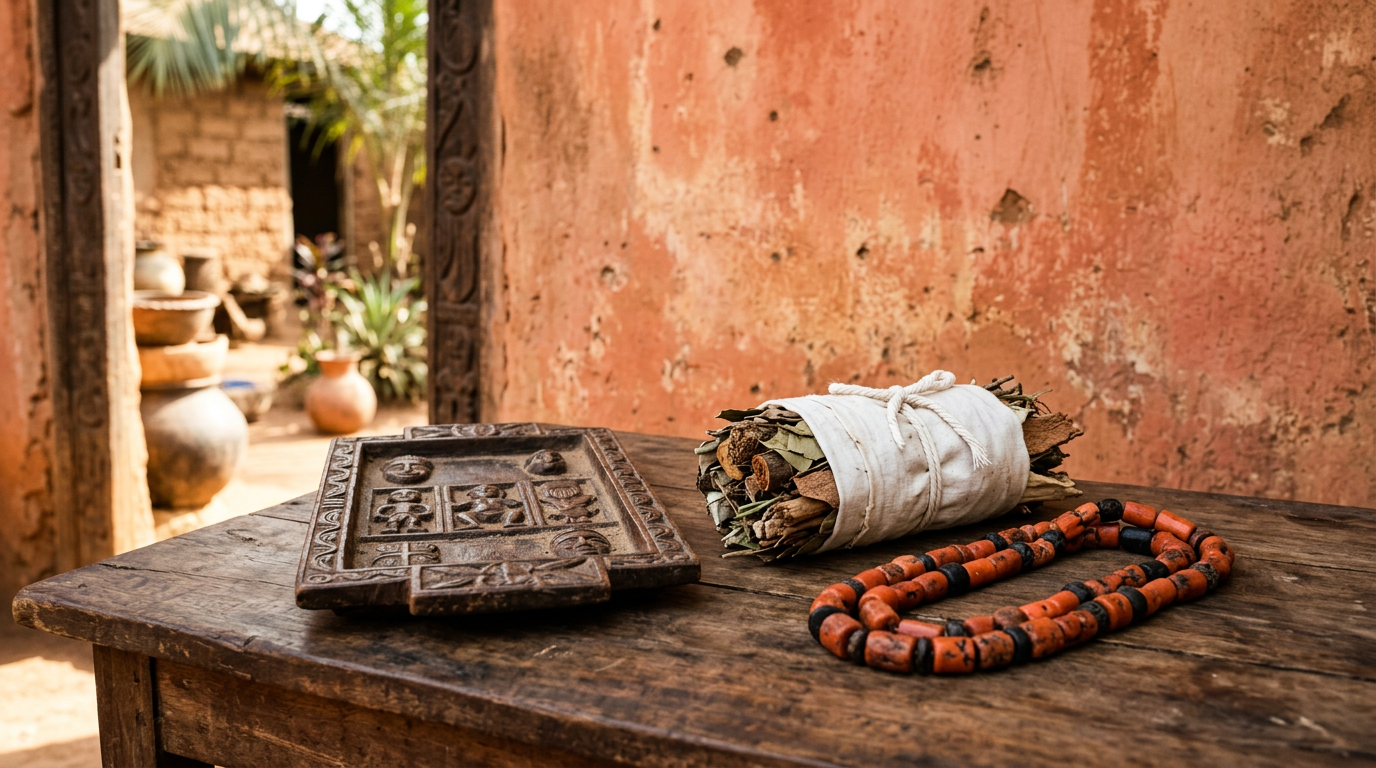
The Ifá tradition did not stay in Yorùbáland. It traveled — violently, under duress, and across an ocean — and it survived.
Ifá's Journey Across the Atlantic
During the transatlantic slave trade, Yoruba-speaking peoples were among the many African populations forcibly transported to the Americas. They brought with them, in memory, in practice, and in oral transmission, the core of the Ifá tradition. What emerged in the Americas was not a single form but several, each shaped by the specific conditions of the colonial context in which it took root.
In Brazil, Ifá became embedded in Candomblé. In Cuba, it developed into the Lucumí tradition (also called Santería or Regla de Ocha-Ifá). Related traditions took hold in Puerto Rico, Haiti, and Trinidad. As academic OER sources from the Atlanta University Center document, each diaspora form adapted Ifá's core structures under different colonial pressures — producing genuine variation in practice, terminology, ritual structure, and cosmological emphasis. A practitioner trained in Lucumí and one trained in Ilé-Ifẹ̀ will recognize shared roots while encountering real differences.
These forms are not degraded versions of a "pure" original. Each represents an act of survival and cultural intelligence under extreme conditions. Readers from diasporic backgrounds may encounter the Odù under different names, find different Ẹbọ prescriptions for the same sign, or experience initiation structures that diverge from contemporary Yoruba practice. None of this means any tradition is wrong; it means the tradition is alive and has been for centuries, across radically different contexts.
Contemporary Practice and Cultural Revival
The late twentieth century brought a significant revival of interest in Ifá, both in Yorùbáland and globally. Nigeria's post-independence cultural renaissance, the broader African diaspora rights movements of the 1960s and 1970s, and the growing interest in indigenous knowledge systems in international academic circles all contributed. UNESCO's 2005 proclamation accelerated this trend by giving the tradition a form of international legitimacy that practitioners and scholars could use to advocate for preservation funding, educational programs, and protection from religious discrimination.
Today, Ifá is practiced on every inhabited continent. Online communities connect initiates in Lagos, Havana, New York, and London. Babalawo offer remote consultations — a practice that generates its own internal debates about propriety and efficacy. The history and culture of the Yoruba people provides essential context for understanding why this expansion has been both celebrated and contested within the tradition: questions of who can legitimately transmit, who can receive, and what adaptations are permissible remain alive and unresolved.
The tradition is not a museum exhibit. It is a living institution, with all the internal disagreements that implies.
How to Begin Your Journey with Ifá
Intellectual curiosity about Ifá is genuinely valuable — and it becomes more valuable when it leads to real engagement with the tradition.
Finding a Reputable Babaláwo or Ìyánífá
There is no universally recognized certification body for Ifá practitioners, and no title or organization name guarantees authenticity or integrity. This matters, because the practitioner community is large, global, and uneven. Some Babaláwo and Ìyánífá carry deep lineage training and decades of practice; others have received limited instruction and may present themselves with more authority than their training supports.
The most reliable guides here are community networks. Seek practitioners who are known within established Ifá or Òrìṣà communities, who can speak clearly about their lineage and where they were trained, and who are transparent about their teachers. Practitioners who discourage questions about their background, who charge escalating fees for additional "work," or who create urgency or fear around consultations are worth approaching with caution. Consulting a glossary of Ifá and Òrìṣà terminology before your first conversation will help you ask informed questions.
Word of mouth within communities remains the most reliable method. If you have access to a local Candomblé house, Lucumí ile, or Yoruba cultural organization, those networks can often provide introductions to practitioners with known reputations.
What to Expect from Your First Consultation
Come with a genuine question or concern. Ifá consultation is not entertainment, and the system works best when the querent engages sincerely rather than testing whether the Babaláwo will "get it right." You will likely be asked to hold objects, to pray, and to be present in a particular posture or orientation while the casting occurs.
The Babaláwo will recite verses and ask questions to identify which Ese are relevant to your situation. This is a dialogue, not a lecture. Your responses, corrections, and clarifications matter. The Odù that falls is specific to this moment and this question; the same person asking the same question on a different day may receive a different Odù, because the tradition understands that circumstances, not just identity, shape what guidance is needed.
You will receive a prescription — an Ẹbọ of some kind. This is not optional within the tradition's logic. You are free, of course, to decide what you do with the guidance you receive. But the system is designed around the assumption that divination without action is incomplete.
Arrive with respect, an open mind, and patience.
Where to Go From Here
Ifá is not a system you understand in a single afternoon, and this guide is not meant to be a substitute for engagement with the tradition itself. What it can do — and what it has tried to do — is give you a framework accurate enough to be useful.
The foundational points are these. Ifá is a structured knowledge system, not fortune-telling. Its 256 Odù encode a vast oral corpus that addresses the full range of human experience. A trained Babaláwo or Ìyánífá interprets that corpus for specific human situations using instruments, memory, and judgment that take years to develop. The philosophical core of the system — Orí, Ìwà Pẹ̀lẹ́, reciprocity, cosmic order — makes Ifá a serious ethical and metaphysical tradition, not a curiosity.
Whether your interest is scholarly, spiritual, or both, the next step is the same: find a practitioner or a community connected to the tradition, and engage directly. Reading about Ifá is preparation. The tradition itself is the thing.