The 16 Principal Odù of Ifá: Sacred Corpus and Living Wisdom
Before a Babaláwo can interpret a single Odù for a client, years of training stand between that moment and mastery of the 16 foundational texts that make the entire system possible. Those 16 — the Ojú Odù — are the subject of this article. You'll find here a clear map of their structure, their names and sequence, what they contain, how they appear in ceremony, and why their significance has only grown as the tradition spreads across continents.
What Is the Ifá Corpus and Why Does It Matter?
The Ifá corpus is one of humanity's most ambitious attempts to encode a complete philosophy of living inside an oral tradition. Encompassing myth, ethics, medicine, history, and practical guidance, the Odù are not hymns or creeds but active repositories of knowledge that practitioners carry in memory and activate in ceremony. In 2008, UNESCO inscribed the Ifá divination system on its Representative List of the Intangible Cultural Heritage of Humanity, having first proclaimed it a Masterpiece of Oral and Intangible Heritage in 2005 — formal recognition that what the Yoruba tradition had known for generations was finally visible to the wider world.
Mastery of the 256 Odù is only one dimension of what makes a Babaláwo. The initiatory path itself — lineage acceptance, formal Ìtẹfá, and multi-year apprenticeship — is covered in our guide on the training required to become a Babaláwo.
Ifá as a Living Oral Tradition
The corpus runs to 256 Odù, each subdivided into poetic verses called Ẹsẹ̀. UNESCO documentation estimates approximately 800 Ẹsẹ̀ per Odù, though the exact total is genuinely unknown because the corpus continues to grow. New Ẹsẹ̀ emerge as Babaláwo receive new knowledge, make new observations, and transmit new experiences across generations. No single authoritative written edition exists. The Ifá corpus is, by design, alive.
This matters because it shapes how we understand the Odù. Unlike a fixed scriptural canon, the Odù tradition is inseparable from the lineage relationships and initiatory chains that carry it forward. What a particular Babaláwo knows about a given Odù reflects his teachers, their teachers, and the transmission stretching back across centuries. The knowledge and the people who hold it cannot be fully separated.
The Role of the Babaláwo in Preserving Odù
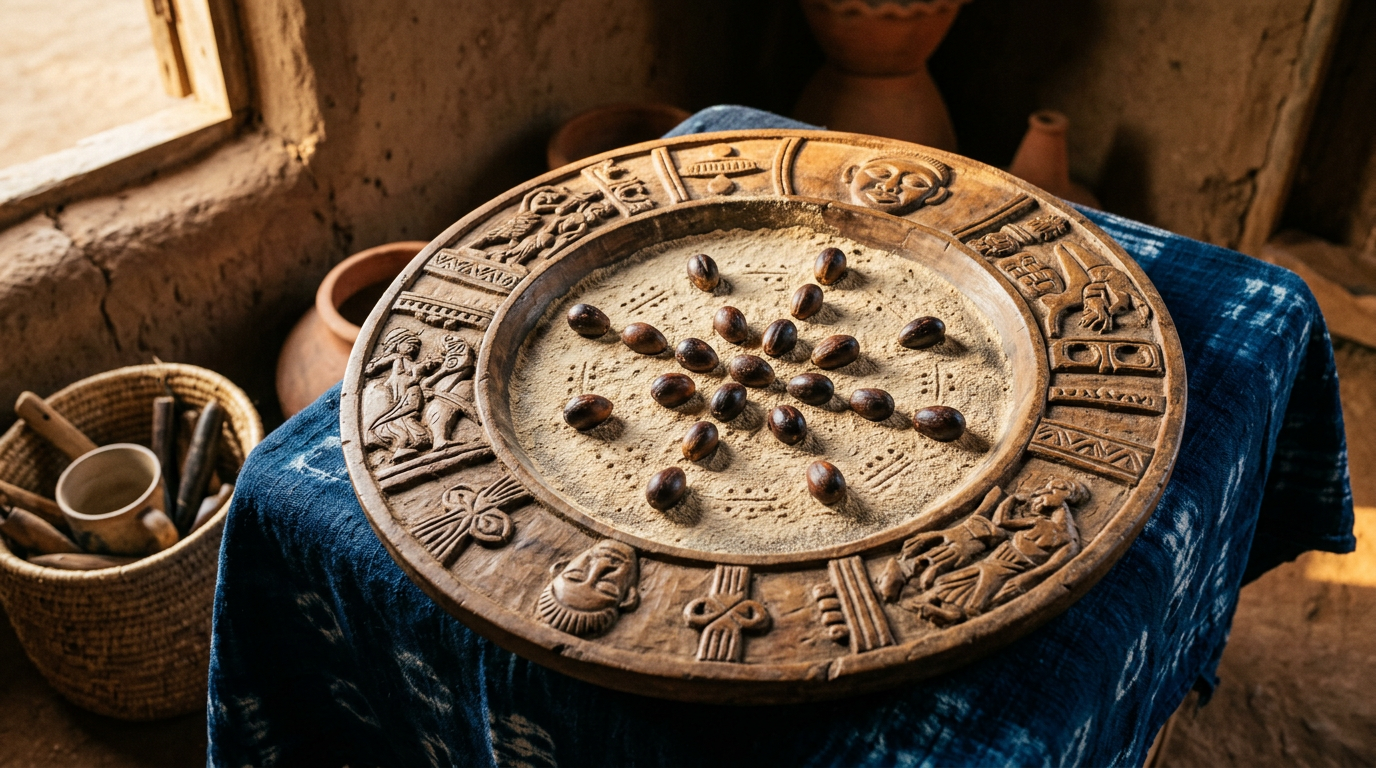
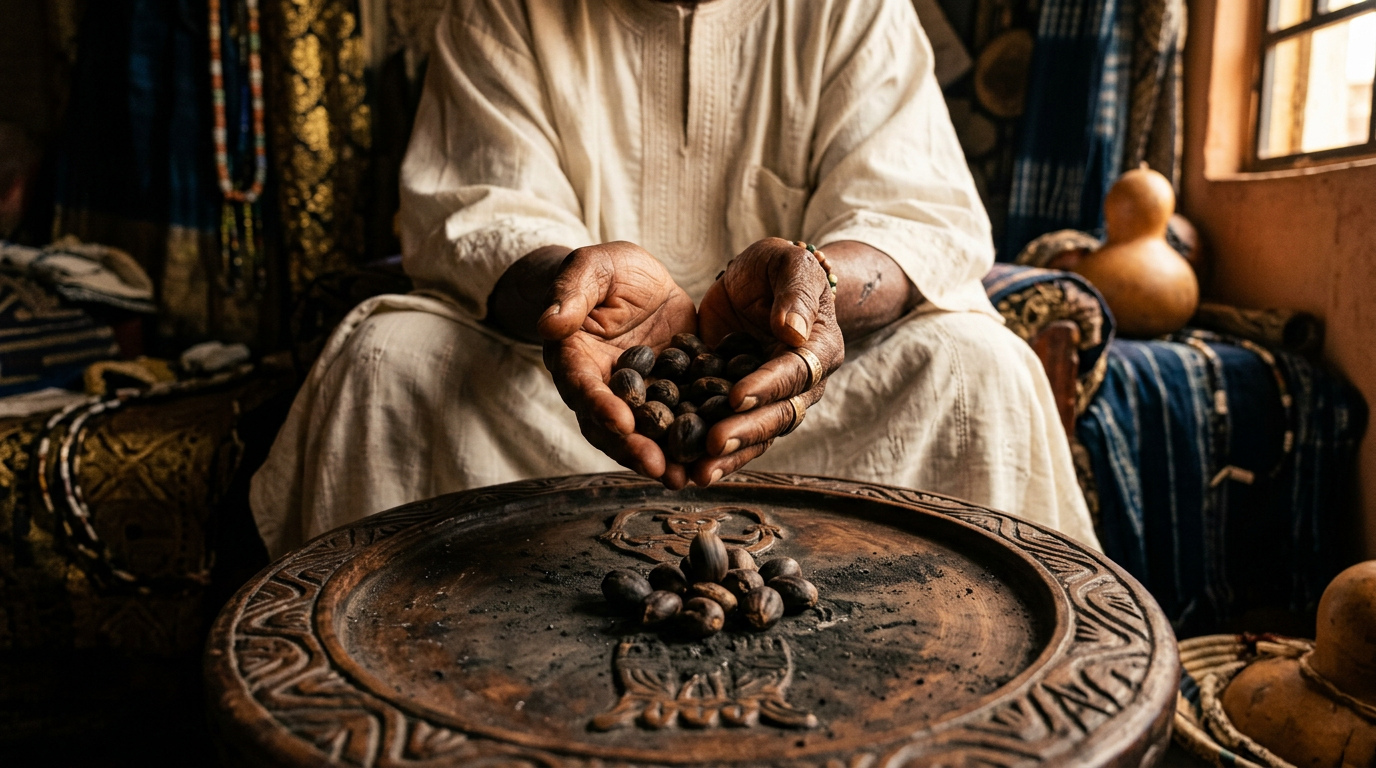
The Babaláwo, whose title literally means "father of secrets," is both custodian and interpreter of the corpus. His task is not passive storage but active engagement: casting the Ọ̀pẹ̀lẹ̀ chain or manipulating the Ikin (sacred palm nuts) on the Ọpọ́n Ifá divination tray, reading the binary pattern revealed, and reciting the Ẹsẹ̀ verses relevant to that moment and that client. For a deeper look at this role, see the role of the Babaláwo in Ifá.
Crucially, Ifá divination does not involve spirit mediumship or trance. The Babaláwo interprets a structured system of signs drawn from a memorized oral corpus — a distinction UNESCO explicitly highlights when comparing Ifá to other oracular traditions in the same region. The system's power comes from knowledge and precision, not altered states.
Understanding the Structure of the 16 Principal Odù
Sixteen is a deceptively small number given what it generates. The 16 principal Odù, known as Ojú Odù (literally "face" or "eye" of the Odù), are the seed from which the entire 256-Odù corpus grows.
How the 16 Odù Generate 256 Derivative Odù
The arithmetic is elegant. Each of the 16 Ojú Odù pairs with each of the other 15 — and with itself — to produce a unique composite Odù. Sixteen times sixteen yields 256. The resulting 240 non-principal Odù are called Amúlù Odù, the derivative combinations that branch outward from the original sixteen. Practitioners commonly describe the Ojú Odù as parents and the Amúlù Odù as their offspring, a metaphor that captures both the generative logic and the relational character of the system.
A student training to become a Babaláwo must demonstrate mastery of the 16 Ojú Odù, including their governing principles and their signature Ẹsẹ̀ verses, before advancing to study of the 240 derivative Odù. The sixteen are not merely a starting point; they are the foundation every practitioner returns to throughout a lifetime of practice.
Binary Marks and the Language of Ifá
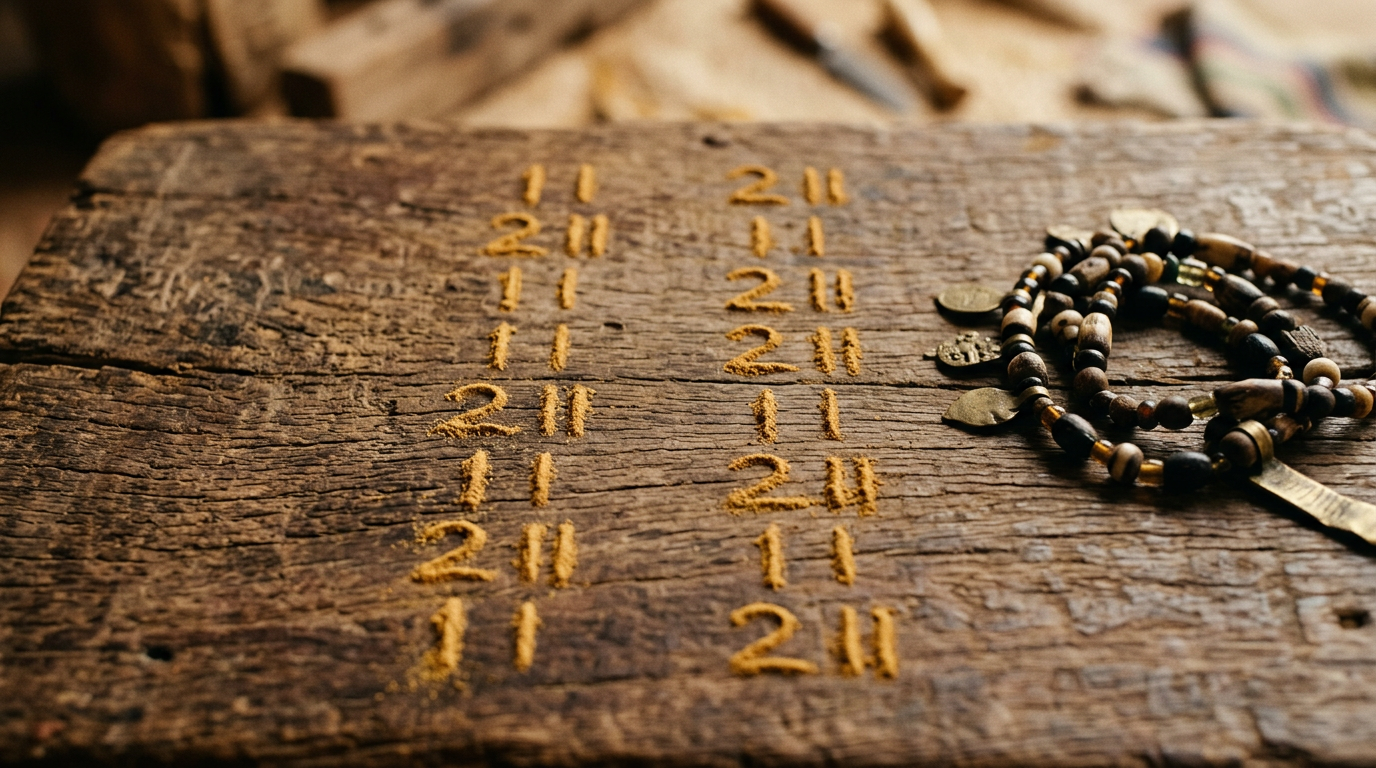
Each of the 256 Odù carries a unique binary signature — a pattern of single and double marks produced during divination. Single marks and double marks combine in sets of eight positions across two columns to create a signature that cannot be confused with any other. The structure has prompted some observers to draw parallels to binary computing. That comparison has genuine descriptive value for newcomers trying to grasp the system's logic, but practitioners and tradition-holders rightly caution against reducing Odù to abstract data structures. Each Odù is understood in the tradition as a living spiritual entity with its own character, agency, and relationships — not a data point.
The 16 Principal Odù: Names, Order, and Significance
The sixteen names below follow the predominant Yoruba mainland sequence. Lineages vary — diaspora traditions in Cuba and Brazil sometimes arrange or name the Odù slightly differently — so this list should be understood as the canonical order most commonly taught on the Nigerian mainland rather than a universal standard shared by every lineage on earth.
Èjì Ogbè Through Òfún Méjì: An Overview
Widely cited accounts describe Èjì Ogbè as the first and most senior of the Ojú Odù, characterized as the manifestation of pure light and the king of the Odù. Children born under its signature are regarded in Yoruba tradition as comparable to kings. The remaining fifteen, in traditional sequence, are:
- Èjì Ogbè — light, kingship, abundance
- Òyèkú Méjì — death, endings, transformation
- Ìwòrì Méjì — inner vision, intuition, the mind
- Ọ̀dí Méjì — the hidden, the womb, that which lies beneath
- Ìrosùn Méjì — conflict, blood, medicine, and healing
- Owọ́nrín Méjì — unpredictability, creativity, the trickster dimension
- Obàrà Méjì — royalty, prosperity, generosity
- Ọ̀kànràn Méjì — speed, aggression, war
- Ògúndá Méjì — Ògún's path, justice through force, opening roads
- Òsá Méjì — rapid change, upheaval, the unexpected
- Ìká Méjì — arrogance corrected, the lesson of humility
- Oturúpọ̀n Méjì — suffering and its resolution, endurance
- Otúrá Méjì — diplomacy, speech, the power of words
- Ìretẹ̀ Méjì — patience, long-term reward, faithfulness
- Òsẹ̀ Méjì — wealth, sexuality, Òṣun's domain
- Òfún Méjì — mystery, sacrifice, completion
Why Hierarchical Order Matters in Divination
The sequence is not arbitrary. The ranking of the Ojú Odù encodes a relationship of spiritual seniority that affects how a Babaláwo interprets overlapping messages when multiple Odù appear. Èjì Ogbè's seniority means its counsel carries particular weight; Òfún Méjì's position at the end reflects its association with completion and the deepest mysteries. Knowing where an Odù falls in the sequence tells the practitioner something about its temperament before a single verse is recited. For a fuller exploration of Òrìṣà and their relationship to Odù, the connections between specific Ojú Odù and particular Òrìṣà deepen this picture considerably.
Themes and Teachings within the Principal Odù
Seen from the outside, the Odù can look like a divination index. Lived with over years of study, they reveal themselves as something far more demanding: a complete moral and philosophical framework for how to be human.
Moral Lessons Encoded in the Odù
Woven through the entire corpus is the concept of Ìwà Pẹ̀lẹ̀, meaning gentle or good character. Scholars and practitioners widely describe Ìwà Pẹ̀lẹ̀ as Ifá's central ethical teaching: the alignment of a person's actions with their Orí, their individual destiny. The Odù don't merely recommend good character; they illustrate through verse what happens when it's present and what happens when it's absent. Specific Ẹsẹ̀ within Ìrosùn Méjì, Ìká Méjì, and Obàrà Méjì, for instance, return repeatedly to the consequences of pride, the rewards of generosity, and the long cost of deception.
This ethical dimension is one reason practitioners resist reducing the Odù to fortune-telling. The corpus encodes Yoruba myth, history, proverbs, medicine, and communal guidance in a form designed to help a person navigate their entire life, not just a single crisis.
Mythology and Ancestral Narratives
Each Ojú Odù carries foundational stories connecting it to the Òrìṣà, the divine forces that animate Yoruba cosmology. The entire divinatory system is attributed to Ọ̀rúnmìlà, the Òrìṣà of wisdom known as Elérì Ìpín ("the divine witness to human destiny"), who is understood to have transmitted the knowledge of Ifá to humanity. Stories within Ogúndá Méjì link it directly to Ògún, the Òrìṣà of iron and warfare. Òsẹ̀ Méjì carries narratives associated with Òṣun. These are not decorative mythological trappings; they orient the practitioner's interpretation toward the right spiritual domain when that Odù falls.
Historically, Ifá also served as a pillar of Yoruba civic life. Major political decisions — enthroning kings, initiating war, managing famine — required divinatory consultation. The Odù corpus carried institutional weight, not just personal guidance. That history lives inside the verses, even when they appear in modern ceremony.
How the Odù Are Revealed in Divination
The moment an Odù becomes operational is the divination session itself. Everything in the corpus exists to be activated here.
The Use of Ikin and Ọ̀pẹ̀lẹ̀
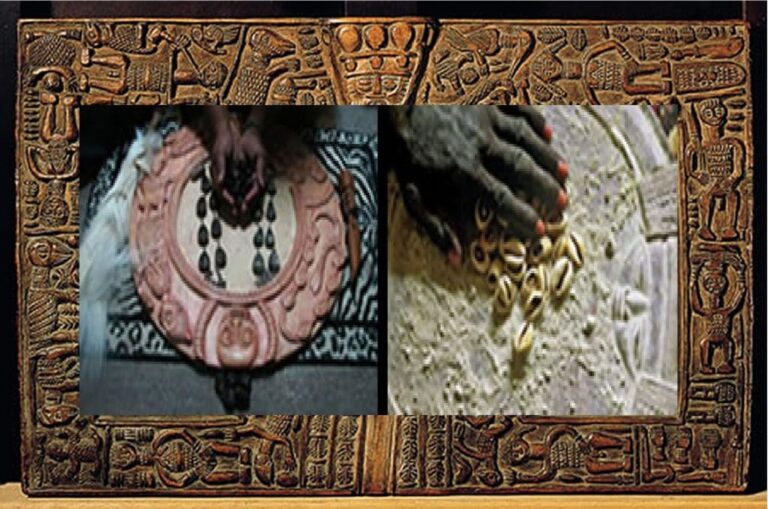
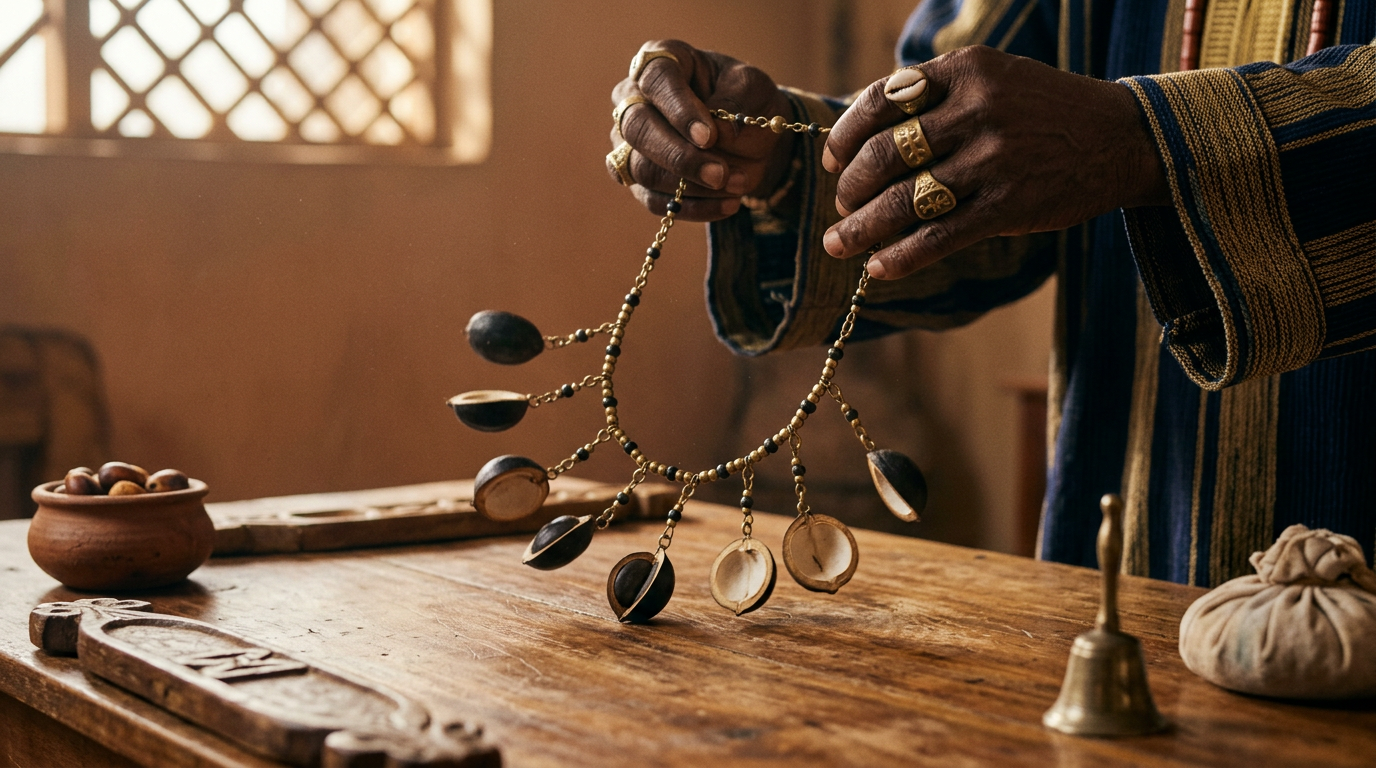
Two principal instruments reveal the Odù. The Ikin are sacred palm nuts, typically sixteen, manipulated through a careful casting process on the Ọpọ́n Ifá to produce the binary marks that identify an Odù. The Ọ̀pẹ̀lẹ̀ is a divining chain of eight discs or seed pods, cast in a single swing to produce the same binary pattern more quickly. Ikin are generally considered more ceremonially weighty; Ọ̀pẹ̀lẹ̀ are more commonly used for routine consultations. Both produce the same structured binary result, and both call up the same corpus. For a fuller introduction to Ifá divination, the mechanics of each instrument deserve dedicated attention.
Interpreting the Odù That Appears
Once the binary signature is marked in sacred wood dust (Iyẹ̀rọ̀sùn) on the tray, the Babaláwo identifies the Ojú Odù or Amúlù Odù it represents and begins to recite the relevant Ẹsẹ̀ verses from memory. The verses contain narratives — characters who faced analogous situations, what they were advised, whether they complied, and what resulted. The client's situation becomes legible through the story the Odù tells. A good Babaláwo doesn't announce a verdict; he recites, the client recognizes, and the solution emerges from the encounter between text and life.
The Odù of Ifá in the Modern World
Colonialism and the transatlantic slave trade both worked to suppress Yoruba spiritual traditions, including Ifá. Missionaries denigrated the Odù. Enslavers attempted to sever practitioners from their traditions. Neither fully succeeded.
Preserving Sacred Knowledge Across the Diaspora
Widely cited accounts describe how Ifá and the Odù tradition survived the Middle Passage and took root across the Americas. Cuba's Lucumí lineage, in particular, is commonly noted for preserving close structural continuity with the 16 Ojú Odù framework — a remarkable feat given the conditions under which the tradition was carried and maintained. In Brazil, the Candomblé tradition absorbed and adapted Yoruba divinatory knowledge. Today, practitioners on four continents consult the same foundational sixteen.
Contemporary efforts by tradition-holders, scholars, and diaspora communities to document, teach, and transmit the corpus on its own terms are ongoing. That work matters because the Odù belong to a living tradition, not an archive.
Studying Odù with Respect and Reverence
For newcomers — whether spiritual seekers, cultural scholars, or people tracing ancestral roots — the Odù tradition calls for a specific disposition. The texts are not freely available in the way a published anthology is; much of the corpus is transmitted only within initiatory relationships. That boundary is intentional and should be respected. Approaching the tradition means approaching the community that carries it. Ethical engagement begins with humility about what one doesn't yet know.
If you're considering formal study or initiation, understanding the Ifá initiation process is a necessary next step. And for broader historical context, exploring the history of Yoruba spiritual traditions helps situate the Odù within the full arc of a civilization, not just a religious practice.
Where to Go From Here
The 16 Ojú Odù are, at once, the simplest entry point into Ifá and the work of an entire lifetime. Sixteen names. 256 combinations. Hundreds of verses per combination, and the corpus still growing. What that structure encodes — ethics, cosmology, history, governance, and the individual's relationship to destiny — is not reducible to a list or a chart. The list and the chart are where you begin.
From here, the path runs toward the specific: learning the signature of a single Odù in depth, understanding its associated Òrìṣà, sitting with its stories. The tradition has always been transmitted this way — one teacher, one student, one verse at a time. The sixteen have been waiting. They're patient.
Continue Reading
New to Odù? Start with our guide on how to read the Odù — a beginner’s guide to Ifá interpretation.
Read our dedicated spoke on Odù Eji Ogbe.
Read our dedicated spoke on Odù Odi Meji.
Read our dedicated spoke on Odù Ogbe Òfún.
Read our dedicated spoke on Odù Ose Ifá.