Thursday, January 28th, 2010 at
1:00 am
Exploring the Opon Ifa
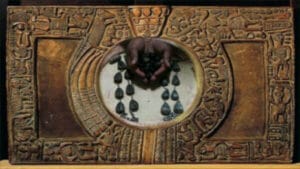
The Opon Ifa is the great divining tray used in Ifa divination and is also used in the preparation of sacred medicines. Opons vary in size and decoration, but are generally carved from wood and are decorated with the sacred symbols of the Ifa cosmology. A characteristic symbol of the Opon is the Head of Esu that decorates the top quadrant of the tray. Some trays have one, two or even four Esu faces carved around their rim. The border of the tray is usually carved with anthropomorphic figures, each with a special purpose and meaning. The Babalawo makes use of the Opon Ifa when performing divination with the I kin. Read the rest of this entry
Tuesday, January 19th, 2010 at
2:40 pm
Saturday, November 21st, 2009 at
3:29 am
When the master-priest is satisfied with the trainee’s ability in the different branches of Ifá, he allows the trainee to present himself for initiation. Of the numerous stages in the initiation ceremony the four principal ones are described below.
as sísí öpëlë já
The first stage is the ceremony marking what is known as as as sísí öpëlë já (ceremony marking the mastery of the Odù by using the divining chain). This is a very important ceremony involving the offering of sacrifice to Òrúnmìlà and the giving of a feast for all Ifá priests in the community concerned. Read the rest of this entry
Wednesday, November 18th, 2009 at
2:52 pm
The Babalawo are the trained dedicated Ifa priests and diviners in the Yoruba community of Nigeria. In Yoruba traditional society, a Babalawo is a ‘doctor’, a ‘pharmacist’, a herbalist and the most popular diviner who the people’ consult for advice, guidance and medical treatment. When a pregnant woman is under labor, when a person is seriously sick or when there is a breakout of epidemic disease, the Babalawos help is sought personally or on behalf of the victim. It should however be noted that the Babalawos unique position in the Yoruba society is neither attained through lineage or honor. The status of a Babalawo can only be acquired after many years of rigorous training and experiences. The detail on training follows later.
At any point in time, no practicing Babalawo divines without using either the opele (the divining chain) or the ikin (the sacred palmnut). The use of these instruments would enable him, to know, the nature of his client’s problem. The diviner relies on the dictate of the gods. The diviner therefore serves as a link between two worlds: the ephemeral and eternal, the material and the spiritual. Just as a medical doctor always takes with him a stethoscope, a technician has a screwdriver and pliers ready with him for an emergency work, a Babalawo pockets his portable opele when he is invited to a nearby town or village for divine consultation. Read the rest of this entry
Wednesday, November 18th, 2009 at
2:39 pm
Divination is universally concerned with practical problems and it seeks information from which practical decisions may be made. The source of such information is not conceived as mundane.
The divinatory arts are many and a broad understanding of them can only emerge from a survey of actual practices in various cultural settings. Men all over the world practice divination and device various methods of doing this. The Assyro-Babylonians have their Bam (seer and diviner) who employs hapatoacopy-divination by observing the liver of sheep which had been used for sacrifice. The Buddhists in India practice astrology and they use lots and oracles as means of divination. The Greeks had their oracular shrinks of Jupiter at Dodona and Apollo at Delphi. The Romans used the Sortes and the Japanese use Ornoplatoscopy. In Roman society, auspices (auspicia) are the means by which the Romans seek to ascertain the support of the gods.
Other forms of divination are palmistry, cream interpretation and astrology. Diviners of similar kinds include the many types of media who may communicate with the dead (necromancy process) as well as-crystal gazers, dream interpreters and diviners by automatic writing. Read the rest of this entry
Saturday, November 14th, 2009 at
9:04 pm
Disclosure: What follows is my own highly opinionated, intensely felt, not necessarily correct, and perhaps at times alienating view of Odu, and what they mean.
In the eastern quadrant one finds the Otun-Opon. This is the region that governs the world of the Self – the diviner, their home, immediate family and intimate surroundings.
The Otun-Opon is the “I” of the “I/Not-I” equation. This is the region of life whose symbol is the element of fire. The seed that was sown in the Ese-Opon springs forth in the Otun-Opon. It is further represented by the rising sun and signals the beginning, marking the dawn or a new realm of the Otun-Opon that the kinetic energy moves within the individual’s private world.
Anatomically this region relates to the portion of the body from the neck to the sternum, located at the base of the rib cage. This region also deals with the visible realm and those forces that are in plain view. The sacred Odu Ogbe represents the Otun-Opon. Read the rest of this entry
Friday, November 13th, 2009 at
10:04 pm
Nowhere is the profundity and beauty of African spirituality more apparent than in the Odu Ifa, the sacred text of the spiritual and ethical tradition of Ifa, which is one of the greatest sacred texts of the world and a classic of African and world literature. Its central message revolves around the teachings of the Goodness of and in the world; the chosen status of humans in the world; the criteria of a good world; and the requirements for a good world. Although these themes are throughout the Odu Ifa, nowhere are they more explicit than in Odu Irosun Iwori. The Odu begins by declaring “Let’s do things with joy…” For it is understood that the world was created in goodness and that we are to find good in the world, embrace it, increase it, and not let any good be lost. It is obvious here that all is not well with the world, given the poverty, oppression, exploitation and general suffering of people. But inherent in this firm belief in the good that is found in the Odu Ifa is the faith that in the midst of the worst of situations there are good people, good will and possibilities for creating good, increasing good, and thus constantly expanding the realm of good. Read the rest of this entry
Wednesday, November 4th, 2009 at
1:41 pm
OGBE OWORIN
(Day of Weeping)
This is the Odu that shares why Ifa is worshiped every five days. We Babalawos give respect by performing this ritual, here and in Nigeria, because of the ability of Orunmila/Esu to combat Death… Read the rest of this entry